Georgia 7.PR.6
Georgia Standard (Expectation Cluster)
Using mathematical reasoning, investigate chance processes and develop, evaluate, and use probability models to find probabilities of simple events presented in authentic situations.
Georgia's K-12 Mathematics Standards
Cluster contents
Expectations in This Standard
7.PR.6 is a Georgia mathematics standard. These are the expectations under it.
- 7.PR.6.1
Represent the probability of a chance event as a number between 0 and 1 that expresses the likelihood of the event occurring. Describe that a probability near 0...
- 7.PR.6.2
Approximate the probability of a chance event by collecting data on an event and observing its long-run relative frequency will approach the theoretical probabi...
- 7.PR.6.3
Develop a probability model and use it to find probabilities of simple events. Compare experimental and theoretical probabilities of events. If the probabilitie...
- 7.PR.6.4
Develop a uniform probability model by assigning equal probability to all outcomes and use the model to determine probabilities of events.
- 7.PR.6.5
Develop a probability model (which may not be uniform) by observing frequencies in data generated from a chance process.
- 7.PR.6.6
Use appropriate graphical displays and numerical summaries from data distributions with categorical or quantitative (numerical) variables as probability models ...
Teacher's field guide
What This Cluster Means
What Students Need to Do
- Students represent chance situations with sample spaces, tables, diagrams, or simulations. They find simple-event probabilities, explain their reasoning, and check whether a model makes sense.
What Mastery Looks Like
- A student creates a complete sample space and calculates the probability of a stated event. They explain their assumptions and judge whether a probability model fits the situation.
Common Misconceptions
- Students may treat outcomes as equally likely when they are not, or leave outcomes out of the sample space. They may confuse probability with certainty or give answers outside 0 to 1.
How to Assess It
- Exit ticket: A spinner has eight equal sections, three blue. Find P(blue), then explain whether a model using P(blue) = 1/2 is reasonable.
Lesson moves
Ways to Teach It
Students roll two number cubes 30 times, record sums, and compare observed results with probabilities from a complete outcome table.
Ask students to explain why drawing a red marble may not have probability 1/2 when a bag contains two colors.
Play a probability match game where students pair event cards with sample spaces, fractions, decimals, and verbal likelihoods.
Use a school raffle with known ticket counts to calculate one student's chance of winning and evaluate whether the game seems fair.
Free download
Printable 7.PR.6 Worksheet
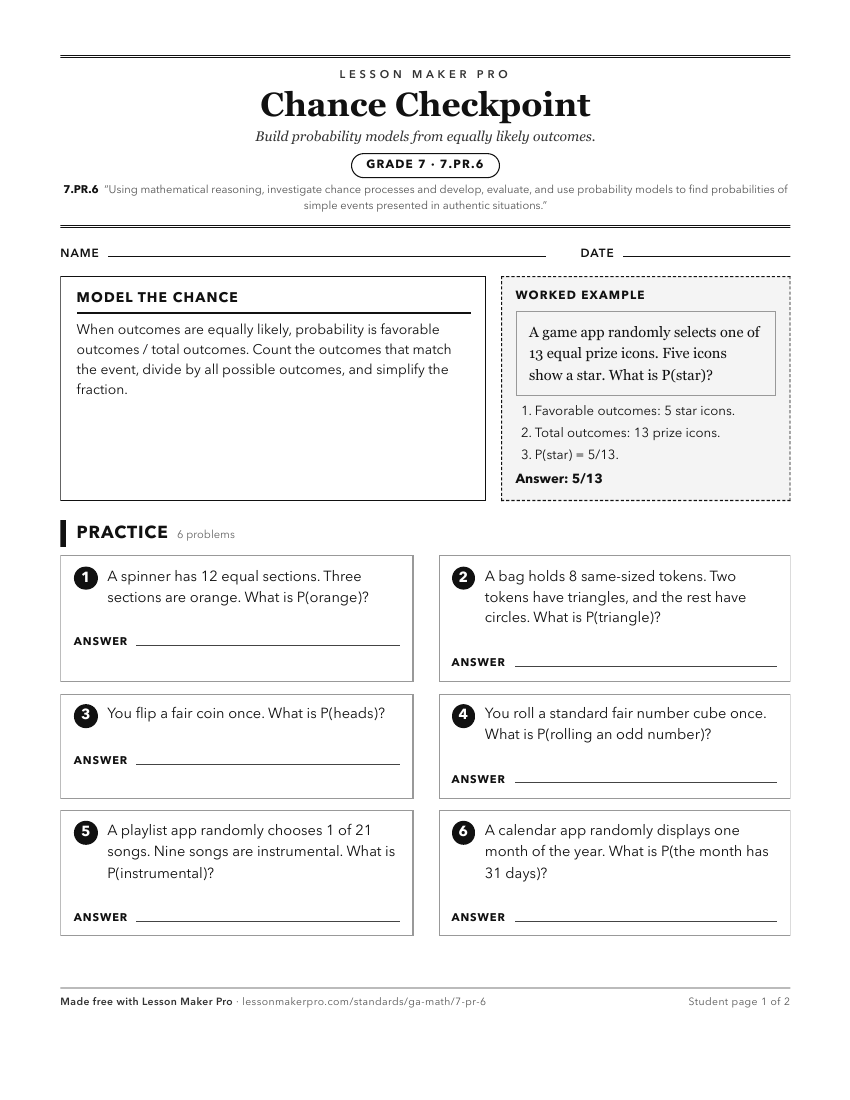
A ready-to-print activity worksheet aligned to 7.PR.6, with an answer key for the teacher on its own page. No account needed.
PDF, US Letter, prints cleanly in black and white.
Download the worksheetKeep exploring
Related Standards
Turn this cluster into a lesson
Grade, subject, topic, and the complete cluster are prefilled. Create one free, no account needed.
Also for this cluster:Make a WorksheetMake a QuizMake a Sub Lesson