Georgia 7.PR.6.1
The Standard
Represent the probability of a chance event as a number between 0 and 1 that expresses the likelihood of the event occurring. Describe that a probability near 0 indicates an unlikely event, a probability around 1/2 indicates an event that is neither unlikely nor likely, and a probability near 1 indicates a likely event.
Georgia's K-12 Mathematics Standards · Using mathematical reasoning, investigate chance processes and develop, evaluate, and use probability models to find probabilities of simple events presented in authentic situations.
Teacher's field guide
What This Standard Means
What Students Need to Do
- Students place chance outcomes on a 0-to-1 scale and explain what each location says about likelihood. They compare probabilities and classify outcomes as rare, about even, or likely.
What Mastery Looks Like
- A student can order probability values and match them to reasonable chance events. They can explain why 0.08 suggests a rare outcome, 0.5 suggests an even chance, and 0.92 suggests a strong chance.
Common Misconceptions
- Students may treat 0.2 as 2 percent instead of 20 percent. They may think a value near 1 guarantees an outcome, or that a value near 0 makes it impossible. Some assume 0.5 means likely rather than an even chance.
How to Assess It
- Give an exit ticket: Place 0.07, 0.48, and 0.90 on a probability line, then label and explain each likelihood.
Lesson moves
Ways to Teach It
Give pairs three mystery bags of colored cubes, let them sample with replacement, then place each bag's red-cube chance on a 0-to-1 line.
Ask students to explain whether a 0.48 rain chance is low, high, or close to even, using a probability line.
Play a card sort race where teams match event cards, probability cards, and likelihood labels, then defend one disputed match.
Use a seven-day weather forecast; students plot rain probabilities and explain which outdoor event date carries the least weather risk.
Free download
Printable 7.PR.6.1 Worksheet
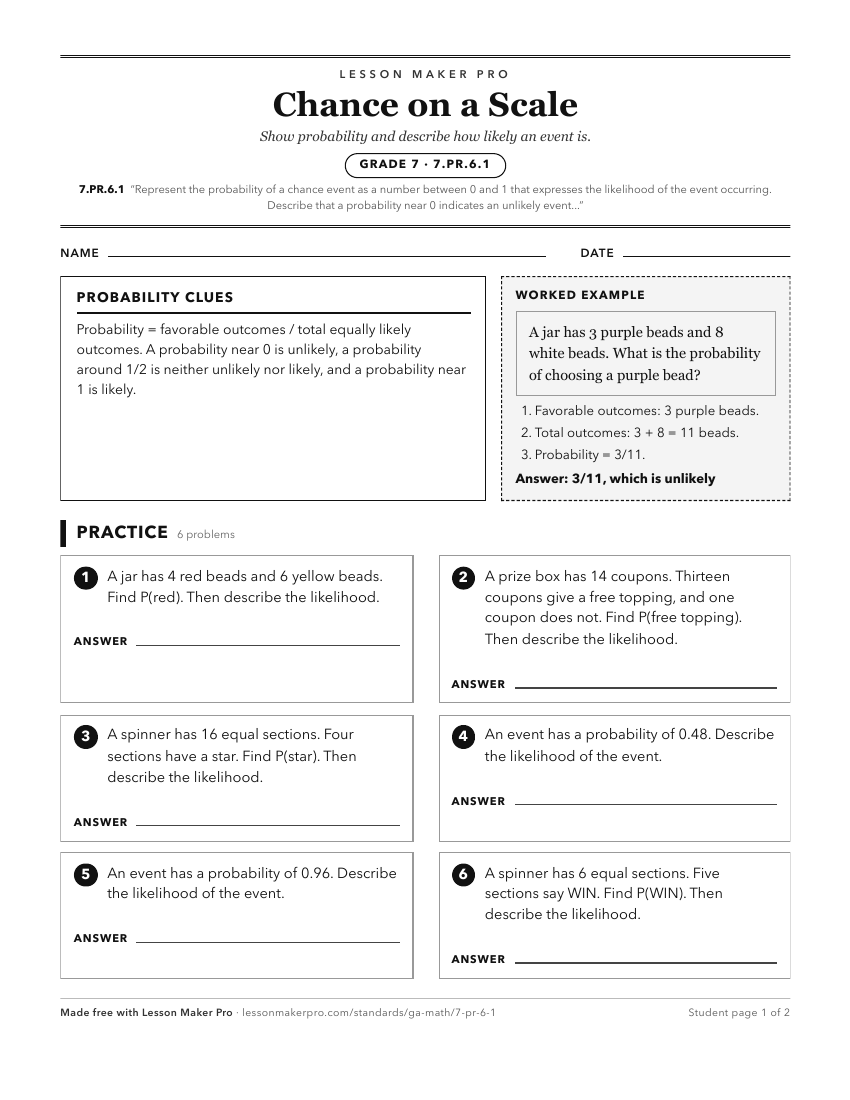
A ready-to-print activity worksheet aligned to 7.PR.6.1, with an answer key for the teacher on its own page. No account needed.
PDF, US Letter, prints cleanly in black and white.
Download the worksheetKeep exploring
Related Standards
- 7.PR.6.4
Develop a uniform probability model by assigning equal probability to all outcomes and use the model to determine probabilities of events.
- 7.PR.6.3
Develop a probability model and use it to find probabilities of simple events. Compare experimental and theoretical probabilities of events. If the probabilitie...
- 7.PR.6
Using mathematical reasoning, investigate chance processes and develop, evaluate, and use probability models to find probabilities of simple events presented in...
- 7.PR.6.2
Approximate the probability of a chance event by collecting data on an event and observing its long-run relative frequency will approach the theoretical probabi...
Turn this exact standard into a lesson
Grade, subject, topic, and the complete standard are prefilled. Create one free, no account needed.
Also for this standard:Make a WorksheetMake a QuizMake a Sub Lesson