Georgia 7.PR.6.4
The Standard
Develop a uniform probability model by assigning equal probability to all outcomes and use the model to determine probabilities of events.
Georgia's K-12 Mathematics Standards · Using mathematical reasoning, investigate chance processes and develop, evaluate, and use probability models to find probabilities of simple events presented in authentic situations.
Teacher's field guide
What This Standard Means
What Students Need to Do
- Students list every possible outcome in a fair chance situation. They give each outcome the same probability, then count favorable outcomes to find an event's probability.
What Mastery Looks Like
- Given a fair die, spinner, or shuffled set of cards, students build a complete sample space without repeats or omissions. They calculate favorable outcomes over total outcomes and simplify the fraction. They explain why equal probabilities fit the situation.
Common Misconceptions
- Students may treat grouped results, such as spinner colors, as equally likely when the colors cover different numbers of equal sections. They may omit outcomes, count repeated outcomes incorrectly, or use favorable outcomes as the denominator.
How to Assess It
- Exit ticket: A fair eight-sided die is numbered 1 through 8. Write the probability of each outcome, then find the probability of rolling a number greater than 5.
Lesson moves
Ways to Teach It
Roll a fair six-sided die 60 times, tally results, build a uniform model, and compare theoretical probabilities with the observed frequencies.
Discuss this claim: A fair die has a one-half chance of showing an even number because three of its six outcomes are even.
Play Probability Match by pairing sample-space cards with event cards and probability cards, then checking each completed set with a partner.
Analyze a classroom raffle with 30 equal tickets, including four bearing one student's name, and calculate that student's chance of winning.
Free download
Printable 7.PR.6.4 Worksheet
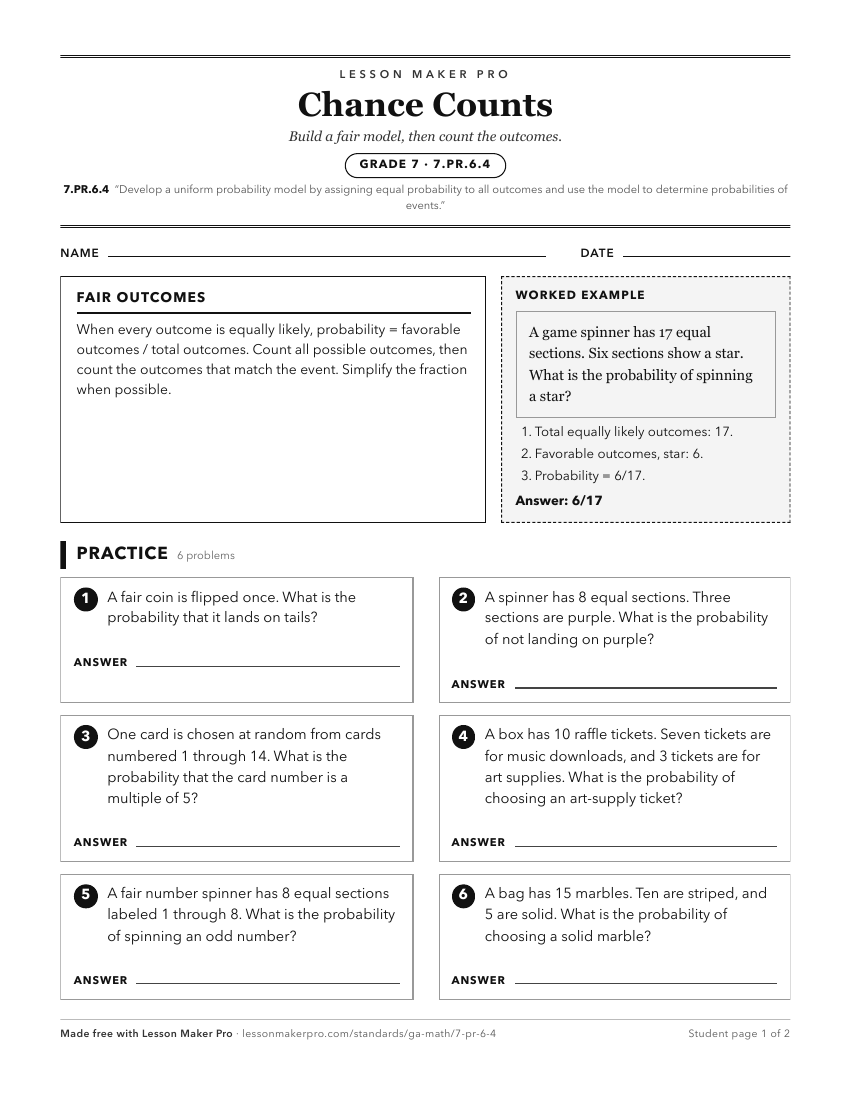
A ready-to-print activity worksheet aligned to 7.PR.6.4, with an answer key for the teacher on its own page. No account needed.
PDF, US Letter, prints cleanly in black and white.
Download the worksheetKeep exploring
Related Standards
- 7.PR.6.3
Develop a probability model and use it to find probabilities of simple events. Compare experimental and theoretical probabilities of events. If the probabilitie...
- 7.PR.6
Using mathematical reasoning, investigate chance processes and develop, evaluate, and use probability models to find probabilities of simple events presented in...
- 7.PR.6.2
Approximate the probability of a chance event by collecting data on an event and observing its long-run relative frequency will approach the theoretical probabi...
- 7.PR.6.5
Develop a probability model (which may not be uniform) by observing frequencies in data generated from a chance process.
Turn this exact standard into a lesson
Grade, subject, topic, and the complete standard are prefilled. Create one free, no account needed.
Also for this standard:Make a WorksheetMake a QuizMake a Sub Lesson