Georgia 7.PR.6.2
The Standard
Approximate the probability of a chance event by collecting data on an event and observing its long-run relative frequency will approach the theoretical probability.
Georgia's K-12 Mathematics Standards · Using mathematical reasoning, investigate chance processes and develop, evaluate, and use probability models to find probabilities of simple events presented in authentic situations.
Teacher's field guide
What This Standard Means
What Students Need to Do
- Students run repeated chance trials, record outcomes, and calculate the relative frequency of an event. They use larger sets of data to estimate probability and compare the estimate with the expected probability.
What Mastery Looks Like
- Students calculate relative frequency by dividing successful outcomes by total trials. They compare it with a theoretical probability and explain why larger samples usually produce closer estimates.
Common Misconceptions
- Students may expect experimental results to match the theoretical probability after only a few trials. They may use the number of successes instead of the fraction of successes. Some think earlier outcomes change the probability of the next independent trial.
How to Assess It
- Exit ticket: A fair spinner lands on blue 18 times in 60 spins. Find the experimental probability and explain what should happen over 600 spins.
Lesson moves
Ways to Teach It
Flip a coin 20 times, record heads, combine class results, and compare relative frequencies after 20, 100, and all trials.
Write a response: Why might 10 spins give a poor probability estimate while 1,000 spins give a better estimate?
Run a dice prediction game where teams estimate the probability of rolling an even number after repeated sets of 10 trials.
Analyze quality control data for defective items, then use the observed relative frequency to predict defects in a larger shipment.
Free download
Printable 7.PR.6.2 Worksheet
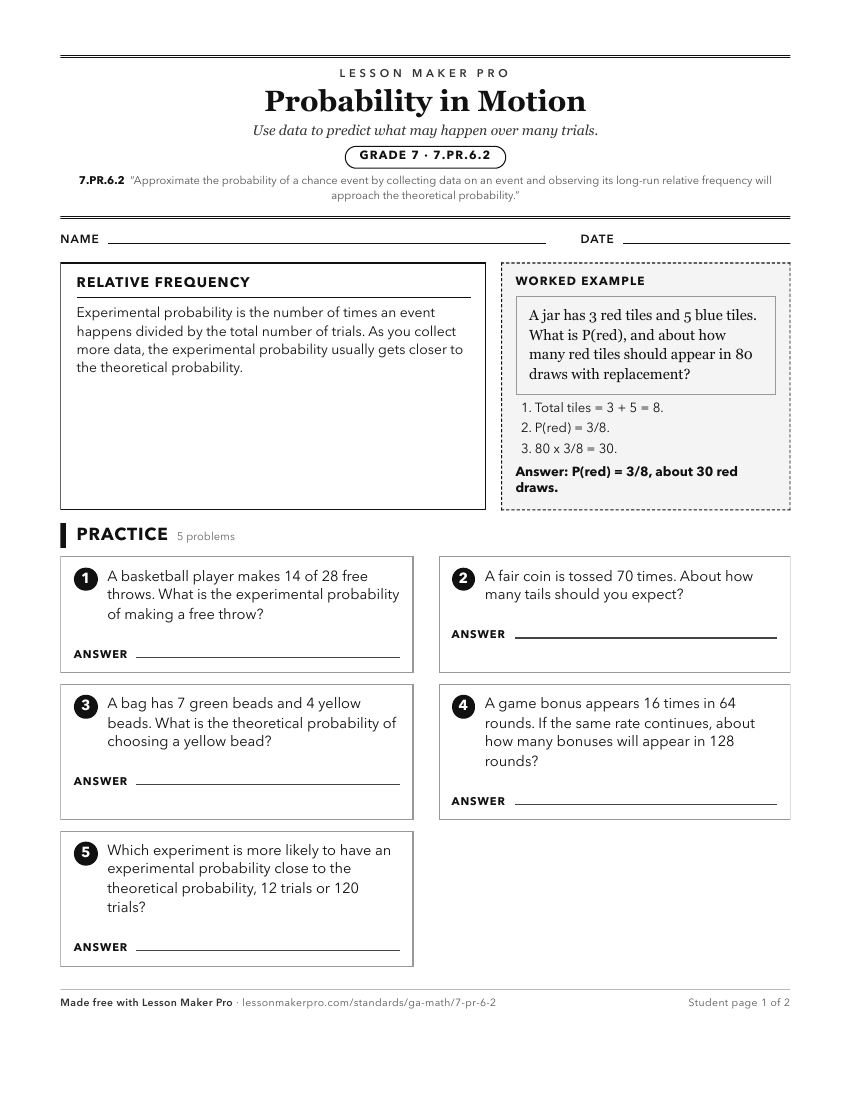
A ready-to-print activity worksheet aligned to 7.PR.6.2, with an answer key for the teacher on its own page. No account needed.
PDF, US Letter, prints cleanly in black and white.
Download the worksheetKeep exploring
Related Standards
- 7.PR.6.4
Develop a uniform probability model by assigning equal probability to all outcomes and use the model to determine probabilities of events.
- 7.PR.6.3
Develop a probability model and use it to find probabilities of simple events. Compare experimental and theoretical probabilities of events. If the probabilitie...
- 7.PR.6.1
Represent the probability of a chance event as a number between 0 and 1 that expresses the likelihood of the event occurring. Describe that a probability near 0...
- 7.PR.6.5
Develop a probability model (which may not be uniform) by observing frequencies in data generated from a chance process.
Turn this exact standard into a lesson
Grade, subject, topic, and the complete standard are prefilled. Create one free, no account needed.
Also for this standard:Make a WorksheetMake a QuizMake a Sub Lesson