Georgia 7.PR.6.5
The Standard
Develop a probability model (which may not be uniform) by observing frequencies in data generated from a chance process.
Georgia's K-12 Mathematics Standards · Using mathematical reasoning, investigate chance processes and develop, evaluate, and use probability models to find probabilities of simple events presented in authentic situations.
Teacher's field guide
What This Standard Means
What Students Need to Do
- Students collect or examine results from repeated trials of a chance process. They use each outcome's relative frequency to estimate its probability, including cases where outcomes are not equally likely.
What Mastery Looks Like
- Students can organize results in a frequency table and divide each outcome count by the total number of trials. Their probabilities add to 1, and they can explain why more trials may produce a more stable model.
Common Misconceptions
- Students may assume all outcomes are equally likely, even when the data show otherwise. They may use raw counts as probabilities, divide by the wrong total, or expect small samples to give exact results.
How to Assess It
- Exit ticket: A spinner lands on red 18 times, blue 9 times, and green 3 times. Build a probability model and name the most likely outcome.
Lesson moves
Ways to Teach It
Draw from a hidden bag 40 times with replacement, tally each color, and use relative frequencies to build a probability model.
Ask students to explain why a model based on 100 trials may be more reliable than one based on 10 trials.
Play Probability Detective by matching frequency tables to possible mystery spinners, then justify each match with calculated probabilities.
Analyze 50 basketball free throws and estimate the probabilities that the next shot will be made or missed.
Free download
Printable 7.PR.6.5 Worksheet
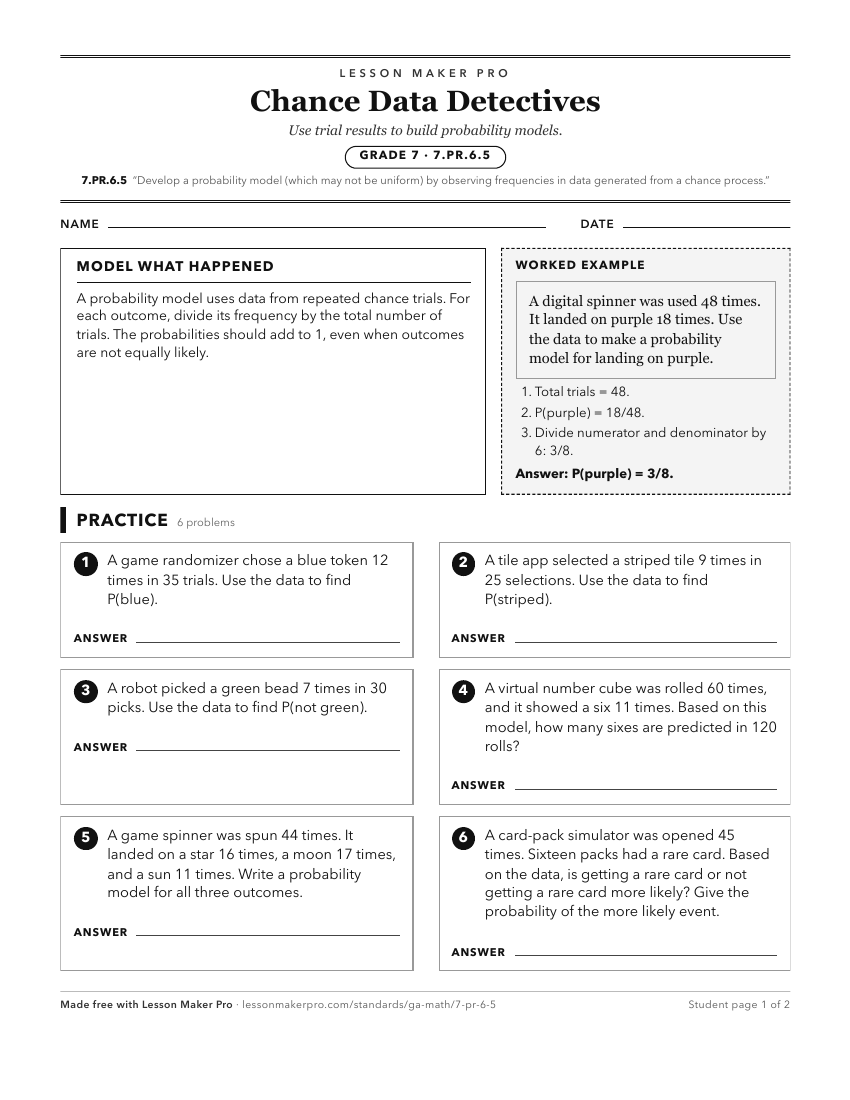
A ready-to-print activity worksheet aligned to 7.PR.6.5, with an answer key for the teacher on its own page. No account needed.
PDF, US Letter, prints cleanly in black and white.
Download the worksheetKeep exploring
Related Standards
- 7.PR.6.4
Develop a uniform probability model by assigning equal probability to all outcomes and use the model to determine probabilities of events.
- 7.PR.6.3
Develop a probability model and use it to find probabilities of simple events. Compare experimental and theoretical probabilities of events. If the probabilitie...
- 7.PR.6
Using mathematical reasoning, investigate chance processes and develop, evaluate, and use probability models to find probabilities of simple events presented in...
- 7.PR.6.2
Approximate the probability of a chance event by collecting data on an event and observing its long-run relative frequency will approach the theoretical probabi...
Turn this exact standard into a lesson
Grade, subject, topic, and the complete standard are prefilled. Create one free, no account needed.
Also for this standard:Make a WorksheetMake a QuizMake a Sub Lesson