Florida SS.6.E.3
Florida Standard (Benchmark Cluster)
Understand the fundamental concepts and interrelationships of the United States in the international marketplace.
Florida Next Generation Sunshine State Standards for Social Studies
Cluster contents
Benchmarks in This Standard
SS.6.E.3 is a Florida social studies standard. These are the benchmarks under it.
- SS.6.E.3.1
Identify examples of mediums of exchange (currencies) used for trade (barter) for each civilization, and explain why international trade requires a system for a...
- SS.6.E.3.2
Categorize products that were traded among civilizations, and give examples of barriers to trade of those products.
- SS.6.E.3.3
Describe traditional economies (e.g., Egypt, Greece, Rome, Kush) and elements of those economies that led to the rise of a merchant class and trading partners.
- SS.6.E.3.4
Describe the relationship among civilizations that engage in trade, including the benefits and drawbacks of voluntary trade.
Teacher's field guide
What This Cluster Means
What Students Need to Do
- Students identify goods the United States buys from and sells to other countries. They explain why countries trade and how a change in one country can affect buyers or sellers in another.
What Mastery Looks Like
- A student can use a product label to name an import and explain why the United States might buy it. They can trace how a shortage of that product could affect its price in a local store.
Common Misconceptions
- Students may think an import is something the United States sells, rather than buys. They may also assume trade only helps the country that sells the product, or that every product sold here is made here.
How to Assess It
- Show students a label that says a shirt was made in Vietnam and sold in Florida. Ask: Is the shirt a U.S. import or export, and what might happen to its price if fewer shirts arrive?
Lesson moves
Ways to Teach It
Give pairs five product packages or labels, and have them mark each country of origin on a world map.
Ask students to write three sentences answering, 'Why might a Florida store buy oranges from another country?'
Play a trade sorting game with cards naming U.S. purchases and sales, and have teams sort them into imports and exports.
Use a grocery flyer to find one imported food, then trace its route from its country of origin to a local store.
Free download
Printable SS.6.E.3 Worksheet
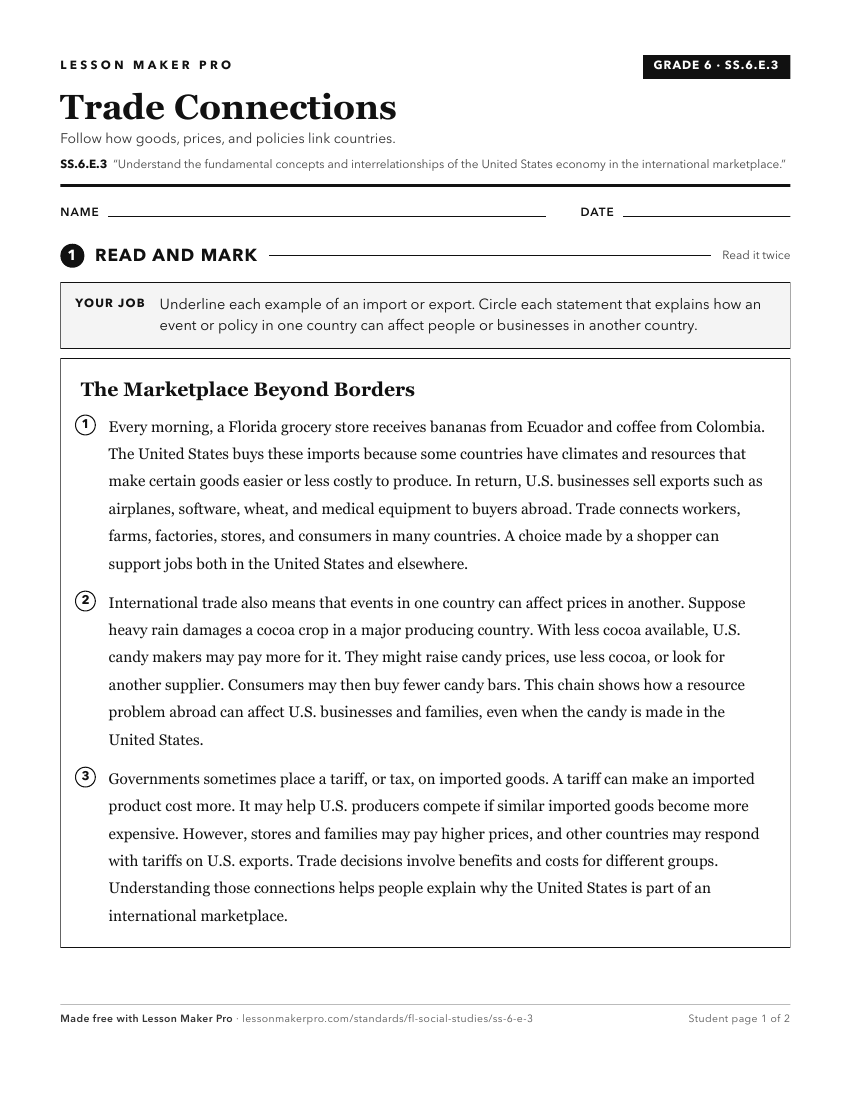
A ready-to-print activity worksheet aligned to SS.6.E.3, with an answer key for the teacher on its own page. No account needed.
PDF, US Letter, prints cleanly in black and white.
Download the worksheetKeep exploring
Related Standards
- SS.8.E.3
Understand the fundamental concepts and interrelationships of the United States economy in the international marketplace.
- SS.7.CG.4
Demonstrate an understanding of contemporary issues in world affairs, and evaluate the role and impact of United States foreign policy.
- SS.8.E.1
Understand the fundamental concepts relevant to the development of a market economy.
- SS.7.E.3
Understand the fundamental concepts and interrelationships of the United States economy in the international marketplace.
Turn this cluster into a lesson
Grade, subject, topic, and the complete cluster are prefilled. Create one free, no account needed.
Also for this cluster:Make a WorksheetMake a QuizMake a Sub Lesson