Florida SS.6.E.3.2
The Standard
- SS.6.E.3
- Understand the fundamental concepts and interrelationships of the United States in the international marketplace.
Categorize products that were traded among civilizations, and give examples of barriers to trade of those products.
Florida Next Generation Sunshine State Standards for Social Studies
Teacher's field guide
What This Standard Means
What Students Need to Do
- Students sort traded products into groups such as food, raw materials, finished goods, and luxury goods. They identify barriers that made trade difficult and explain each barrier's effect.
What Mastery Looks Like
- Students accurately categorize goods such as grain, timber, pottery, metals, spices, and silk. They explain how distance, terrain, conflict, taxes, or poor transportation could delay or prevent trade.
Common Misconceptions
- Students may confuse raw materials with finished goods or label every expensive item as a luxury good. They may name a barrier without explaining how it raises costs, causes delays, or blocks a route.
How to Assess It
- Give students grain, iron ore, pottery, and silk. Ask them to categorize each product and explain one barrier that could affect its trade.
Lesson moves
Ways to Teach It
Give groups product cards to sort into food, raw materials, finished goods, and luxury goods.
Ask students which barrier would most disrupt grain trade, then have them defend their answer in three sentences.
Play a route game where teams move product tokens across a map and draw cards for taxes, storms, mountains, and conflict.
Compare the trade of ancient spices with imported foods today, focusing on distance, transportation, taxes, weather, and conflict.
Free download
Printable SS.6.E.3.2 Worksheet
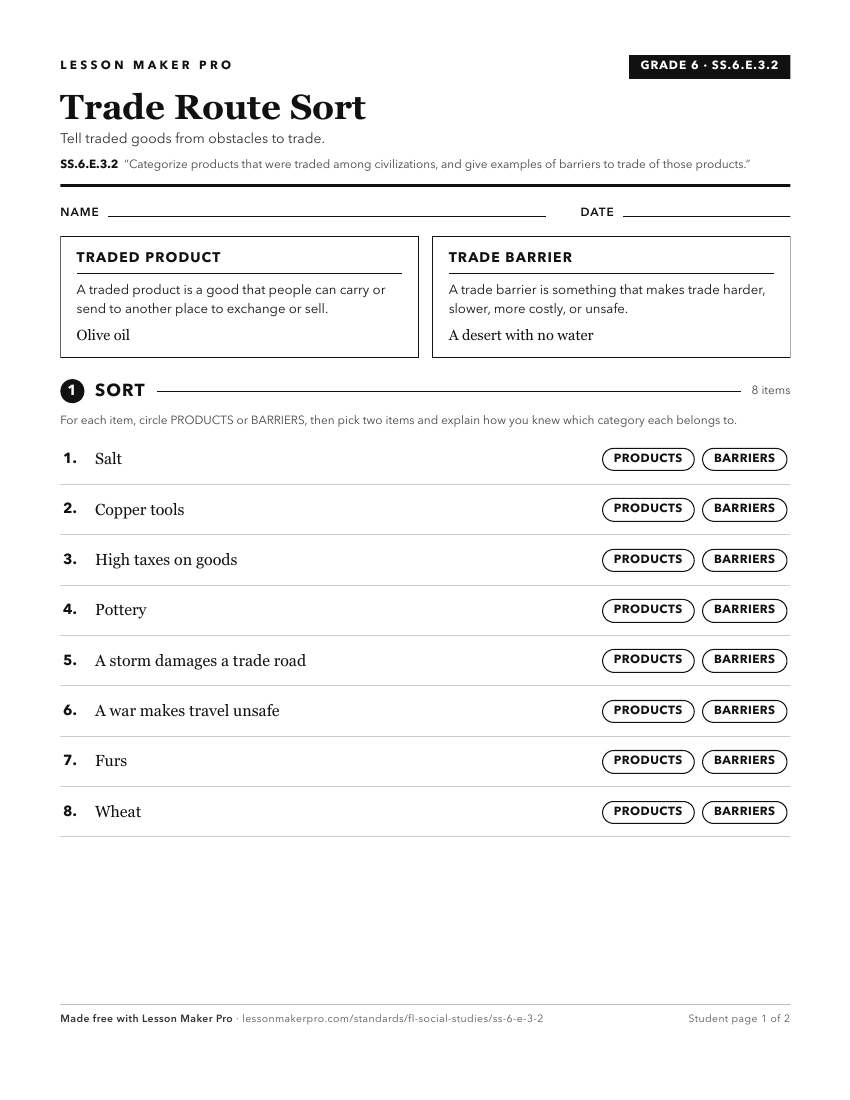
A ready-to-print activity worksheet aligned to SS.6.E.3.2, with an answer key for the teacher on its own page. No account needed.
PDF, US Letter, prints cleanly in black and white.
Download the worksheetKeep exploring
Related Standards
- SS.6.E.3.4
Describe the relationship among civilizations that engage in trade, including the benefits and drawbacks of voluntary trade.
- SS.6.E.3.1
Identify examples of mediums of exchange (currencies) used for trade (barter) for each civilization, and explain why international trade requires a system for a...
- SS.6.G.5.2
Use geographic terms and tools to explain why ancient civilizations developed networks of highways, waterways, and other transportation linkages.
- SS.6.E.3.3
Describe traditional economies (e.g., Egypt, Greece, Rome, Kush) and elements of those economies that led to the rise of a merchant class and trading partners.
Turn this exact standard into a lesson
Grade, subject, topic, and the complete standard are prefilled. Create one free, no account needed.
Also for this standard:Make a WorksheetMake a QuizMake a Sub Lesson