Florida SS.6.E.3.4
The Standard
- SS.6.E.3
- Understand the fundamental concepts and interrelationships of the United States in the international marketplace.
Describe the relationship among civilizations that engage in trade, including the benefits and drawbacks of voluntary trade.
Florida Next Generation Sunshine State Standards for Social Studies
Teacher's field guide
What This Standard Means
What Students Need to Do
- Students explain how trade connects civilizations through the exchange of goods, resources, skills, and ideas. They identify benefits and drawbacks for each trading partner and explain why both sides may choose to trade.
What Mastery Looks Like
- Given a trade map or scenario, students can explain what each civilization gives, receives, and hopes to gain. They can name likely benefits, drawbacks, and unequal outcomes using evidence from the example.
Common Misconceptions
- Students may assume voluntary trade benefits both sides equally or has no risks. They may confuse trade with conquest or tribute and overlook exchanges of ideas, technology, and disease.
How to Assess It
- Give this exit ticket: Civilization A has extra grain but needs metal, while Civilization B has extra metal but needs grain. Explain one benefit and one drawback for each civilization, then tell why the trade is voluntary.
Lesson moves
Ways to Teach It
Give groups resource cards for two ancient civilizations, then have them negotiate trades and record one benefit and one drawback for each side.
Ask students to write: Does voluntary trade always help both civilizations equally? Support your answer with a specific trade example.
Run a trade-route game where teams exchange surplus cards, face one route closure, and tally gains, shortages, and dependence afterward.
Use clothing labels to trace imported products, then discuss how buyers and sellers benefit and what risks arise from relying on distant suppliers.
Free download
Printable SS.6.E.3.4 Worksheet
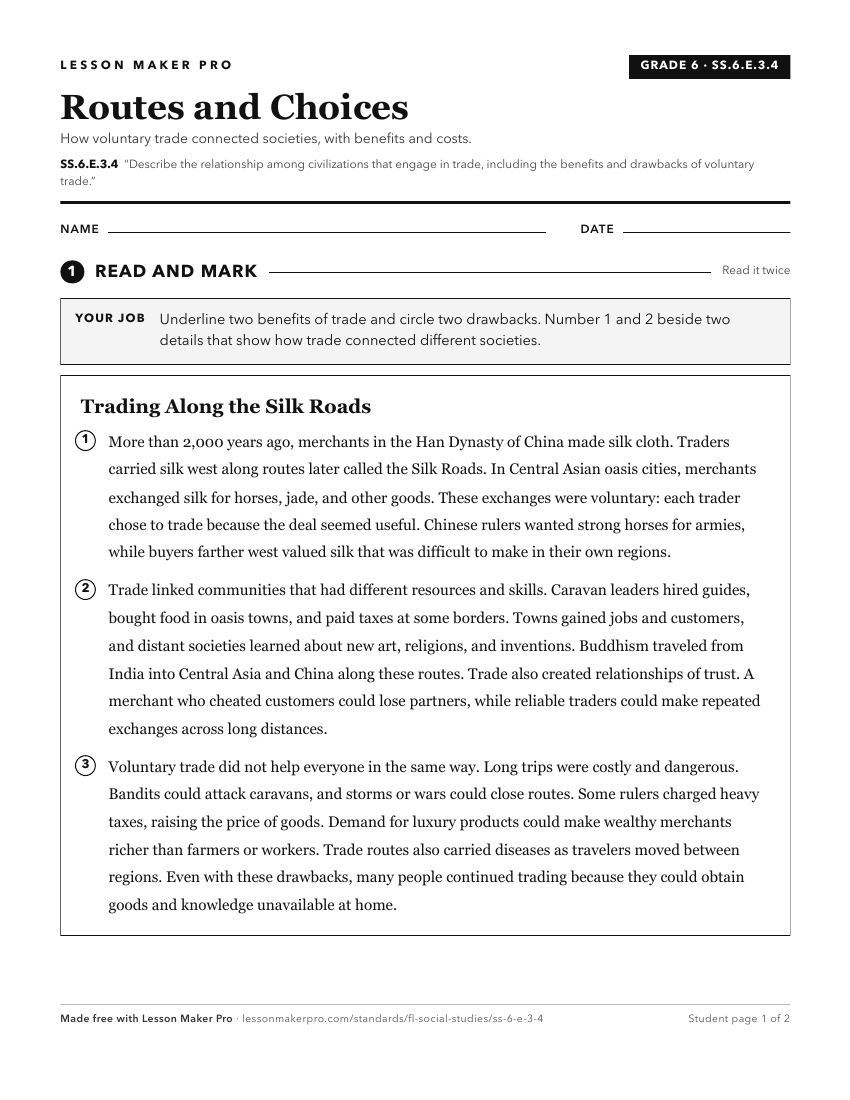
A ready-to-print activity worksheet aligned to SS.6.E.3.4, with an answer key for the teacher on its own page. No account needed.
PDF, US Letter, prints cleanly in black and white.
Download the worksheetKeep exploring
Related Standards
- SS.5.E.2.1
Recognize the positive and negative effects of voluntary trade among Native Americans, European explorers, and colonists.
- SS.6.E.3.1
Identify examples of mediums of exchange (currencies) used for trade (barter) for each civilization, and explain why international trade requires a system for a...
- SS.6.E.3.2
Categorize products that were traded among civilizations, and give examples of barriers to trade of those products.
- SS.6.E.3.3
Describe traditional economies (e.g., Egypt, Greece, Rome, Kush) and elements of those economies that led to the rise of a merchant class and trading partners.
Turn this exact standard into a lesson
Grade, subject, topic, and the complete standard are prefilled. Create one free, no account needed.
Also for this standard:Make a WorksheetMake a QuizMake a Sub Lesson