Florida SS.5.E.2.1
The Standard
- SS.5.E.2
- The International Economy
Recognize the positive and negative effects of voluntary trade among Native Americans, European explorers, and colonists.
Florida Next Generation Sunshine State Standards for Social Studies
Teacher's field guide
What This Standard Means
What Students Need to Do
- Students identify goods exchanged among Native peoples, explorers, and colonists. They explain benefits and harms, including how one exchange could affect each group differently.
What Mastery Looks Like
- Given a trade scenario, students name the groups, goods, and at least one positive and negative result. They support each result with historical details.
Common Misconceptions
- Students may assume a voluntary exchange was always fair or helpful to both sides. They may also treat all contact as trade or overlook disease, conflict, and resource loss.
How to Assess It
- Exit ticket: “A Native community trades furs for metal tools. Name one benefit, one possible harm, and which group experienced each.”
Lesson moves
Ways to Teach It
Give groups corn, fur, tool, and bead cards; let them trade, draw consequence cards, and chart gains and costs by group.
Write: “Did one fur-for-tool exchange affect both groups equally? Use two details to explain each group’s point of view.”
Play a matching game linking traded goods to outcomes, then label each outcome positive, negative, or both and defend one choice.
Compare a modern phone purchase with colonial trade by listing who gains, who bears costs, and how resources move between communities.
Free download
Printable SS.5.E.2.1 Worksheet
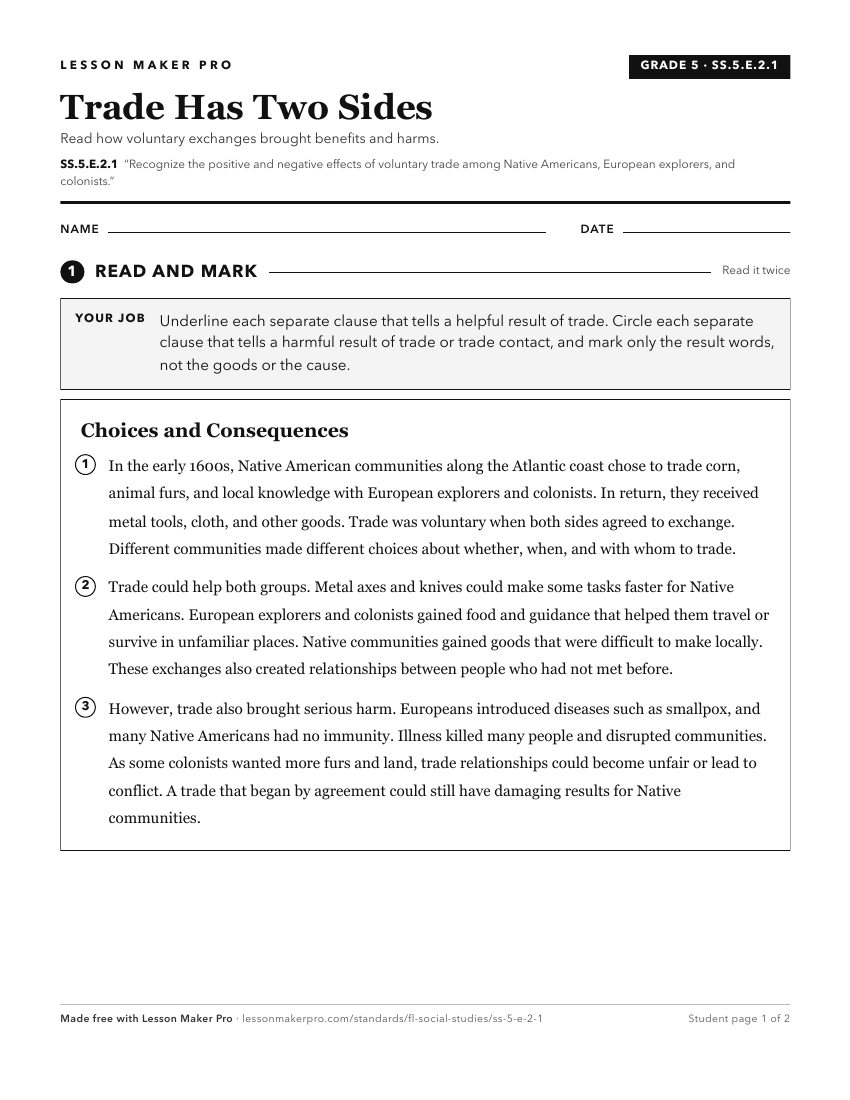
A ready-to-print activity worksheet aligned to SS.5.E.2.1, with an answer key for the teacher on its own page. No account needed.
PDF, US Letter, prints cleanly in black and white.
Download the worksheetKeep exploring
Related Standards
- SS.6.E.3.4
Describe the relationship among civilizations that engage in trade, including the benefits and drawbacks of voluntary trade.
- SS.5.E.1.1
Identify how trade promoted economic growth in North America from pre-Columbian times to 1850.
- SS.8.A.2.5
Discuss the impact of colonial settlement on Native American populations.
- SS.5.A.3.3
Describe interactions among Native Americans, Africans, English, French, Dutch, and Spanish for control of North America.
Turn this exact standard into a lesson
Grade, subject, topic, and the complete standard are prefilled. Create one free, no account needed.
Also for this standard:Make a WorksheetMake a QuizMake a Sub Lesson