Florida SS.5.E.1.1
The Standard
- SS.5.E.1
- Market Economy
Identify how trade promoted economic growth in North America from pre-Columbian times to 1850.
Florida Next Generation Sunshine State Standards for Social Studies
Teacher's field guide
What This Standard Means
What Students Need to Do
- Students trace trade across Indigenous trade networks, European colonial trade, and expanding U.S. trade through 1850. They connect traded goods and transportation routes to larger markets, jobs, settlement, and town growth. They use examples such as shells, furs, tobacco, cotton, canals, steamboats, and railroads.
What Mastery Looks Like
- A student can give a trade example from before European contact, the colonial era, and the early United States. For each example, the student explains a clear cause-and-effect chain connecting trade to economic growth.
Common Misconceptions
- Students often assume North American trade began when Europeans arrived or that all trade used money. They may list traded goods without explaining how exchange increased production or markets. They may also overlook land loss, forced labor, and slavery when describing growth.
How to Assess It
- Ask students to choose one trade example before European contact and one from 1800 to 1850. For each, write a two-step chain showing how trade led to economic growth.
Lesson moves
Ways to Teach It
Build a floor map with yarn trade routes, then place picture cards for shells, furs, tobacco, cotton, and manufactured goods.
Write about which mattered more for economic growth, new trade goods or better transportation, using two historical examples.
Play a card-matching relay that pairs trade goods, regions, transportation methods, and economic effects from different periods.
Compare a modern product's shipping route with a fur, cotton, or tobacco route, then identify how each route supports jobs and markets.
Free download
Printable SS.5.E.1.1 Worksheet
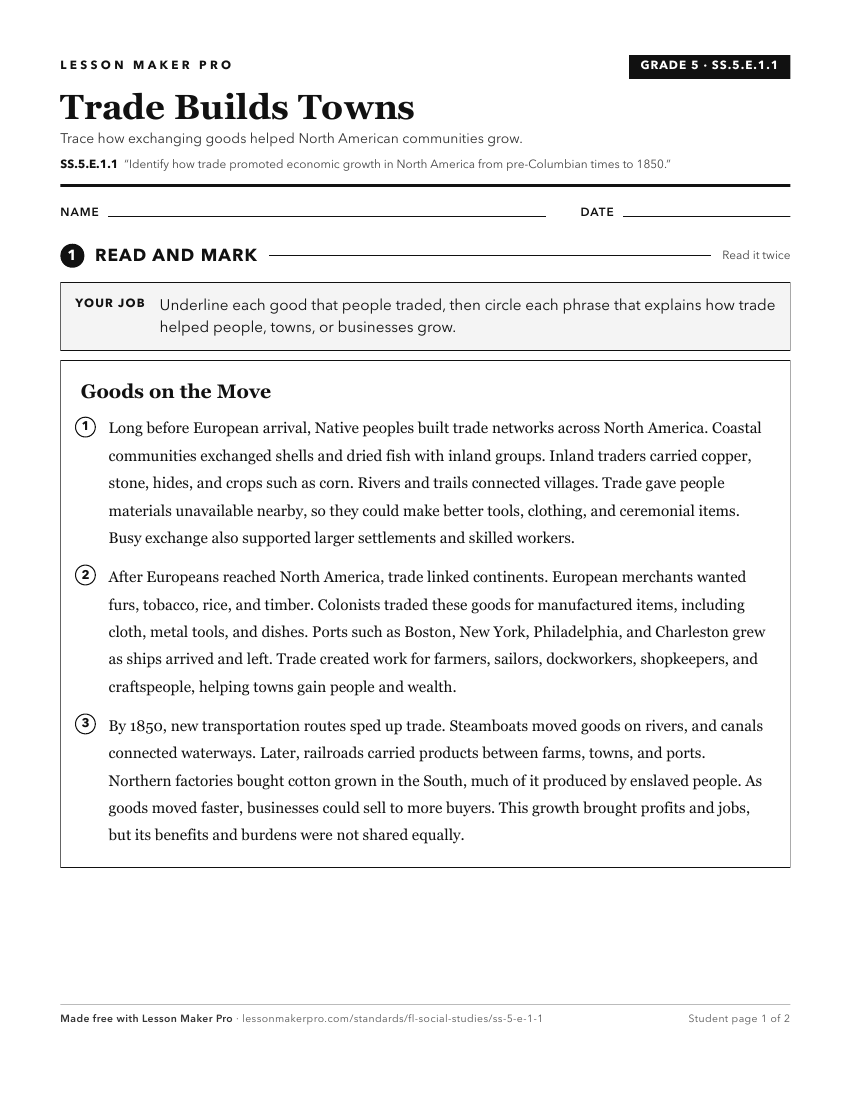
A ready-to-print activity worksheet aligned to SS.5.E.1.1, with an answer key for the teacher on its own page. No account needed.
PDF, US Letter, prints cleanly in black and white.
Download the worksheetKeep exploring
Related Standards
- SS.7.G.2.3
Explain how major physical characteristics, natural resources, climate, and absolute and relative location have influenced settlement, economies, and inter-gove...
- SS.5.E.2.1
Recognize the positive and negative effects of voluntary trade among Native Americans, European explorers, and colonists.
- SS.5.A.2
Pre-Columbian North America
- SS.6.E.1.1
Identify the factors (e.g., new resources, increased productivity, education, technology, slave economy, territorial expansion) that increase economic growth.
Turn this exact standard into a lesson
Grade, subject, topic, and the complete standard are prefilled. Create one free, no account needed.
Also for this standard:Make a WorksheetMake a QuizMake a Sub Lesson