Florida SS.6.E.3.3
The Standard
- SS.6.E.3
- Understand the fundamental concepts and interrelationships of the United States in the international marketplace.
Describe traditional economies (e.g., Egypt, Greece, Rome, Kush) and elements of those economies that led to the rise of a merchant class and trading partners.
Florida Next Generation Sunshine State Standards for Social Studies
Teacher's field guide
What This Standard Means
What Students Need to Do
- Students identify how people in Egypt, Greece, Rome, and Kush produced and exchanged goods. They explain how surpluses, specialized workers, and trade routes supported merchants and connected societies.
What Mastery Looks Like
- Students can name goods a society produced, explain how they were traded, and identify likely trading partners. They can connect growing trade to the rise of full-time merchants.
Common Misconceptions
- Students may assume all ancient trade used barter or stayed within one society. They may name traded goods without explaining how surpluses and specialized work created merchant jobs.
How to Assess It
- Exit ticket: Choose Egypt, Greece, Rome, or Kush. Name one traded good, one trading partner, and explain why a merchant was needed.
Lesson moves
Ways to Teach It
Give groups resource, product, merchant, and location cards to arrange into trade chains on a Mediterranean and African map.
Ask students to write: How could a grain surplus lead someone to become a full-time merchant?
Play a trade-route game where teams exchange grain, gold, pottery, and cloth while recording partners and merchant profits.
Have students inspect product labels from home, then compare modern imports with goods traded by ancient societies.
Free download
Printable SS.6.E.3.3 Worksheet
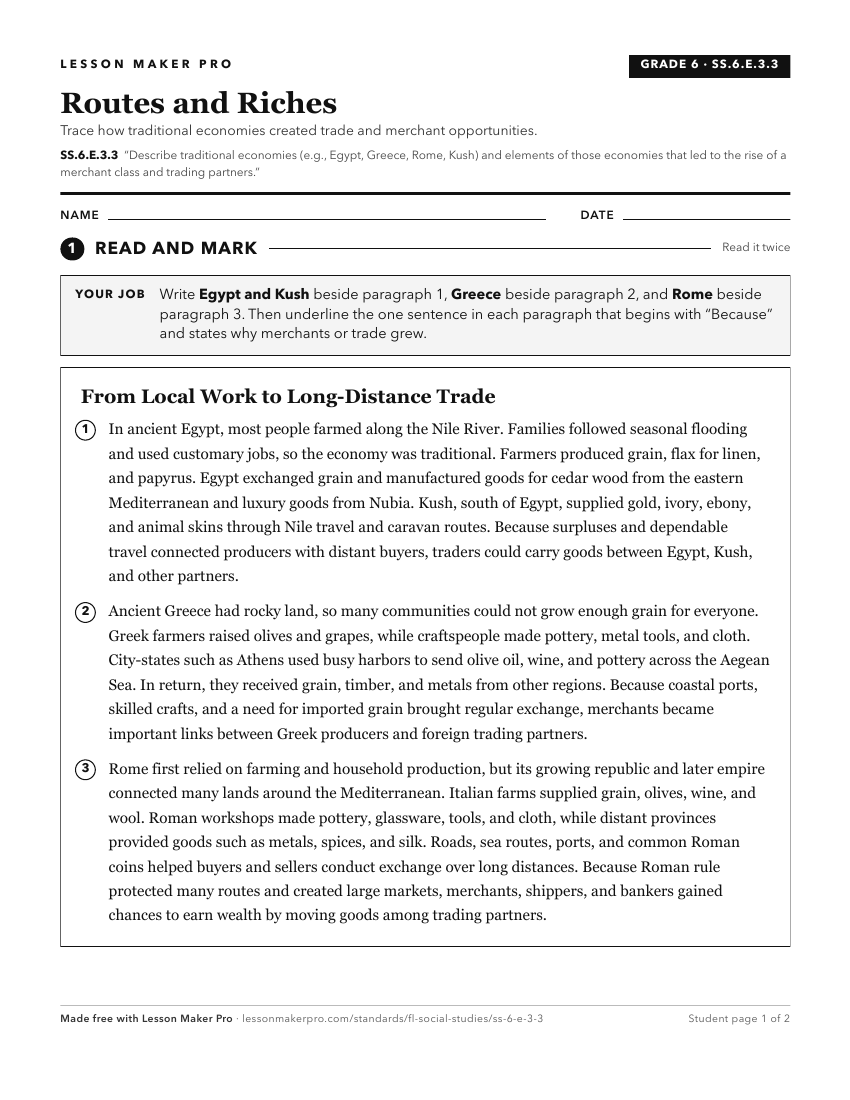
A ready-to-print activity worksheet aligned to SS.6.E.3.3, with an answer key for the teacher on its own page. No account needed.
PDF, US Letter, prints cleanly in black and white.
Download the worksheetKeep exploring
Related Standards
- SS.6.E.3.2
Categorize products that were traded among civilizations, and give examples of barriers to trade of those products.
- SS.6.E.1.2
Describe and identify traditional and command economies as they appear in different civilizations.
- SS.6.E.1.3
Describe the following economic concepts as they relate to early civilization: scarcity, opportunity cost, supply and demand, barter, trade, productive resource...
- SS.6.G.2.1
Explain how major physical characteristics, natural resources, climate, and absolute and relative locations have influenced settlement, interactions, and the ec...
Turn this exact standard into a lesson
Grade, subject, topic, and the complete standard are prefilled. Create one free, no account needed.
Also for this standard:Make a WorksheetMake a QuizMake a Sub Lesson