Florida SS.6.E.1.3
The Standard
- SS.6.E.1
- Understand the fundamental concepts relevant to the development of a market economy.
Describe the following economic concepts as they relate to early civilization: scarcity, opportunity cost, supply and demand, barter, trade, productive resources (e.g., land, labor, capital, entrepreneurship).
Florida Next Generation Sunshine State Standards for Social Studies
Teacher's field guide
What This Standard Means
What Students Need to Do
- Students explain how limited resources forced people in early civilizations to make choices and give up alternatives. They show how barter, trade, supply, and demand shaped exchanges. They sort productive resources into land, labor, capital, and entrepreneurship.
What Mastery Looks Like
- Given a village scenario, a student identifies the scarce resource, names the next best choice given up, and predicts how supply or demand affects value. The student distinguishes barter from broader trade and correctly labels natural resources, workers, tools, and organizers.
Common Misconceptions
- Students may treat scarcity as a temporary shortage and opportunity cost as every option given up, rather than the next best choice. They often use barter and trade as exact synonyms. They may call money capital, overlook entrepreneurs, or reverse how limited supply and high demand affect value.
How to Assess It
- Exit ticket: A river village has limited timber, many families seeking boats, skilled builders, tools, and one organizer. Students identify the scarcity, opportunity cost, barter, supply and demand, and each productive resource.
Lesson moves
Ways to Teach It
Give groups unequal bags of beans, clay, and craft sticks; they barter to build irrigation models and record each scarce resource.
Prompt groups: A village can build a wall or canal with the same workers; what is the opportunity cost, and why?
Run three market rounds with changing grain supply and buyer demand; students set prices, make trades, and explain each price change.
Compare a Mesopotamian grain market with a farmers market, naming what is traded and which resources producers use.
Free download
Printable SS.6.E.1.3 Worksheet
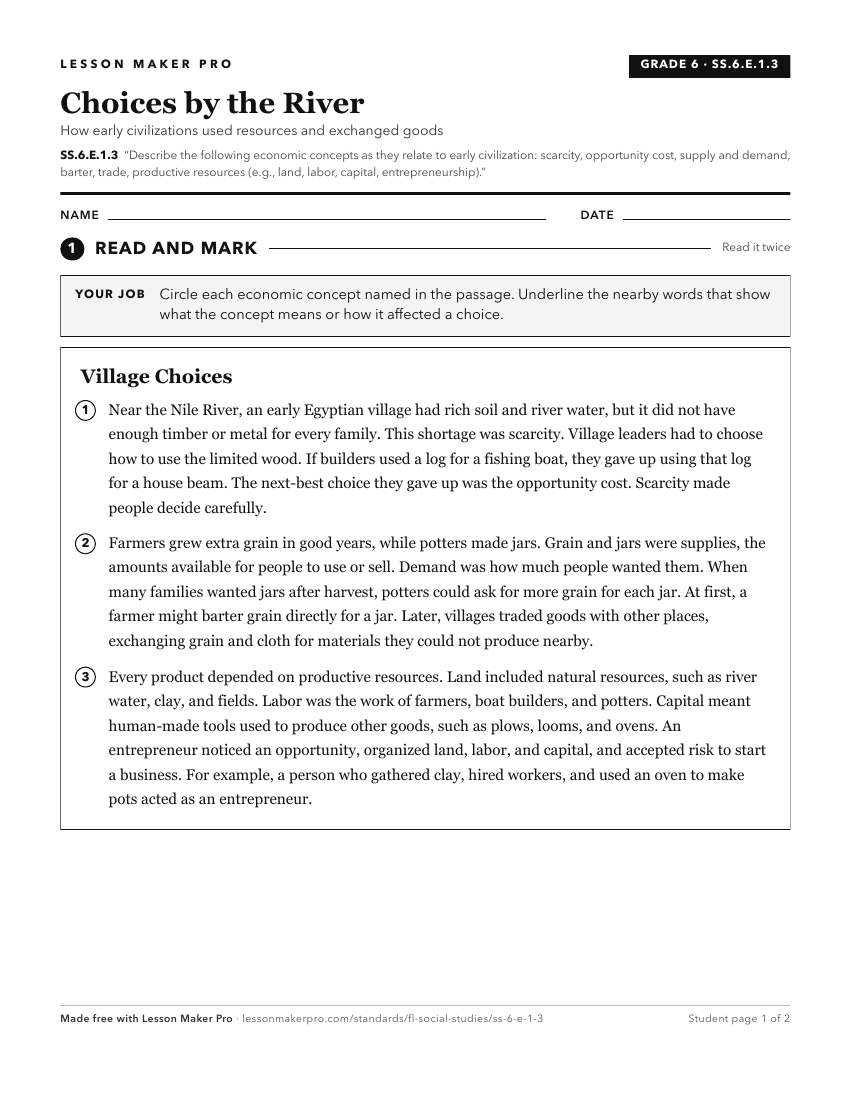
A ready-to-print activity worksheet aligned to SS.6.E.1.3, with an answer key for the teacher on its own page. No account needed.
PDF, US Letter, prints cleanly in black and white.
Download the worksheetKeep exploring
Related Standards
- SS.6.E.1.2
Describe and identify traditional and command economies as they appear in different civilizations.
- SS.7.E.1.3
Review the concepts of supply and demand, choice, scarcity, and opportunity cost as they relate to the development of the mixed market economy in the United Sta...
- SS.6.E.3.3
Describe traditional economies (e.g., Egypt, Greece, Rome, Kush) and elements of those economies that led to the rise of a merchant class and trading partners.
- SS.6.G.5.1
Identify the methods used to compensate for the scarcity of resources in the ancient world.
Turn this exact standard into a lesson
Grade, subject, topic, and the complete standard are prefilled. Create one free, no account needed.
Also for this standard:Make a WorksheetMake a QuizMake a Sub Lesson