Virginia SOL 6.9
SOL Standard (Key Ideas Cluster)
The student will investigate and understand that humans impact the environment and individuals can influence public policy decisions related to energy and the environment. Key ideas include natural resources are important to protect and maintain; renewable and nonrenewable resources can be managed; major health and safety issues are associated with air and water quality; major health and safety issues are related to different forms of energy; preventive measures can protect land-use and reduce environmental hazards; and there are cost/benefit tradeoffs in conservation policies.
Virginia Standards of Learning for Science
Cluster contents
Key Ideas in This Standard
6.9 is a Standards of Learning science standard. These are the key ideas and practices under it.
- 6.9.a
natural resources are important to protect and maintain
- 6.9.b
renewable and nonrenewable resources can be managed
- 6.9.c
major health and safety issues are associated with air and water quality
- 6.9.d
major health and safety issues are related to different forms of energy
- 6.9.e
preventive measures can protect land-use and reduce environmental hazards
- 6.9.f
there are cost/benefit tradeoffs in conservation policies.
Teacher's field guide
What This Cluster Means
What Students Need to Do
- Students trace how choices about energy, water, land, and materials affect ecosystems and human health. They compare renewable and nonrenewable resources and explain ways each can be managed. They use evidence to weigh costs and benefits, recommend a policy, and explain how people can influence the decision.
What Mastery Looks Like
- A student can classify resources and explain the environmental effects of using them. Given a local scenario, the student identifies a health or environmental risk and suggests a practical prevention measure. The student supports a policy recommendation with evidence, costs, and benefits.
Common Misconceptions
- Students may think renewable resources are unlimited or cause no environmental harm. They may treat pollution as only visible litter and overlook chemicals or particles in air and water. They may assume conservation policies have no costs or that individuals cannot affect public decisions.
How to Assess It
- Exit ticket: A town plans a gas station beside a stream that supplies drinking water. Name one hazard, propose one preventive measure, state one cost and benefit of your measure, and explain how residents could influence the decision.
Lesson moves
Ways to Teach It
Pour equal cups of water over trays of bare soil and grass-covered soil, then compare runoff color and soil loss.
Write a town council recommendation on replacing diesel buses with electric buses, using one health benefit, one cost, and one tradeoff.
Sort resource and energy cards into renewable and nonrenewable groups, then match each card to one impact and one management action.
Read your locality's water quality report and identify one measured pollutant, its health concern, and one prevention step.
Free download
Printable 6.9 Worksheet
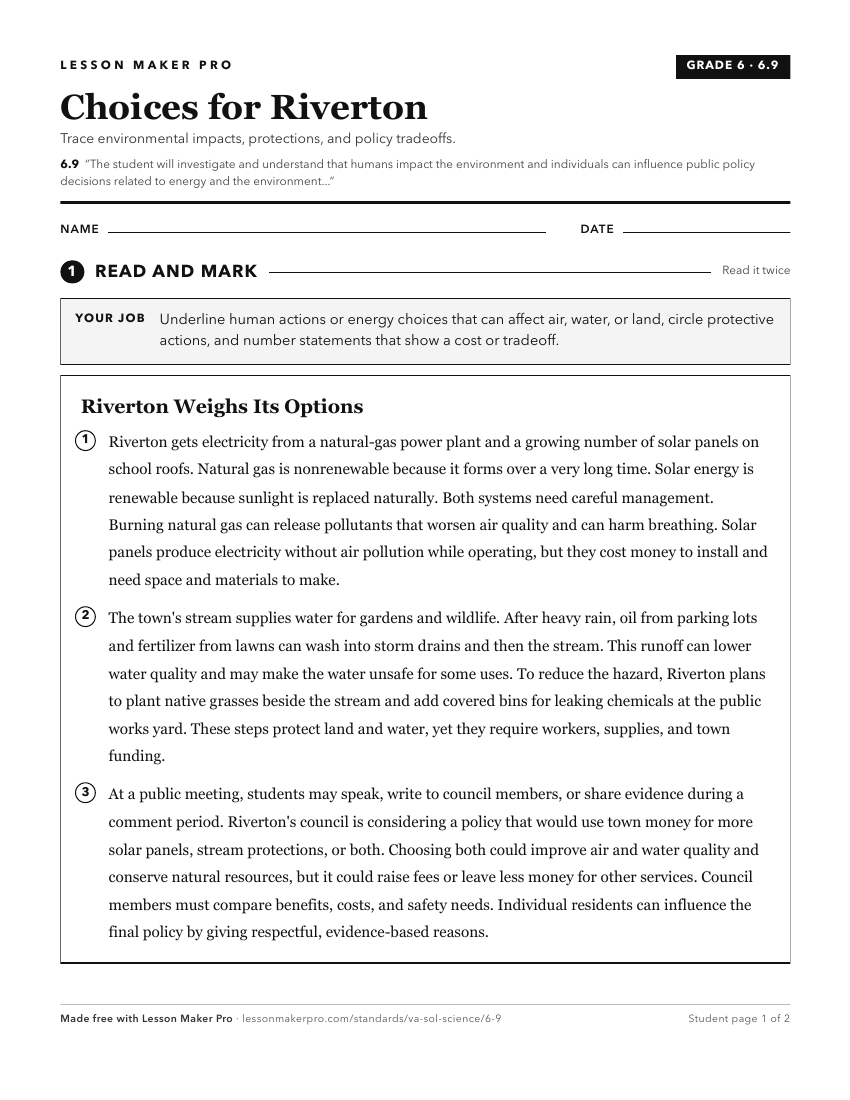
A ready-to-print activity worksheet aligned to 6.9, with an answer key for the teacher on its own page. No account needed.
PDF, US Letter, prints cleanly in black and white.
Download the worksheetKeep exploring
Related Standards
- LS.9
The student will investigate and understand that relationships exist between ecosystem dynamics and human activity. Key ideas include
- 3.8
The student will investigate and understand that natural events and humans influence ecosystems. Key ideas include
- K.11
The student will investigate and understand that humans use resources. Key ideas include
- 5.9
The student will investigate and understand that the conservation of energy resources is important. Key ideas include
Turn this cluster into a lesson
Grade, subject, topic, and the complete cluster are prefilled. Create one free, no account needed.
Also for this cluster:Make a WorksheetMake a QuizMake a Sub Lesson