Virginia SOL 6.9.f
The Standard
- 6.9
- The student will investigate and understand that humans impact the environment and individuals can influence public policy decisions related to energy and the environment. Key ideas include
there are cost/benefit tradeoffs in conservation policies.
Virginia Standards of Learning for Science
Teacher's field guide
What This Standard Means
What Students Need to Do
- Students identify who gains and who bears costs when a conservation rule is adopted. They use evidence to compare environmental, economic, and social effects.
What Mastery Looks Like
- Students can explain multiple benefits and drawbacks of one policy. They can recommend an option and support their choice with evidence while recognizing effects on different groups.
Common Misconceptions
- Students may assume every conservation policy helps everyone or has only environmental effects. They may treat cost as money only and overlook time, convenience, jobs, access, or limits on resource use.
How to Assess It
- Ask: “A town limits lawn watering to protect its water supply. Name two benefits, two costs, and the group affected by each.”
Lesson moves
Ways to Teach It
Give groups 20 water tokens, then introduce drought limits and have them allocate water among homes, farms, parks, and wildlife.
Discuss or write: “Should stores charge for plastic bags?” Require one benefit, one cost, and two affected groups.
Sort policy cards into likely benefits and costs, then earn a point for each claim supported with an evidence card.
Examine a local recycling, fishing, or water-use rule and identify its effects on residents, businesses, government, and natural resources.
Free download
Printable 6.9.f Worksheet
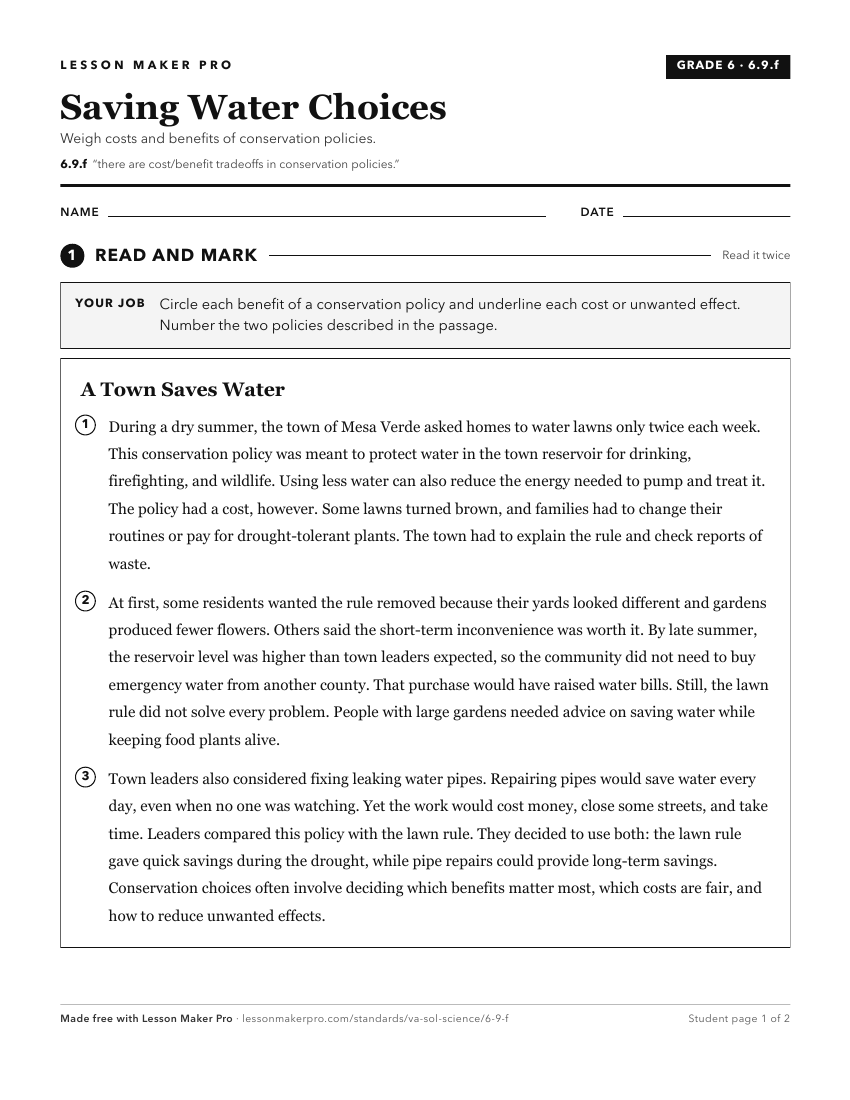
A ready-to-print activity worksheet aligned to 6.9.f, with an answer key for the teacher on its own page. No account needed.
PDF, US Letter, prints cleanly in black and white.
Download the worksheetKeep exploring
Related Standards
Turn this exact standard into a lesson
Grade, subject, topic, and the complete standard are prefilled. Create one free, no account needed.
Also for this standard:Make a WorksheetMake a QuizMake a Sub Lesson