Virginia SOL 6.9.d
The Standard
- 6.9
- The student will investigate and understand that humans impact the environment and individuals can influence public policy decisions related to energy and the environment. Key ideas include
major health and safety issues are related to different forms of energy
Virginia Standards of Learning for Science
Teacher's field guide
What This Standard Means
What Students Need to Do
- Students connect energy sources with specific health and safety risks. They explain how each risk occurs and identify ways people can reduce harm.
What Mastery Looks Like
- Students can compare hazards from fossil fuels, nuclear power, hydropower, solar power, and wind power. They can name a realistic safety measure for each hazard.
Common Misconceptions
- Students may think renewable energy has no risks or that all radiation exposure is deadly. They may also overlook air pollution, mining injuries, dam failures, electrical shock, and battery fires.
How to Assess It
- Exit ticket: For coal, nuclear, and hydroelectric power, name one health or safety concern and one action that reduces the risk.
Lesson moves
Ways to Teach It
Give groups energy source cards, hazard cards, and safety measure cards, then have them build and explain three matching sets.
Ask students to write which energy source they would place near their town and what safety conditions they would require.
Play a hazard relay where teams match energy scenarios to air pollution, radiation, fire, electrical shock, or structural failure.
Have students inspect school safety signs and devices, then connect each one to an energy hazard it helps prevent.
Free download
Printable 6.9.d Worksheet
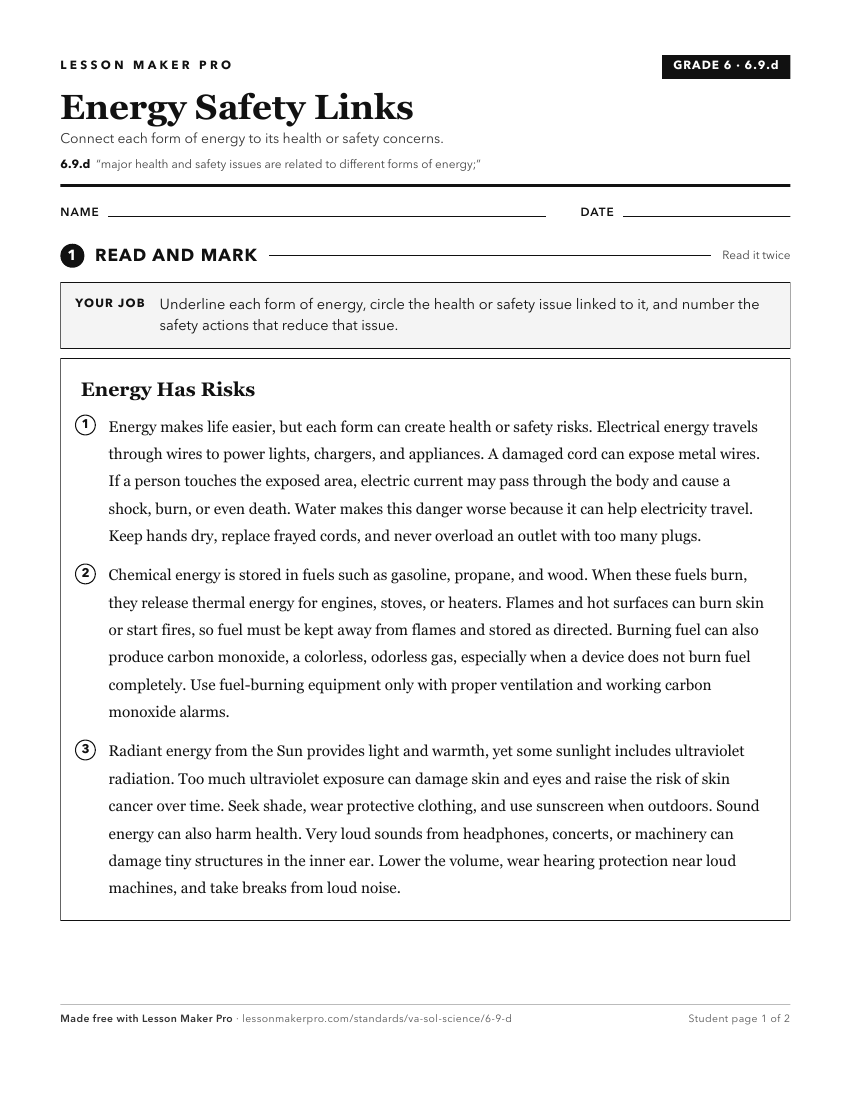
A ready-to-print activity worksheet aligned to 6.9.d, with an answer key for the teacher on its own page. No account needed.
PDF, US Letter, prints cleanly in black and white.
Download the worksheetKeep exploring
Related Standards
Turn this exact standard into a lesson
Grade, subject, topic, and the complete standard are prefilled. Create one free, no account needed.
Also for this standard:Make a WorksheetMake a QuizMake a Sub Lesson