Virginia SOL 5.9.a
The Standard
- 5.9
- The student will investigate and understand that the conservation of energy resources is important. Key ideas include
some sources of energy are considered renewable and others are not
Virginia Standards of Learning for Science
Teacher's field guide
What This Standard Means
What Students Need to Do
- Students sort energy sources into renewable and nonrenewable groups. They explain each choice by considering how quickly nature replaces the source.
What Mastery Looks Like
- Students correctly classify sunlight, wind, moving water, and biomass as renewable. They classify coal, oil, natural gas, and uranium as nonrenewable and explain why.
Common Misconceptions
- Students may think natural gas is renewable because it has the word natural. They may call electricity renewable, even though electricity must be produced from another energy source.
How to Assess It
- Give students six energy sources: sunlight, coal, wind, oil, moving water, and natural gas. Have them label each and explain one choice.
Lesson moves
Ways to Teach It
Give pairs energy-source cards and two labeled hoops, then have them sort the cards and defend one disputed choice.
Ask students to write: Could a renewable source ever run low? Support your answer with one example.
Play Renewable Relay, where teams race to place source cards under the correct heading and explain each placement.
Examine a Virginia electricity generation chart, then color-code each listed source as renewable or nonrenewable.
Free download
Printable 5.9.a Worksheet
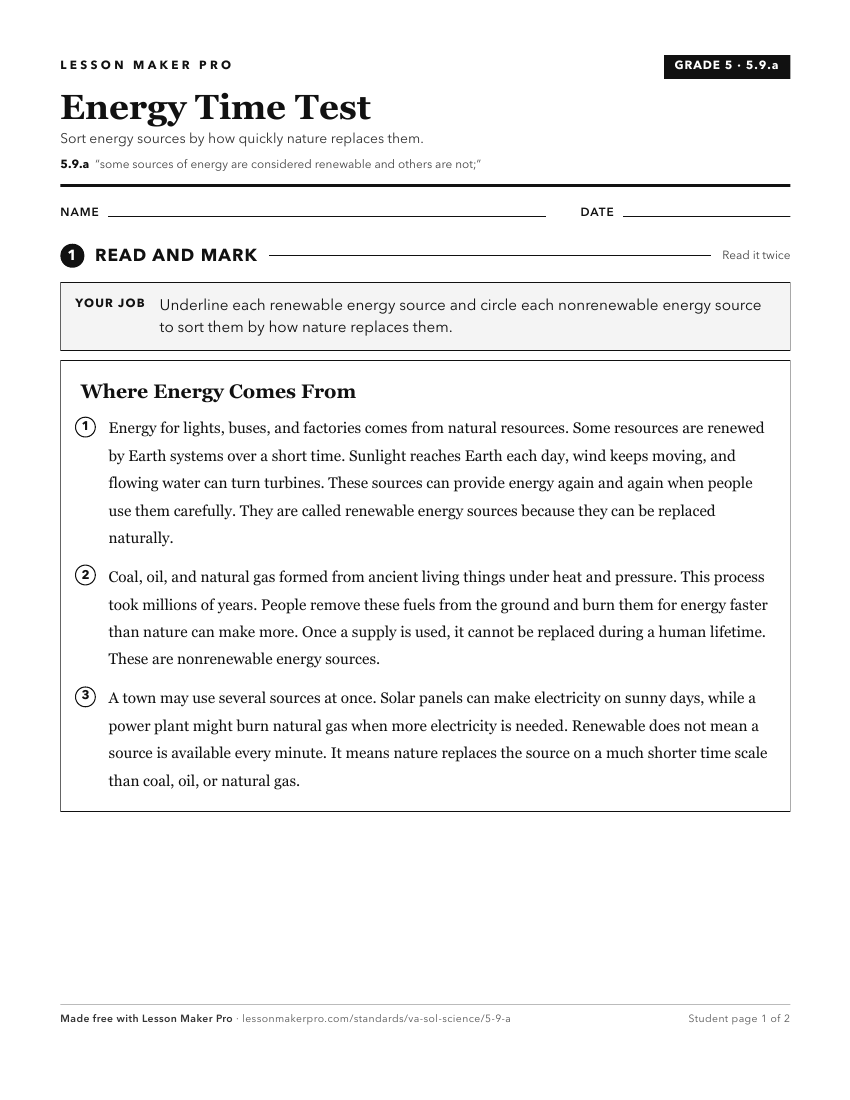
A ready-to-print activity worksheet aligned to 5.9.a, with an answer key for the teacher on its own page. No account needed.
PDF, US Letter, prints cleanly in black and white.
Download the worksheetKeep exploring
Related Standards
Turn this exact standard into a lesson
Grade, subject, topic, and the complete standard are prefilled. Create one free, no account needed.
Also for this standard:Make a WorksheetMake a QuizMake a Sub Lesson