Virginia SOL PS.5.a
The Standard
- PS.5
- The student will investigate and understand that energy is conserved. Key ideas include
energy can be stored in different ways
Virginia Standards of Learning for Science · The student will investigate and understand that energy is conserved. Key ideas include
Teacher's field guide
What This Standard Means
What Students Need to Do
- Students identify energy held in objects above the ground, stretched materials, batteries, food, and fuels. They name the type of stored energy and describe what happens when it is released.
What Mastery Looks Like
- Students can identify gravitational, elastic, and chemical energy in diagrams and demonstrations. They can explain how stored energy changes into motion, heat, light, or sound.
Common Misconceptions
- Students may think only moving objects have energy or that energy disappears when motion stops. They may confuse a battery with the chemical energy held inside it.
How to Assess It
- Show a book on a shelf, a compressed spring, and a battery. Ask students to identify each energy store and predict one result of its release.
Lesson moves
Ways to Teach It
Stretch rubber bands by different amounts, launch paper balls, and measure how stored elastic energy affects travel distance.
Ask students where energy is held in a windup toy before it moves and where that energy goes afterward.
Match picture cards of food, springs, batteries, and raised weights to chemical, elastic, or gravitational energy.
Inspect a phone battery label, then explain how its stored chemical energy becomes light, sound, motion, and heat.
Free download
Printable PS.5.a Worksheet
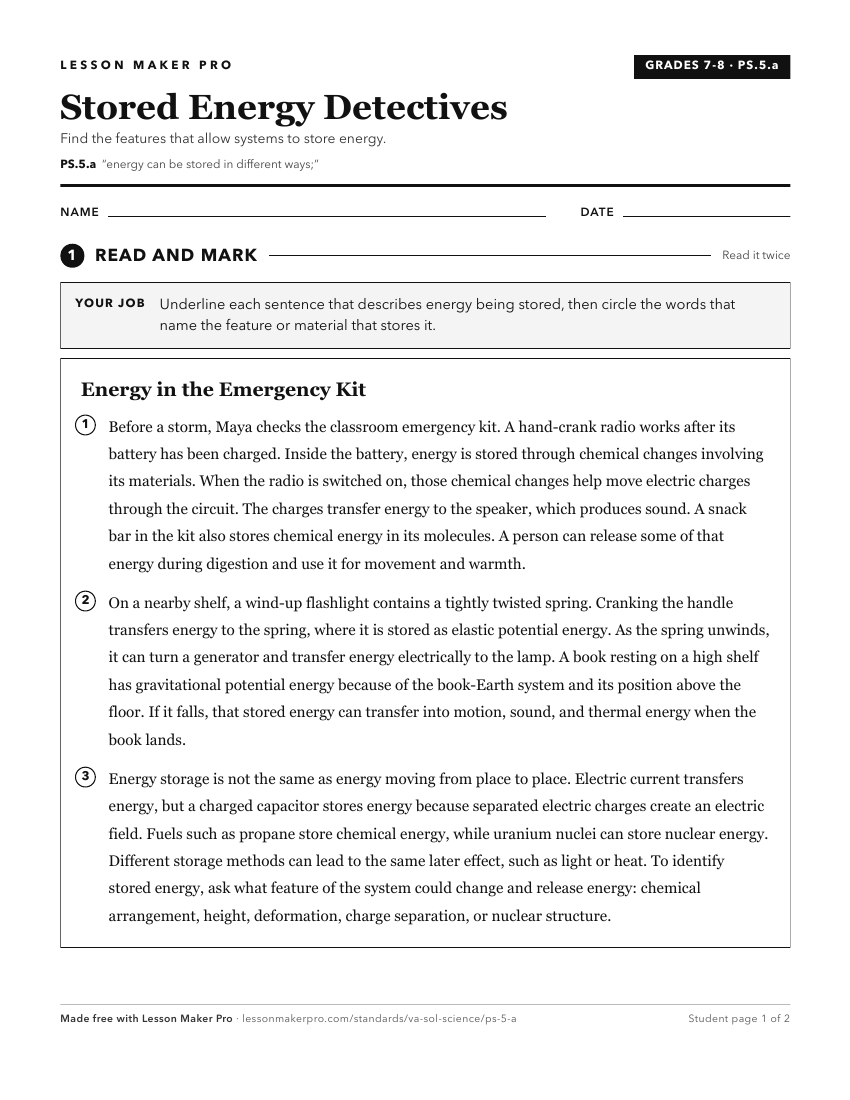
A ready-to-print activity worksheet aligned to PS.5.a, with an answer key for the teacher on its own page. No account needed.
PDF, US Letter, prints cleanly in black and white.
Download the worksheetKeep exploring
Related Standards
Turn this exact standard into a lesson
Grade, subject, topic, and the complete standard are prefilled. Create one free, no account needed.
Also for this standard:Make a WorksheetMake a QuizMake a Sub Lesson