Virginia SOL 6.9.a
The Standard
- 6.9
- The student will investigate and understand that humans impact the environment and individuals can influence public policy decisions related to energy and the environment. Key ideas include
natural resources are important to protect and maintain
Virginia Standards of Learning for Science
Teacher's field guide
What This Standard Means
What Students Need to Do
- Students identify natural resources and explain how human actions can damage or conserve them. They compare ways to manage air, water, soil, forests, wildlife, minerals, and fuels over time.
What Mastery Looks Like
- Students can connect a specific human activity to its effect on a resource. They can recommend a practical conservation action and explain how it reduces harm or waste.
Common Misconceptions
- Students may think renewable resources cannot run out or become polluted. They may also think recycling alone protects resources, or that conservation means people cannot use resources at all.
How to Assess It
- Give this exit ticket: “Our school is using too much water. Name one action the school should take and explain how it protects the resource.”
Lesson moves
Ways to Teach It
Give groups 20 resource tokens, then have them model repeated use under wasteful and conservation rules and compare what remains.
Ask students to write: “Should a forest be used for lumber, protected, or both?” Require one reason and one management plan.
Play a conservation matching game in which students pair resource threats, such as erosion or overfishing, with specific solutions.
Conduct a classroom resource audit of paper, water, and electricity use, then have students propose one measurable change for the week.
Free download
Printable 6.9.a Worksheet
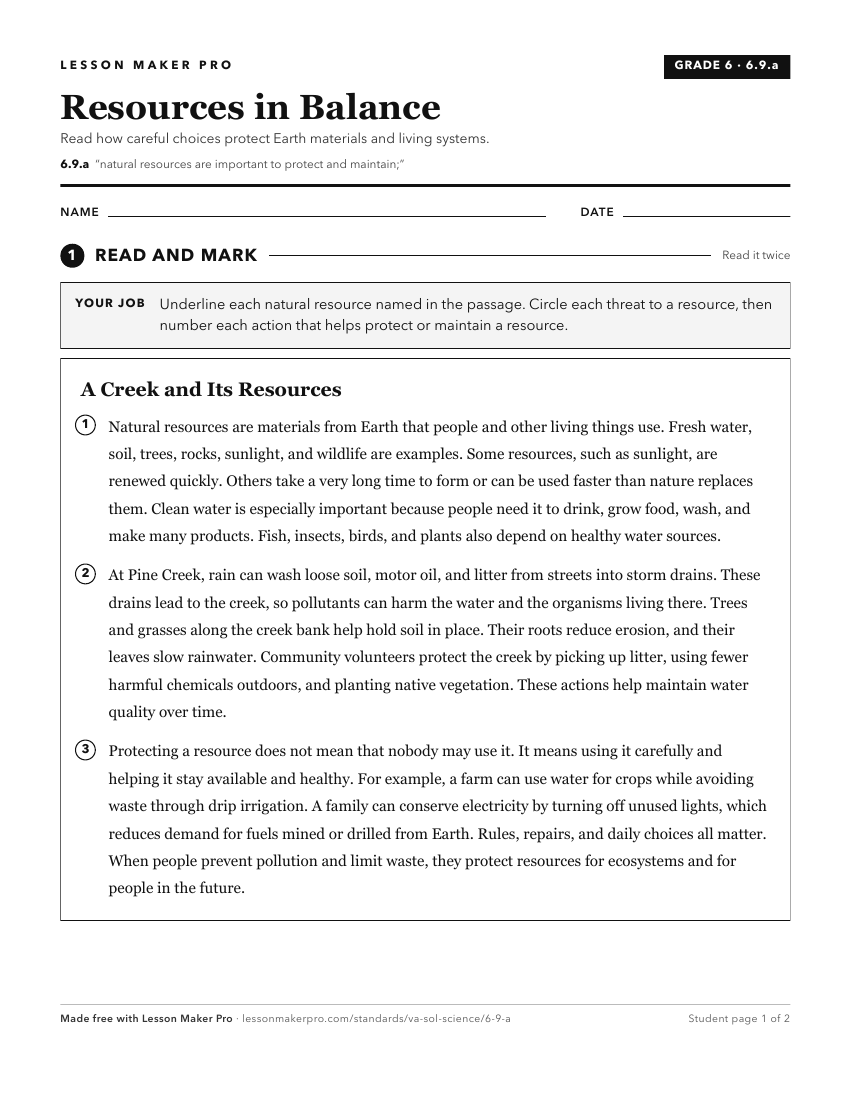
A ready-to-print activity worksheet aligned to 6.9.a, with an answer key for the teacher on its own page. No account needed.
PDF, US Letter, prints cleanly in black and white.
Download the worksheetKeep exploring
Related Standards
Turn this exact standard into a lesson
Grade, subject, topic, and the complete standard are prefilled. Create one free, no account needed.
Also for this standard:Make a WorksheetMake a QuizMake a Sub Lesson