Virginia SOL 6.2
SOL Standard (Key Ideas Cluster)
The student will investigate and understand that the solar system is organized and the various bodies in the solar system interact. Key ideas include matter is distributed throughout the solar system; planets have different sizes and orbit at different distances from the sun; gravity contributes to orbital motion; and the understanding of the solar system has developed over time.
Virginia Standards of Learning for Science
Cluster contents
Key Ideas in This Standard
6.2 is a Standards of Learning science standard. These are the key ideas and practices under it.
Teacher's field guide
What This Cluster Means
What Students Need to Do
- Students identify the major bodies and matter found across the solar system. They compare planet sizes and distances from the Sun using data and models. They explain orbital motion and describe how new evidence changed earlier models.
What Mastery Looks Like
- Students can order planets by diameter and average distance from the Sun. They can classify moons, asteroids, comets, dust, and gas. They can explain an orbit using gravity and forward motion, then cite evidence that revised earlier ideas.
Common Misconceptions
- Students often treat textbook diagrams as accurate scales and assume planets are evenly spaced. They may think gravity pushes planets around the Sun or that orbiting objects have no forward motion. Some think scientific models change because of opinion rather than new evidence.
How to Assess It
- Exit ticket: Draw the Sun, Earth, Jupiter, and the asteroid belt with correct order and relative size. Add arrows showing Earth's motion and the Sun's gravitational pull, then name one observation that changed an earlier model.
Lesson moves
Ways to Teach It
Use clay to build planet-size models, then place labeled cards along a measured hallway using a separate distance scale.
Discuss: If the Sun's gravity pulls Earth inward, why does Earth not fall straight into the Sun?
Race teams to sort cards for planets, moons, asteroids, comets, dust, and gas by type, location, and composition clues.
Compare early telescope sketches of Jupiter's moons with current NASA images, then explain how better tools changed solar system models.
Free download
Printable 6.2 Worksheet
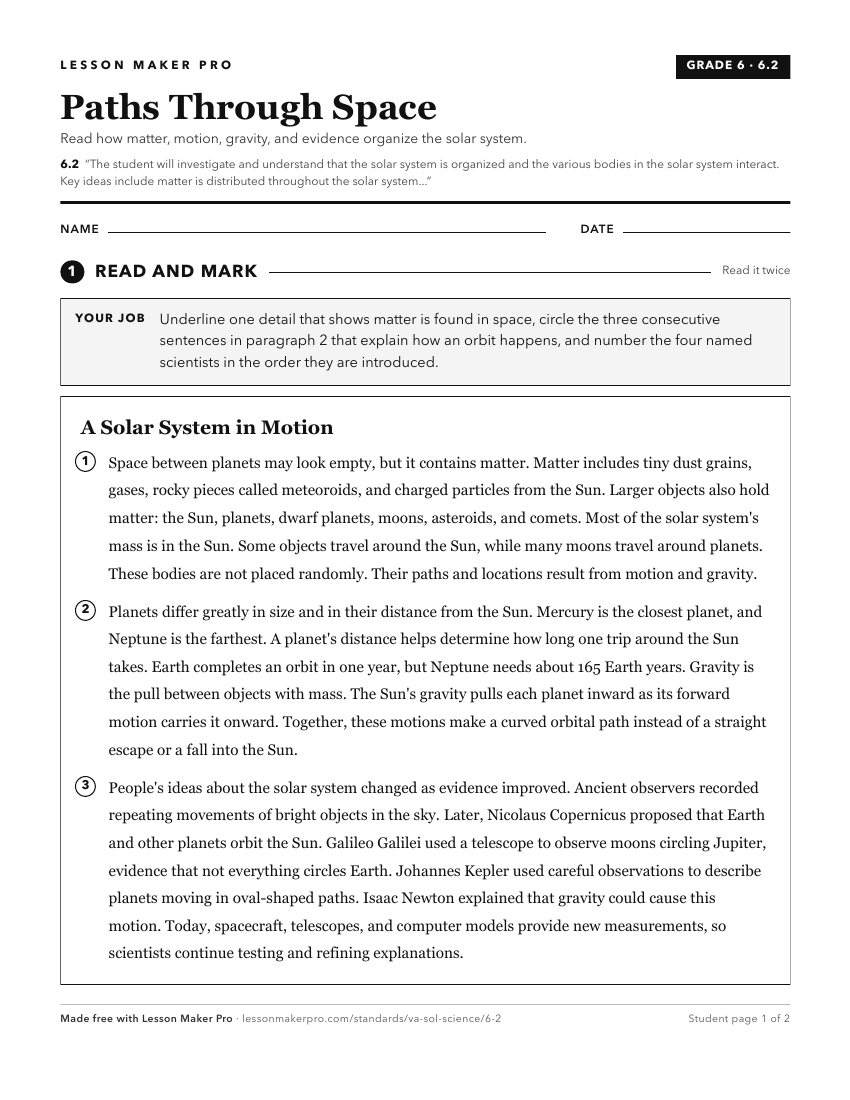
A ready-to-print activity worksheet aligned to 6.2, with an answer key for the teacher on its own page. No account needed.
PDF, US Letter, prints cleanly in black and white.
Download the worksheetKeep exploring
Related Standards
- 4.5
The student will investigate and understand that the planets have characteristics and a specific place in the solar system. Key ideas include
- 6.3
The student will investigate and understand that there is a relationship between the sun, Earth, and the moon. Key ideas include
- 1.6
The student will investigate and understand that there is a relationship between the sun and Earth. Key ideas include
- 4.6
The student will investigate and understand that there are relationships among Earth, the moon, and the sun. Key relationships include
Turn this cluster into a lesson
Grade, subject, topic, and the complete cluster are prefilled. Create one free, no account needed.
Also for this cluster:Make a WorksheetMake a QuizMake a Sub Lesson