Virginia SOL 6.3
SOL Standard (Key Ideas Cluster)
The student will investigate and understand that there is a relationship between the sun, Earth, and the moon. Key ideas include Earth has unique properties; the rotation of Earth in relationship to the sun causes day and night; the movement of Earth and the moon in relationship to the sun causes phases of the moon; Earth’s tilt as it revolves around the sun causes the seasons; and the relationship between Earth and the moon is the primary cause of tides.
Virginia Standards of Learning for Science
Cluster contents
Key Ideas in This Standard
6.3 is a Standards of Learning science standard. These are the key ideas and practices under it.
- 6.3.a
Earth has unique properties
- 6.3.b
the rotation of Earth in relationship to the sun causes day and night
- 6.3.c
the movement of Earth and the moon in relationship to the sun causes phases of the moon
- 6.3.d
Earth's tilt as it revolves around the sun causes the seasons
- 6.3.e
the relationship between Earth and the moon is the primary cause of tides.
Teacher's field guide
What This Cluster Means
What Students Need to Do
- Students identify properties that make Earth able to support life, including liquid water, a protective atmosphere, and suitable temperatures. They use models to explain day and night, moon phases, seasons, and tides. They connect each pattern to a specific motion, tilt, or gravitational pull.
What Mastery Looks Like
- Students can interpret or create sun, Earth, and moon diagrams and explain the pattern shown. They correctly link Earth’s rotation to day and night, Earth’s tilt and revolution to seasons, and the moon’s gravity to tides.
Common Misconceptions
- Students often think Earth’s shadow causes moon phases, seasons result from changing distance from the sun, or the sun moves around Earth each day. They may also think tides are caused only by waves or wind rather than mostly by the moon’s gravity.
How to Assess It
- Give students four small diagrams showing day and night, a moon phase, a season, and a tidal bulge. Ask them to label each and write one sentence explaining its cause.
Lesson moves
Ways to Teach It
Use a lamp, tilted globe, foam moon, and clay ocean ring to model day, seasons, phases, and tidal bulges.
Write which position or motion causes day and night, moon phases, seasons, and tides, then defend each answer with a diagram.
Play a cause-and-effect card match using terms, diagrams, and outcomes, then correct mismatches with a partner.
Compare a local tide table, daylight chart, and moon calendar, then identify patterns linked to Earth and moon movements.
Free download
Printable 6.3 Worksheet
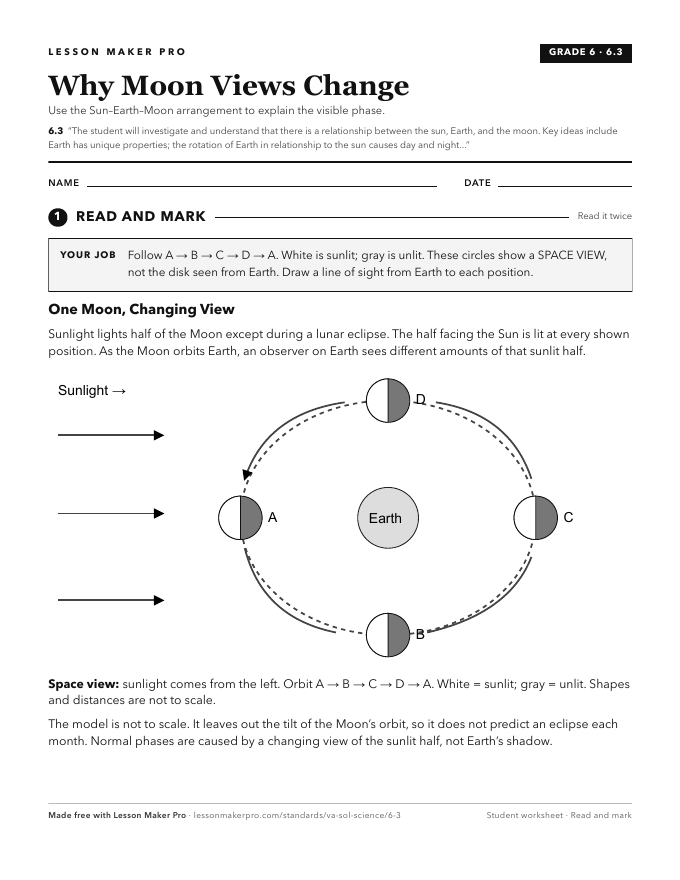
A ready-to-print activity worksheet aligned to 6.3, with an answer key for the teacher on its own page. No account needed.
PDF, US Letter, prints cleanly in black and white.
Download the worksheetKeep exploring
Related Standards
- 6.2
The student will investigate and understand that the solar system is organized and the various bodies in the solar system interact. Key ideas include
- 4.5
The student will investigate and understand that the planets have characteristics and a specific place in the solar system. Key ideas include
- 1.6
The student will investigate and understand that there is a relationship between the sun and Earth. Key ideas include
- 4.6
The student will investigate and understand that there are relationships among Earth, the moon, and the sun. Key relationships include
Turn this cluster into a lesson
Grade, subject, topic, and the complete cluster are prefilled. Create one free, no account needed.
Also for this cluster:Make a WorksheetMake a QuizMake a Sub Lesson