Virginia SOL 6.3.d
The Standard
- 6.3
- The student will investigate and understand that there is a relationship between the sun, Earth, and the moon. Key ideas include
Earth’s tilt as it revolves around the sun causes the seasons
Virginia Standards of Learning for Science
Teacher's field guide
What This Standard Means
What Students Need to Do
- Students explain how Earth’s tilted axis changes sunlight angle and day length during its orbit. They use models or diagrams to identify seasons in each hemisphere.
What Mastery Looks Like
- Students correctly identify the season shown at several points in Earth’s orbit. They explain that direct sunlight and longer days produce warmer seasons, not Earth’s distance from the sun.
Common Misconceptions
- Students may think seasons happen because Earth moves closer to or farther from the sun. They may also think both hemispheres have the same season or that Earth’s tilt changes direction during its orbit.
How to Assess It
- Give students an orbit diagram with Earth’s axis tilted toward the sun. Ask them to name the season in each hemisphere and explain their answer using sunlight angle and day length.
Lesson moves
Ways to Teach It
Use a lamp and tilted globe to track sunlight angle and day length at four positions around an orbit.
Write why Virginia and Australia have opposite seasons, using the words tilt, sunlight angle, and day length.
Sort season cards onto four orbit positions, then earn a point by defending each placement with evidence.
Compare local sunrise and sunset times from January and June, then connect the daylight difference to seasonal temperatures.
Free download
Printable 6.3.d Worksheet
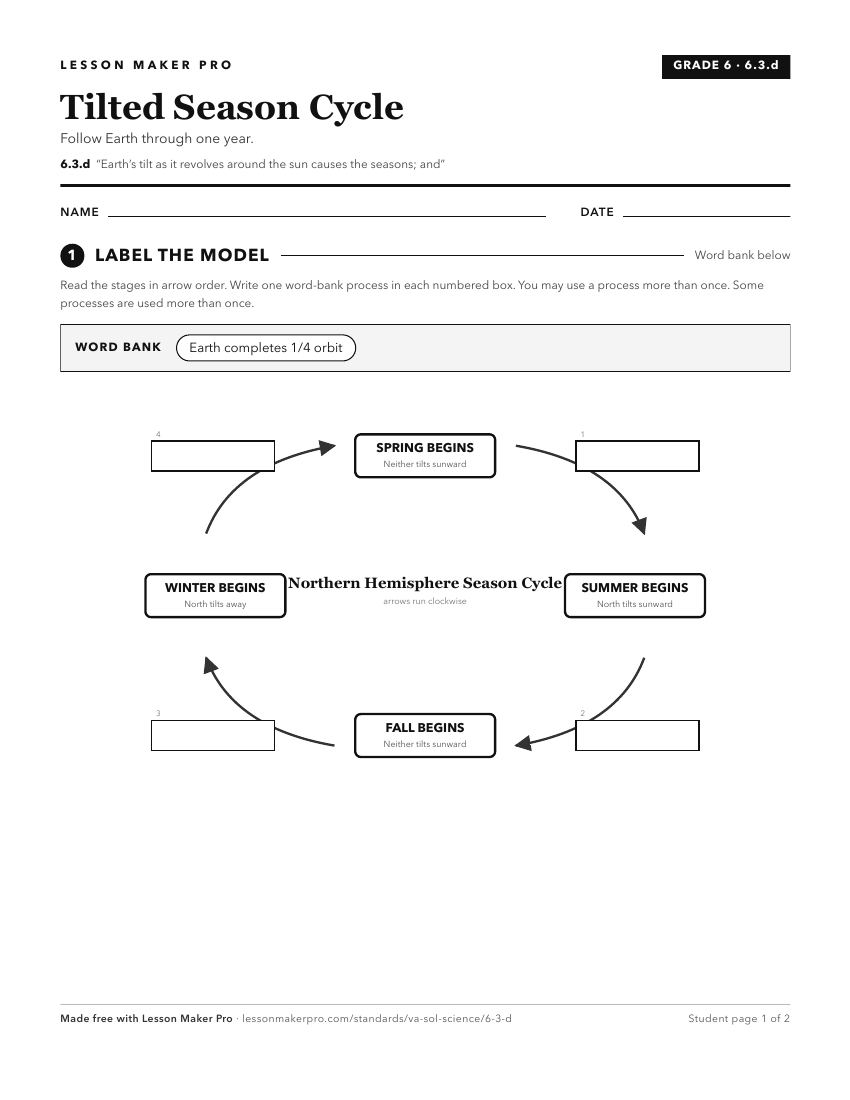
A ready-to-print activity worksheet aligned to 6.3.d, with an answer key for the teacher on its own page. No account needed.
PDF, US Letter, prints cleanly in black and white.
Download the worksheetKeep exploring
Related Standards
Turn this exact standard into a lesson
Grade, subject, topic, and the complete standard are prefilled. Create one free, no account needed.
Also for this standard:Make a WorksheetMake a QuizMake a Sub Lesson