Virginia SOL 6.3.b
The Standard
- 6.3
- The student will investigate and understand that there is a relationship between the sun, Earth, and the moon. Key ideas include
the rotation of Earth in relationship to the sun causes day and night
Virginia Standards of Learning for Science
Teacher's field guide
What This Standard Means
What Students Need to Do
- Students model Earth spinning on its axis while sunlight reaches only half the planet. They explain how a location moves into light and then into darkness during one rotation.
What Mastery Looks Like
- Students correctly identify which side of a model is experiencing daylight and which is experiencing night. They can predict how conditions change as a marked location rotates toward or away from the Sun.
Common Misconceptions
- Students may think the Sun travels around Earth each day or that Earth’s orbit causes the daily light and dark cycle. They may also think the whole planet experiences daytime at once.
How to Assess It
- Give students a diagram of Earth lit from one side, with four labeled locations. Ask which locations have day or night and what will happen as Earth rotates.
Lesson moves
Ways to Teach It
Shine a flashlight on a globe, mark your town with clay, and rotate the globe to track light and darkness.
Ask students to write why sunrise appears to move across the sky even though Earth is the object rotating.
Give pairs position cards labeled dawn, noon, dusk, and midnight, then have them place each card correctly around a lit globe.
Use a world clock to compare local times in four cities, then connect each time to the city’s position in sunlight or darkness.
Free download
Printable 6.3.b Worksheet
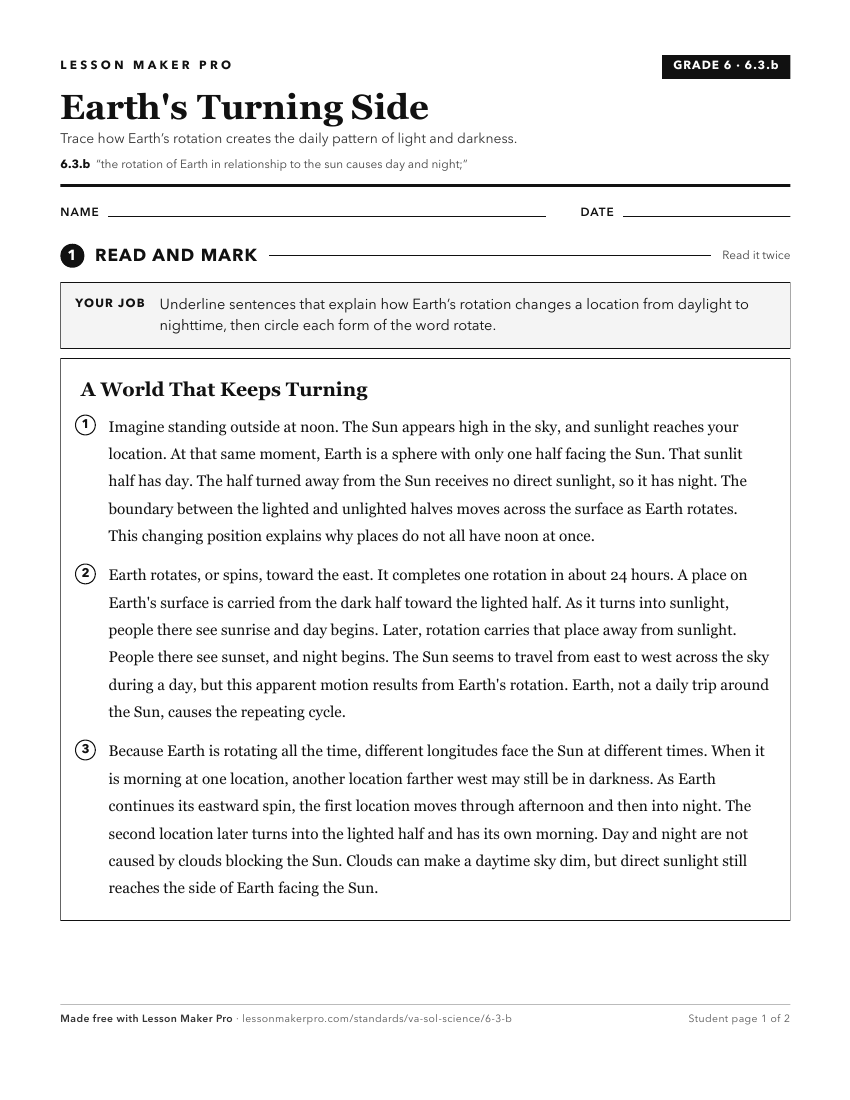
A ready-to-print activity worksheet aligned to 6.3.b, with an answer key for the teacher on its own page. No account needed.
PDF, US Letter, prints cleanly in black and white.
Download the worksheetKeep exploring
Related Standards
Turn this exact standard into a lesson
Grade, subject, topic, and the complete standard are prefilled. Create one free, no account needed.
Also for this standard:Make a WorksheetMake a QuizMake a Sub Lesson