Virginia SOL 1.6.b
The Standard
- 1.6
- The student will investigate and understand that there is a relationship between the sun and Earth. Key ideas include
the sun’s relative position changes in the Earth’s sky throughout the day.
Virginia Standards of Learning for Science
Teacher's field guide
What This Standard Means
What Students Need to Do
- Students observe where the sun appears in the sky at different times of day. They compare its location with fixed objects and describe the pattern.
What Mastery Looks Like
- Students can sequence pictures of the sun from morning, midday, and late afternoon. They can explain that its position appears to change as the day passes.
Common Misconceptions
- Students may think the sun stays directly overhead all day or moves randomly. They may also confuse changes in position with changes in the sun’s size.
How to Assess It
- Give students three sky pictures labeled morning, midday, and late afternoon. Ask them to draw the sun in a likely position in each picture.
Lesson moves
Ways to Teach It
Mark a playground observation spot, then sketch the sun’s location relative to a tree or building three times during the day.
Ask students to write or discuss: How does the sun’s place in the sky look different before lunch and after lunch?
Give pairs morning, midday, and afternoon sun cards to sequence, then have them explain the order using position words.
Compare where sunlight enters a classroom window in the morning and afternoon, using sticky notes to mark the bright areas.
Free download
Printable 1.6.b Worksheet
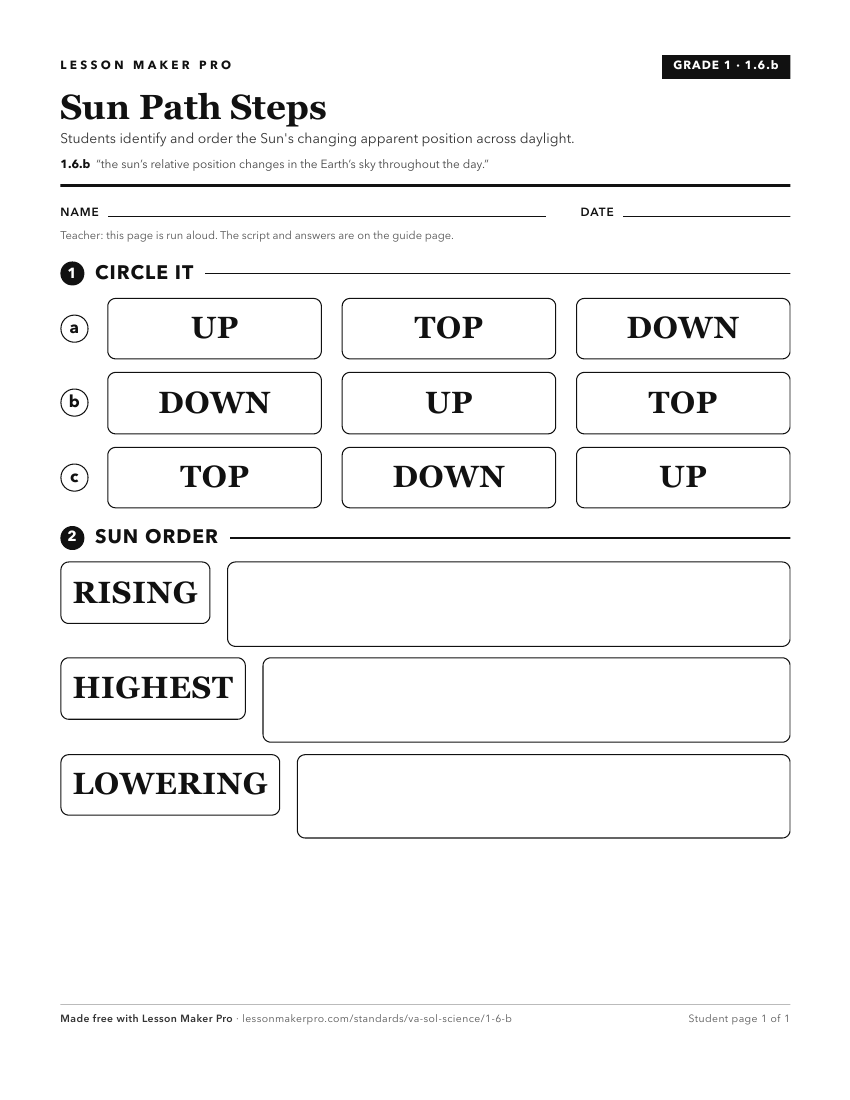
A ready-to-print activity worksheet aligned to 1.6.b, with an answer key for the teacher on its own page. No account needed.
PDF, US Letter, prints cleanly in black and white.
Download the worksheetKeep exploring
Related Standards
- 4.6.d
the relative size, position, age and makeup of Earth, the moon, and the sun.
- 6.3.c
the movement of Earth and the moon in relationship to the sun causes phases of the moon
- 6.3.b
the rotation of Earth in relationship to the sun causes day and night
- 1.6
The student will investigate and understand that there is a relationship between the sun and Earth. Key ideas include
Turn this exact standard into a lesson
Grade, subject, topic, and the complete standard are prefilled. Create one free, no account needed.
Also for this standard:Make a WorksheetMake a QuizMake a Sub Lesson