Virginia SOL 4.6.b
The Standard
- 4.6
- The student will investigate and understand that there are relationships among Earth, the moon, and the sun. Key relationships include
the causes for Earth’s seasons
Virginia Standards of Learning for Science
Teacher's field guide
What This Standard Means
What Students Need to Do
- Students explain how Earth’s tilted axis and yearly movement around the Sun produce seasons. They connect each season to sunlight angle and length of daylight.
What Mastery Looks Like
- Students can identify the season shown in an Earth-Sun diagram and justify their answer using axis tilt. They can explain why the hemispheres experience opposite seasons.
Common Misconceptions
- Students often think summer occurs because Earth is closer to the Sun. They may think the axis changes its tilt during the year. They may also confuse Earth’s daily rotation with its yearly revolution.
How to Assess It
- On an exit ticket, have students draw Earth at one point in its orbit, label the season in each hemisphere, and explain both labels.
Lesson moves
Ways to Teach It
Tilt a globe toward a lamp, move it through four orbital positions, and record which hemisphere receives more direct light.
Write two sentences explaining why Virginia has summer when the Northern Hemisphere tilts toward the Sun, using “direct sunlight” and “daylight.”
Match season cards to four Earth position diagrams, then defend each match to a partner using axis tilt and sunlight clues.
Compare monthly daylight and temperature data for Richmond, then connect the pattern to Earth’s changing position around the Sun.
Free download
Printable 4.6.b Worksheet
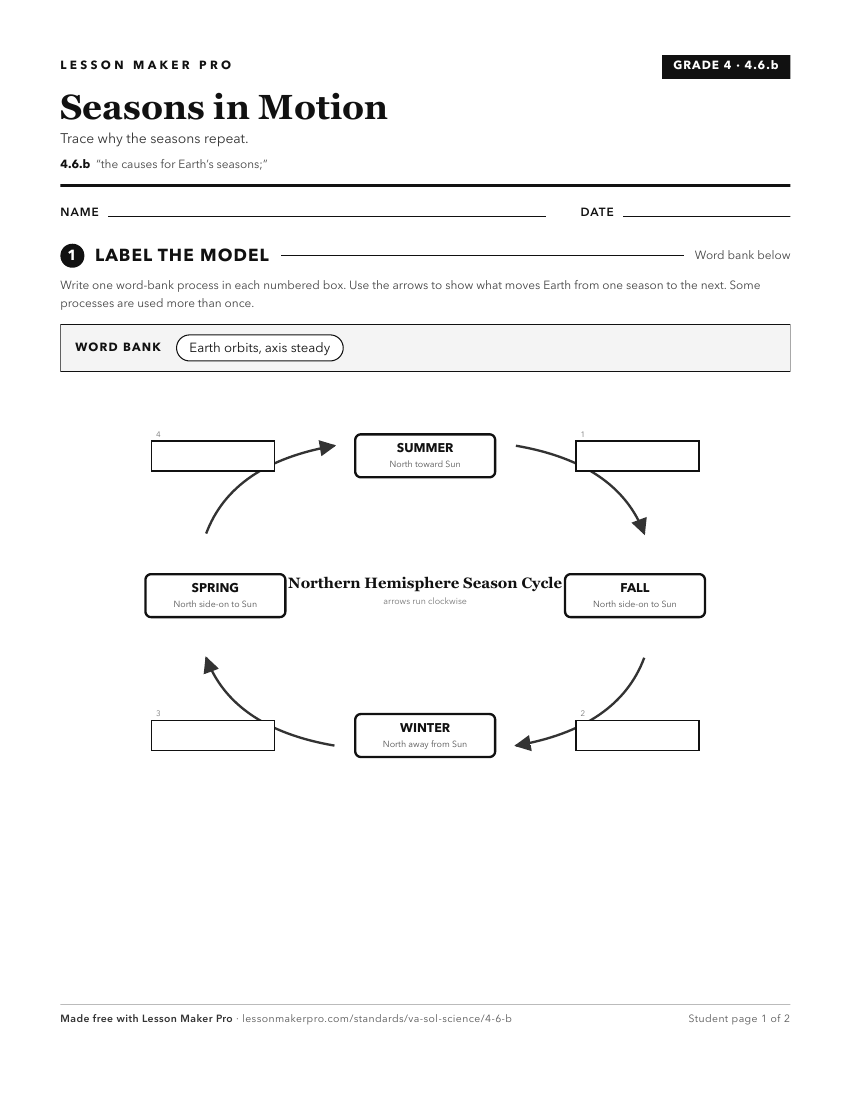
A ready-to-print activity worksheet aligned to 4.6.b, with an answer key for the teacher on its own page. No account needed.
PDF, US Letter, prints cleanly in black and white.
Download the worksheetKeep exploring
Related Standards
Turn this exact standard into a lesson
Grade, subject, topic, and the complete standard are prefilled. Create one free, no account needed.
Also for this standard:Make a WorksheetMake a QuizMake a Sub Lesson