Virginia SOL 4.6
SOL Standard (Key Ideas Cluster)
The student will investigate and understand that there are relationships among Earth, the moon, and the sun. Key relationships include the motions of Earth, the moon, and the sun; the causes for Earth’s seasons; the causes for the four major phases of the moon and the relationship to the tide cycles; and the relative size, position, age and makeup of Earth, the moon, and the sun.
Virginia Standards of Learning for Science
Cluster contents
Key Ideas in This Standard
4.6 is a Standards of Learning science standard. These are the key ideas and practices under it.
Teacher's field guide
What This Cluster Means
What Students Need to Do
- Students use models and diagrams to track Earth's rotation and orbit, the Moon's orbit, and their changing positions around the Sun. They explain seasons using Earth's tilt, phases using the Moon's sunlit half, and tides using gravity. They compare each body's size, location, age, and material.
What Mastery Looks Like
- A student can use a model to explain seasons and predict the four major Moon phases. The student connects new and full moons with larger tidal ranges, and quarter moons with smaller ranges. The student accurately compares the rocky Earth and Moon with the larger, older Sun made of hot gases.
Common Misconceptions
- Students often say seasons happen because Earth moves closer to or farther from the Sun. They may call Moon phases Earth's shadow or think the Moon makes its own light. They may assume tides occur once daily or that all three bodies are similar in size and makeup.
How to Assess It
- Give a two-panel exit ticket showing Earth’s tilted axis as Earth orbits the Sun, alongside four Moon positions. Ask students to circle Northern Hemisphere summer, label each major Moon phase, and explain one related tide pattern.
Lesson moves
Ways to Teach It
Darken the room, then use a lamp, globe, and foam ball to model Earth's tilt and observe the Moon's lit half from Earth.
Ask students to write why summer is not caused by Earth being closer to the Sun, using tilt and sunlight angle.
Run a card-sort relay matching diagrams to rotation, revolution, seasons, Moon phases, spring tides, and neap tides.
Give pairs a local seven-day tide table to mark repeating highs and lows, then connect the pattern to Moon positions.
Free download
Printable 4.6 Worksheet
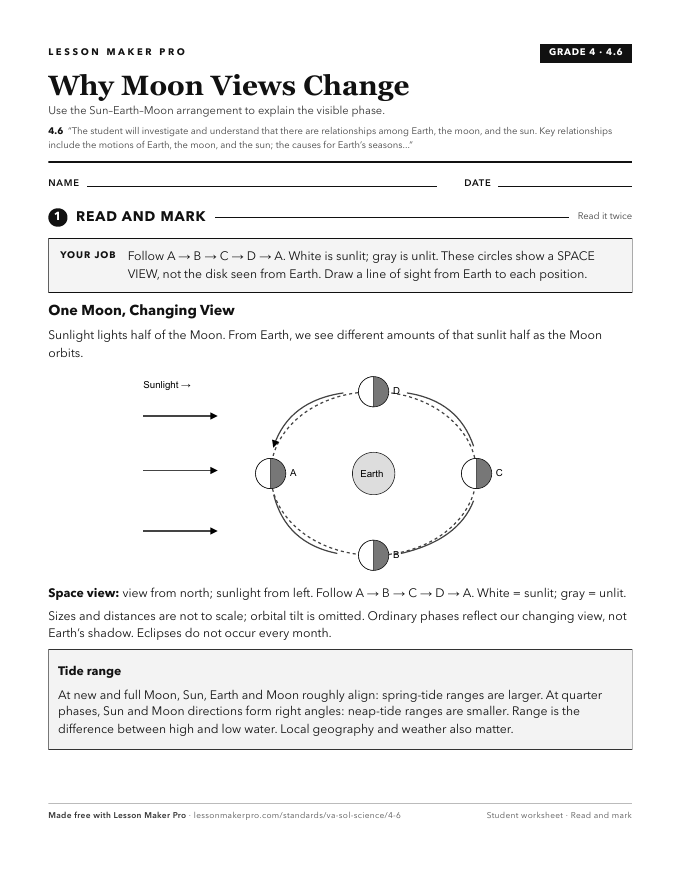
A ready-to-print activity worksheet aligned to 4.6, with an answer key for the teacher on its own page. No account needed.
PDF, US Letter, prints cleanly in black and white.
Download the worksheetKeep exploring
Related Standards
- 6.2
The student will investigate and understand that the solar system is organized and the various bodies in the solar system interact. Key ideas include
- 4.5
The student will investigate and understand that the planets have characteristics and a specific place in the solar system. Key ideas include
- 6.3
The student will investigate and understand that there is a relationship between the sun, Earth, and the moon. Key ideas include
- 1.6
The student will investigate and understand that there is a relationship between the sun and Earth. Key ideas include
Turn this cluster into a lesson
Grade, subject, topic, and the complete cluster are prefilled. Create one free, no account needed.
Also for this cluster:Make a WorksheetMake a QuizMake a Sub Lesson