Virginia SOL 6.2.b
The Standard
- 6.2
- The student will investigate and understand that the solar system is organized and the various bodies in the solar system interact. Key ideas include
planets have different sizes and orbit at different distances from the sun
Virginia Standards of Learning for Science
Teacher's field guide
What This Standard Means
What Students Need to Do
- Students compare the eight planets using diameter and average orbital distance. They order planets from data and explain why size and distance models may use separate scales.
What Mastery Looks Like
- A student can correctly rank planets by diameter and by average distance from the Sun. They can use measurements to compare two planets without relying on a diagram’s appearance.
Common Misconceptions
- Students may think larger planets are always farther from the Sun. They often assume solar system diagrams show accurate sizes and spacing. Some confuse a planet’s diameter with its orbital distance.
How to Assess It
- Ask students to order Earth, Jupiter, Mars, and Neptune by diameter, then by average distance from the Sun. Have them explain why the lists differ.
Lesson moves
Ways to Teach It
Make clay planets from a diameter scale, then place labeled orbit markers along a hallway using a separate distance scale.
Show a typical solar system diagram and ask, "What does this picture show accurately, and what does it distort?"
Give pairs planet cards with diameter and orbital-distance data, then race to sort each set from least to greatest.
Use NASA fact sheets to compare Earth-to-Mars and Earth-to-Neptune mission distances, then explain why spacecraft travel plans differ.
Free download
Printable 6.2.b Worksheet
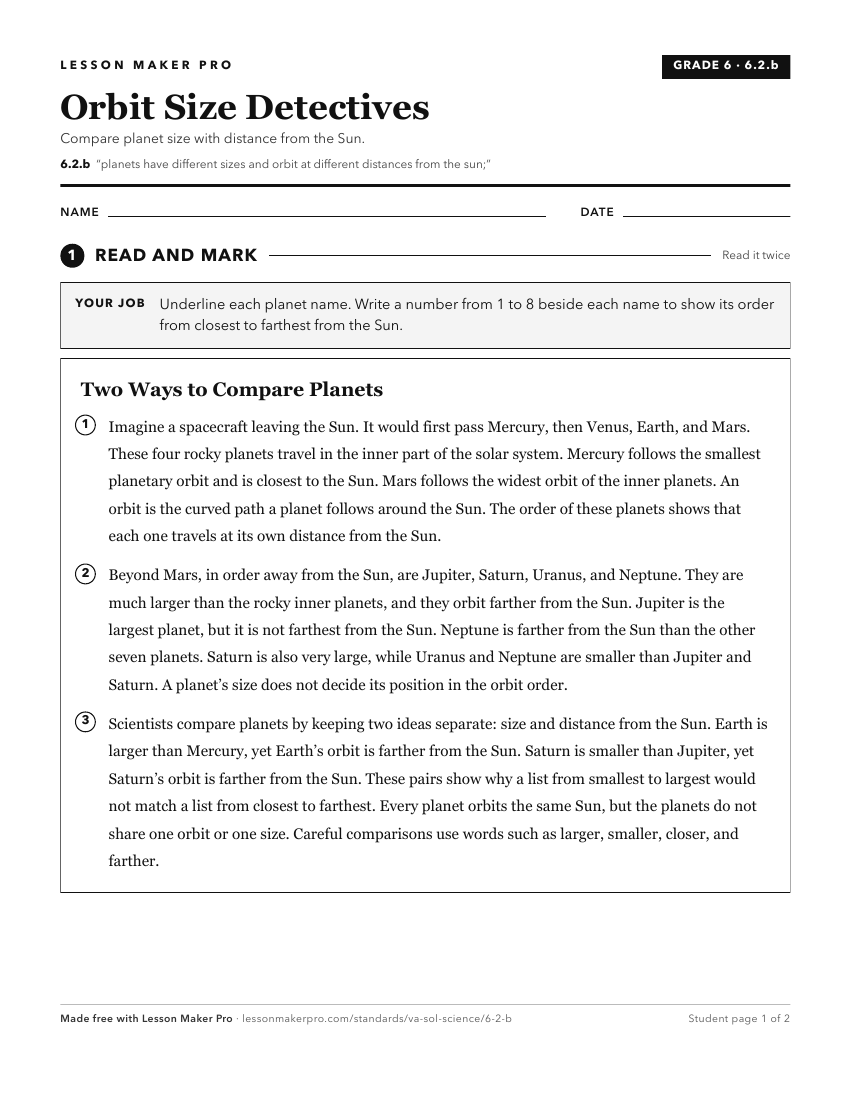
A ready-to-print activity worksheet aligned to 6.2.b, with an answer key for the teacher on its own page. No account needed.
PDF, US Letter, prints cleanly in black and white.
Download the worksheetKeep exploring
Related Standards
- 4.5
The student will investigate and understand that the planets have characteristics and a specific place in the solar system. Key ideas include
- 4.5.b
planets have characteristics and a specific order in the solar system
- 4.5.a
planets rotate on their axes and revolve around the sun
- 4.5.c
the sizes of the sun and planets can be compared to one another.
Turn this exact standard into a lesson
Grade, subject, topic, and the complete standard are prefilled. Create one free, no account needed.
Also for this standard:Make a WorksheetMake a QuizMake a Sub Lesson