Virginia SOL 6.2.c
The Standard
- 6.2
- The student will investigate and understand that the solar system is organized and the various bodies in the solar system interact. Key ideas include
gravity contributes to orbital motion
Virginia Standards of Learning for Science
Teacher's field guide
What This Standard Means
What Students Need to Do
- Students explain why planets, moons, and satellites follow curved paths rather than moving straight through space. They connect an inward gravitational pull with forward motion to describe an orbit.
What Mastery Looks Like
- Given an orbit diagram, students can draw the direction of motion and the inward force at several points. They can predict that an object would move along a straight path if the inward pull disappeared.
Common Misconceptions
- Students may think there is no gravity in space or that orbiting objects have escaped gravity. They may also think gravity pushes objects forward or should make them fall straight into the larger body.
How to Assess It
- Give students a satellite orbit diagram and ask them to draw force and motion arrows, then explain why the satellite does not travel straight.
Lesson moves
Ways to Teach It
Swing a foam ball on a string, then release it and observe how its path changes when the inward pull stops.
Write a two-sentence response to this prompt: Why does the Moon keep moving around Earth instead of traveling straight away?
Play Orbit Match by pairing cards showing force arrows, motion arrows, and the resulting path around a planet.
Use an image of a weather satellite to explain how its forward motion and Earth's pull keep it circling the planet.
Free download
Printable 6.2.c Worksheet
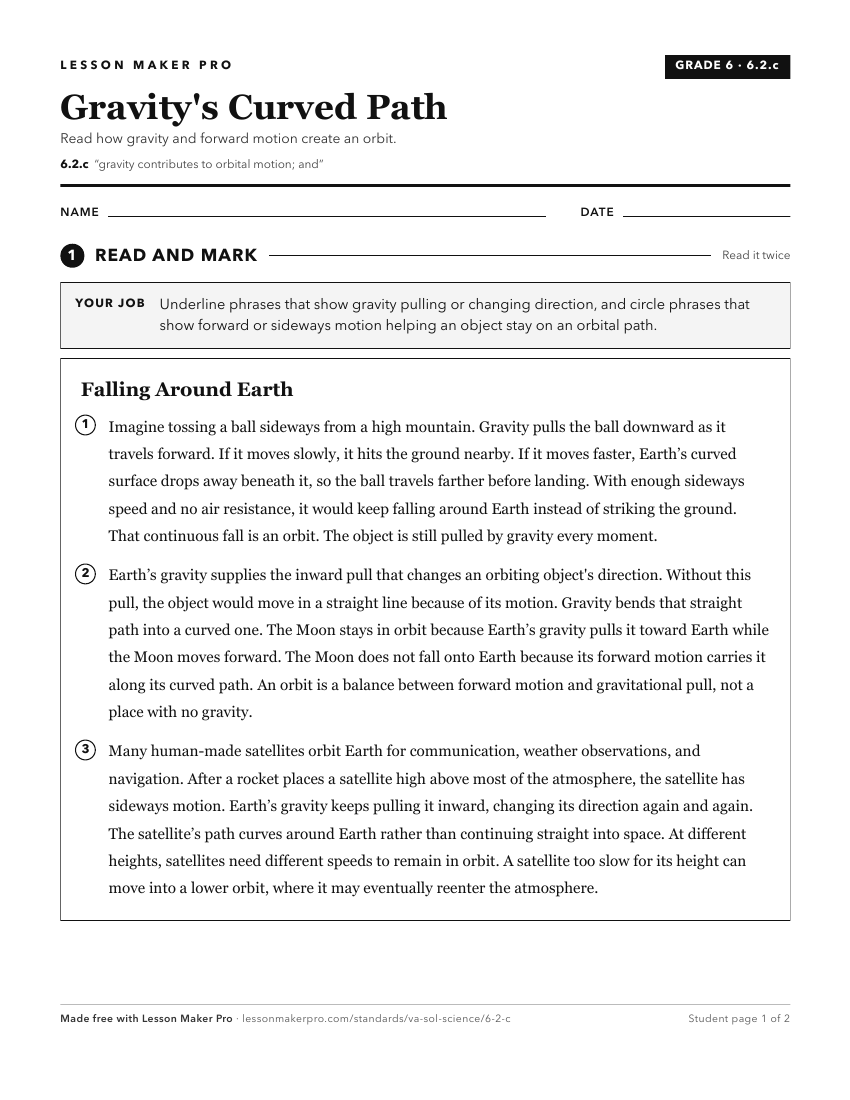
A ready-to-print activity worksheet aligned to 6.2.c, with an answer key for the teacher on its own page. No account needed.
PDF, US Letter, prints cleanly in black and white.
Download the worksheetKeep exploring
Related Standards
Turn this exact standard into a lesson
Grade, subject, topic, and the complete standard are prefilled. Create one free, no account needed.
Also for this standard:Make a WorksheetMake a QuizMake a Sub Lesson