Virginia SOL 6.NS.1
SOL Standard (Knowledge and Skills Cluster)
The student will reason and use multiple strategies to express equivalency, compare, and order numbers written as fractions, mixed numbers, decimals, and percents.
Virginia Standards of Learning for Mathematics
Cluster contents
Knowledge and Skills in This Standard
6.NS.1 is a Standards of Learning standard. These are the knowledge and skills expectations under it.
- 6.NS.1.a
Estimate and determine the percent represented by a given model (e.g., number line, picture, verbal description), including percents greater than 100% and less ...
- 6.NS.1.b
Represent and determine equivalencies among decimals (through the thousandths place) and percents incorporating the use of number lines, and concrete and pictor...
- 6.NS.1.c
Represent and determine equivalencies among fractions (proper or improper) and mixed numbers that have denominators that are 12 or less or factors of 100 and pe...
- 6.NS.1.d
Represent and determine equivalencies among decimals, percents, fractions (proper or improper), and mixed numbers that have denominators that are 12 or less or ...
- 6.NS.1.e
Use multiple strategies (e.g., benchmarks, number line, equivalency) to compare and order no more than four positive rational numbers expressed as fractions (pr...
Teacher's field guide
What This Cluster Means
What Students Need to Do
- Students rewrite positive rational numbers in equivalent fraction, mixed number, decimal, and percent forms. They estimate and find percents shown by models, including values above 100% and below 1%. They compare and order up to four values, then explain their reasoning with benchmarks, equivalent forms, or models.
What Mastery Looks Like
- A student can convert among proper fractions, improper fractions, mixed numbers, decimals, and percents, then place equivalent values at the same point on a number line. They can order up to four values and justify the order using benchmarks, equivalent forms, or a model.
Common Misconceptions
- Students may treat 0.35 as 0.35% instead of 35%, or move the decimal in the wrong direction. They often compare fractions by denominator size alone or compare unlike forms without converting. They may assume a percent cannot exceed 100% or be less than 1%.
How to Assess It
- Exit ticket: A diagram shows one full 100-square grid shaded and 25 squares on a second grid. Write the amount as a mixed number, decimal, and percent, then order it with 1.2 and 130% and justify.
Lesson moves
Ways to Teach It
Build values with fraction strips and 100 grids, then place matching fraction, decimal, and percent cards on a floor number line.
Write two ways to decide whether 7/8 or 86% is greater, then compare your reasoning with a partner.
Play a card-sort race: match equivalent fractions, mixed numbers, decimals, and percents, then order each matched set from least to greatest.
Analyze a factory report with 0.5% defects and 125% of target output, then show both values on double number lines.
Free download
Printable 6.NS.1 Worksheet
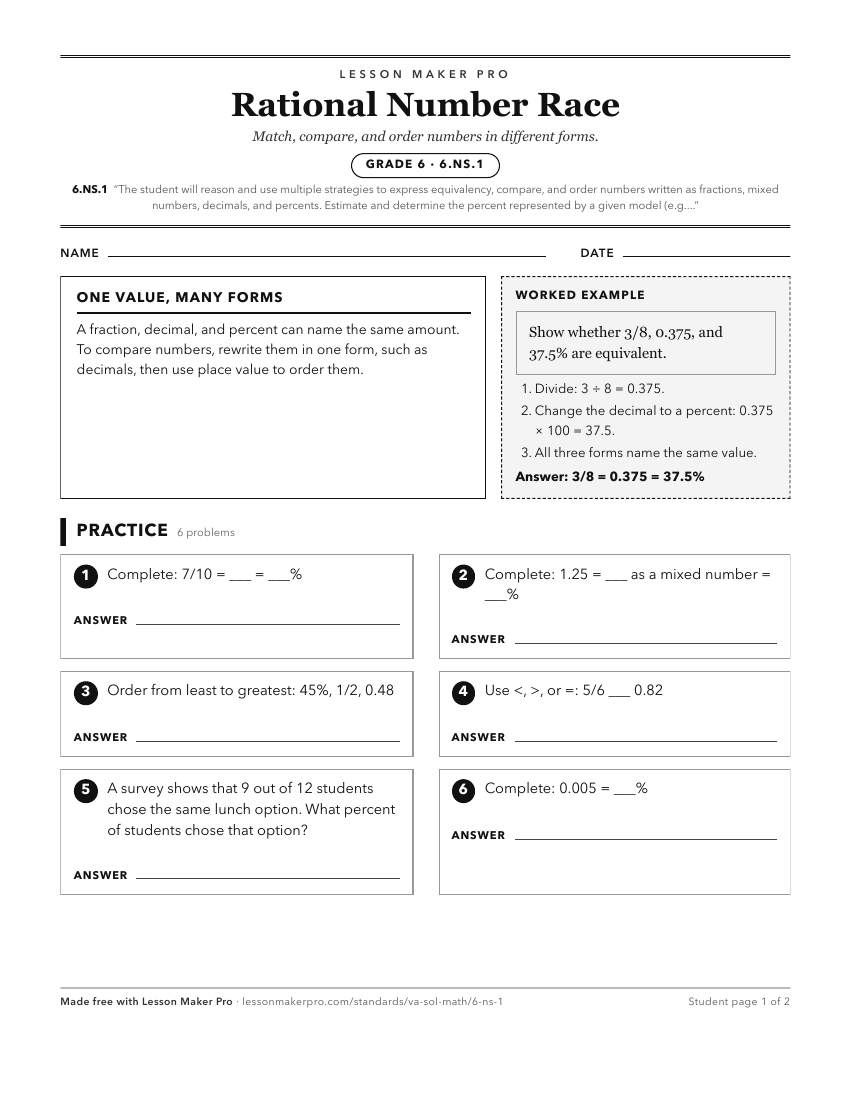
A ready-to-print activity worksheet aligned to 6.NS.1, with an answer key for the teacher on its own page. No account needed.
PDF, US Letter, prints cleanly in black and white.
Download the worksheetKeep exploring
Related Standards
- 5.NS.1
The student will use reasoning and justification to identify and represent equivalency between fractions (with denominators that are thirds, eighths, and factor...
- 7.NS.2
The student will reason and use multiple strategies to compare and order rational numbers.
- 6.NS.2
The student will reason and use multiple strategies to represent, compare, and order integers.
- 3.NS.3
The student will use mathematical reasoning and justification to represent and compare fractions (proper and improper) and mixed numbers with denominators of 2,...
Turn this cluster into a lesson
Grade, subject, topic, and the complete cluster are prefilled. Create one free, no account needed.
Also for this cluster:Make a WorksheetMake a QuizMake a Sub Lesson