Virginia SOL 3.NS.3
SOL Standard (Knowledge and Skills Cluster)
The student will use mathematical reasoning and justification to represent and compare fractions (proper and improper) and mixed numbers with denominators of 2, 3, 4, 5, 6, 8, and 10), including those in context.
Virginia Standards of Learning for Mathematics
Cluster contents
Knowledge and Skills in This Standard
3.NS.3 is a Standards of Learning standard. These are the knowledge and skills expectations under it.
- 3.NS.3.a.i
region/area models (e.g., pie pieces, pattern blocks, geoboards)
- 3.NS.3.a.ii
length models (e.g., paper fraction strips, fraction bars, rods, number lines)
- 3.NS.3.a.iii
set models (e.g., chips, counters, cubes).
- 3.NS.3.b
Identify a fraction represented by a model as the sum of unit fractions.
- 3.NS.3.c
Use a model of a fraction greater than one to count the fractional parts to name and write it as an improper fraction and as a mixed number (e.g., 1 4 , 2 4 , 3...
- 3.NS.3.d
Compose and decompose fractions (proper and improper) with denominators of 2, 3, 4, 5, 6, 8, and 10 in multiple ways (e.g., 7 4 = 4 4 + 3 4 or 4 6 = 3 6 + 1 6 =...
- 3.NS.3.e
Compare a fraction, less than or equal to one, to the benchmarks of 0, 1 2 , and 1 using area/region models, length models, and without models.
- 3.NS.3.f
Compare two fractions (proper or improper) and/or mixed numbers with like numerators of 2, 3, 4, 5, 6, 8, and 10 (e.g., 2 3 > 2 8 ) using words (greater than, l...
- 3.NS.3.g
Compare two fractions (proper or improper) and/or mixed numbers with like denominators of 2, 3, 4, 5, 6, 8, and 10 (e.g., 3 6 < 4 6 ) using words (greater than,...
- 3.NS.3.h
Represent equivalent fractions with denominators of 2, 3, 4, 5, 6, 8, or 10, using region/area models and length models.
Teacher's field guide
What This Cluster Means
What Students Need to Do
- Students represent proper fractions, improper fractions, and mixed numbers with area, length, and set models. They name fractions as sums of unit fractions, decompose them, and connect improper fractions to mixed numbers. They compare amounts using benchmarks, numerator or denominator patterns, models, words, and symbols, and show equivalent fractions.
What Mastery Looks Like
- Given 7/4, a student can build or draw seven fourths, write 1 3/4, and split it into valid sums. They correctly explain why 2/3 is greater than 2/8 and why 3/6 is less than 4/6. They can match equivalent area or length models, such as 1/2 and 4/8.
Common Misconceptions
- Students often think 3/8 is greater than 3/4 because 8 is larger. They may count shaded pieces while ignoring unequal parts or different-sized wholes. They may treat improper fractions as invalid or rename 7/4 as 1 7/4 instead of 1 3/4.
How to Assess It
- Exit ticket: Draw 7/4 on fraction bars, rename it, and decompose it two ways. Then shade an eighths strip equal to 1/2 and compare 3/8 with 1/2.
Lesson moves
Ways to Teach It
Give pairs fraction strips to build 7/4, rename it as a mixed number, and record two decompositions.
Ask students to explain why 3/4 is greater than 3/8 even though 8 is larger, using a labeled sketch.
Play Fraction Sort by placing cards below, at, or above 1/2, then matching cards that show equivalent amounts.
Use a recipe card to decide whether seven quarter-cups of oats equals 1 3/4 cups, then sketch the scoops.
Free download
Printable 3.NS.3 Worksheet
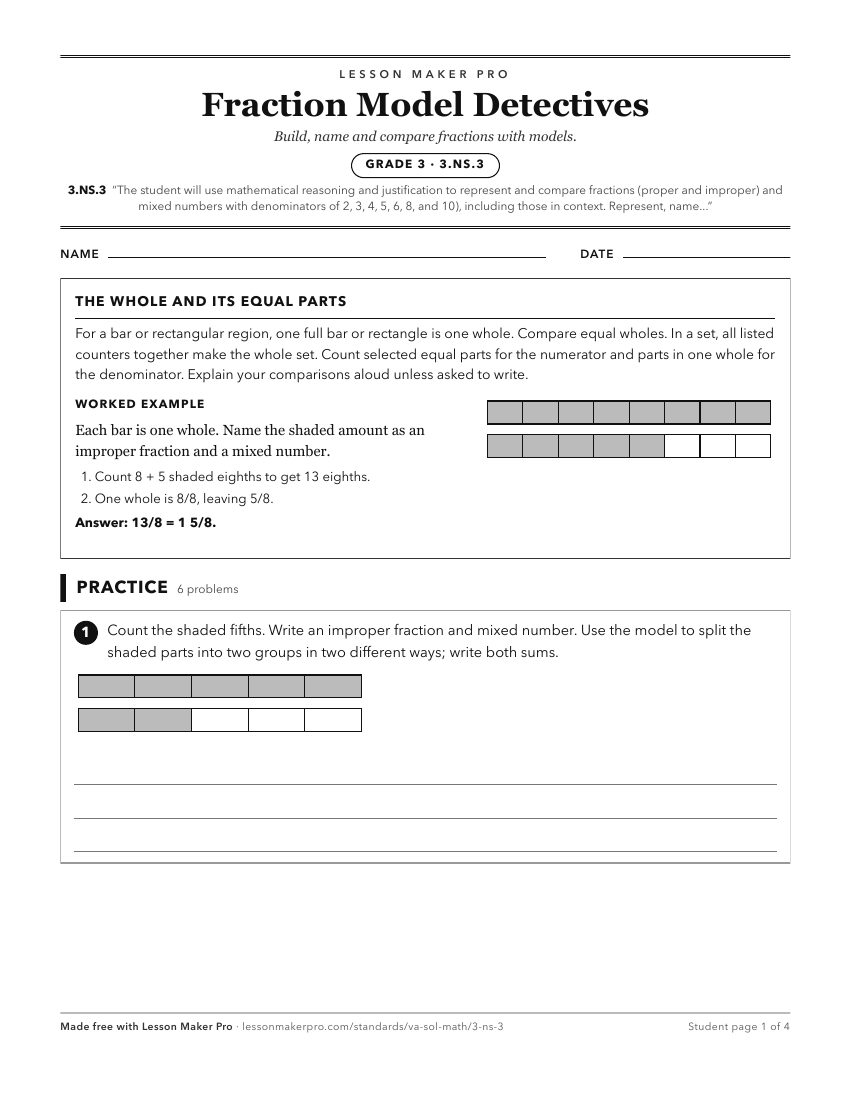
A ready-to-print activity worksheet aligned to 3.NS.3, with an answer key for the teacher on its own page. No account needed.
PDF, US Letter, prints cleanly in black and white.
Download the worksheetKeep exploring
Related Standards
- 6.NS.1
The student will reason and use multiple strategies to express equivalency, compare, and order numbers written as fractions, mixed numbers, decimals, and percen...
- 5.NS.1
The student will use reasoning and justification to identify and represent equivalency between fractions (with denominators that are thirds, eighths, and factor...
- 4.NS.3
The student will use mathematical reasoning and justification to represent, compare, and order fractions (proper, improper, and mixed numbers with denominators ...
- 6.CE.1
The student will estimate, demonstrate, solve, and justify solutions to problems using operations with fractions and mixed numbers, including those in context.
Turn this cluster into a lesson
Grade, subject, topic, and the complete cluster are prefilled. Create one free, no account needed.
Also for this cluster:Make a WorksheetMake a QuizMake a Sub Lesson