Virginia SOL 4.NS.3
SOL Standard (Knowledge and Skills Cluster)
The student will use mathematical reasoning and justification to represent, compare, and order fractions (proper, improper, and mixed numbers with denominators 12 or less), with and without models.
Virginia Standards of Learning for Mathematics
Cluster contents
Knowledge and Skills in This Standard
4.NS.3 is a Standards of Learning standard. These are the knowledge and skills expectations under it.
- 4.NS.3.a
Compare and order no more than four fractions (proper or improper), and/or mixed numbers, with like denominators by comparing the number of parts (numerators) u...
- 4.NS.3.b
Compare and order no more than four fractions (proper or improper), and/or mixed numbers, with like numerators and unlike denominators by comparing the size of ...
- 4.NS.3.c
Use benchmarks (e.g., 0, 1 2 , or 1) to compare and order no more than four fractions (proper or improper), and/or mixed numbers, with like and unlike denominat...
- 4.NS.3.d
Compare two fractions (proper or improper) and/or mixed numbers using fractions with denominators of 12 or less, using the symbols >, <, and = (e.g., 2 3 > 1 7 ...
- 4.NS.3.e
Represent equivalent fractions with denominators of 12 or less, with and without models.*
- 4.NS.3.f
Compose and decompose fractions (proper and improper) and/or mixed numbers with denominators of 12 or less, in multiple ways, with and without models.*
- 4.NS.3.g
Represent the division of two whole numbers as a fraction given a contextual situation and a model (e.g., 3 5 means the same as 3 divided by 5 or 3 5 represents...
Teacher's field guide
What This Cluster Means
What Students Need to Do
- Students show fractions and mixed numbers with drawings, number lines, symbols, and words. They compare and order up to four values using numerator size, part size, or benchmarks such as 0, 1/2, and 1. They also make equivalent forms, break fractions into sums, and connect equal sharing to division and fraction notation.
What Mastery Looks Like
- A student accurately orders proper fractions, improper fractions, and mixed numbers and uses >, <, or = correctly. The student explains a comparison with a model or benchmark, not just a memorized rule. The student can show equivalent forms, write fraction sums, and explain why 3 shared among 5 is 3/5.
Common Misconceptions
- Students often think a larger denominator means a larger fraction, even when numerators match. They may compare only the digits, treat every improper fraction as less than 1, or reverse < and >. Some see 3/5 only as three shaded fifths and do not connect it to 3 ÷ 5 or equal sharing.
How to Assess It
- Give this exit ticket: Order 3/4, 7/8, 1 1/4, and 9/8, then justify one comparison with a benchmark or sketch. Show two fractions equal to 2/3, decompose 7/4 two ways, and draw how three muffins shared by five children gives 3/5.
Lesson moves
Ways to Teach It
Give students fraction strips for halves through twelfths; have them build equivalent fractions, compare pairs, and record two decompositions of one mixed number.
Students write which is greater, 5/6 or 7/8, then defend their choice with a benchmark, drawing, or fraction-strip explanation.
Play Fraction Line-Up: teams draw four fraction cards, arrange them least to greatest, and earn a point only after a correct justification.
Have students divide three paper pizzas among four people, label each share as 3/4, and explain why the division matches the fraction.
Free download
Printable 4.NS.3 Worksheet
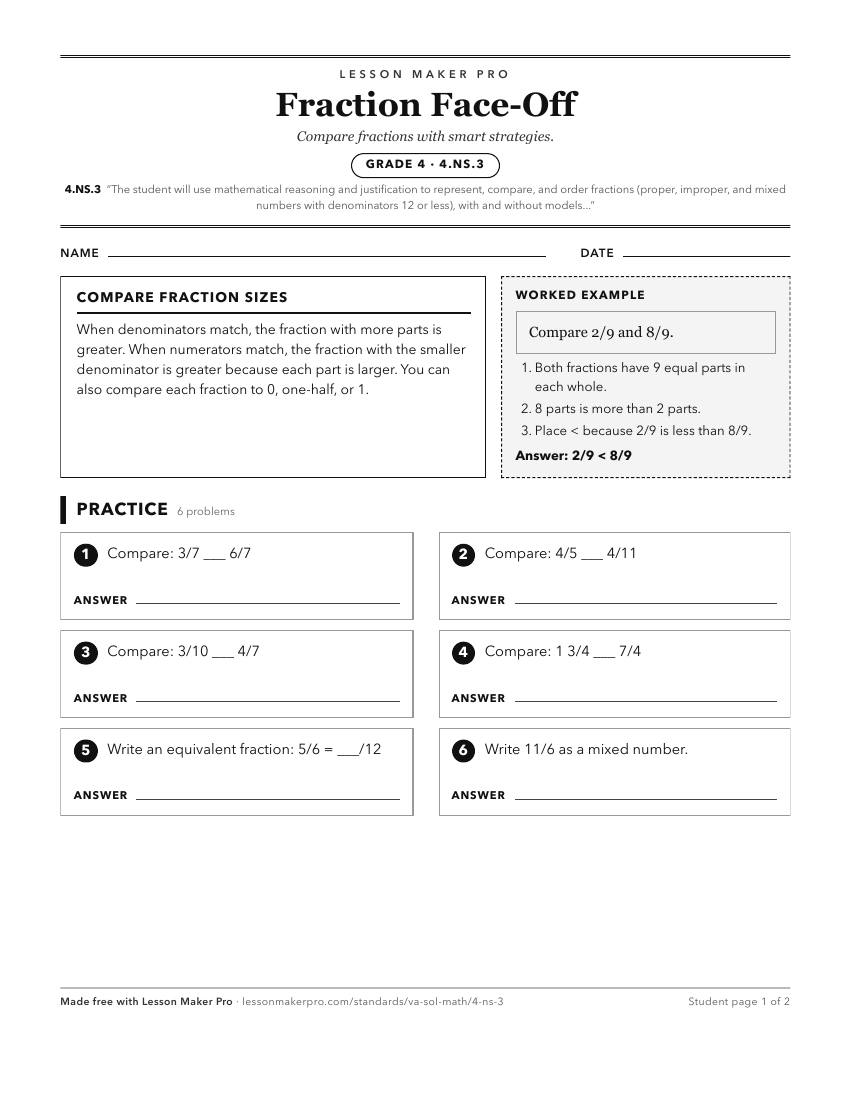
A ready-to-print activity worksheet aligned to 4.NS.3, with an answer key for the teacher on its own page. No account needed.
PDF, US Letter, prints cleanly in black and white.
Download the worksheetKeep exploring
Related Standards
- 6.NS.1
The student will reason and use multiple strategies to express equivalency, compare, and order numbers written as fractions, mixed numbers, decimals, and percen...
- 5.NS.1
The student will use reasoning and justification to identify and represent equivalency between fractions (with denominators that are thirds, eighths, and factor...
- 3.NS.3
The student will use mathematical reasoning and justification to represent and compare fractions (proper and improper) and mixed numbers with denominators of 2,...
- 4.NS.4
The student will use mathematical reasoning and justification to represent, compare, and order decimals through thousandths, with and without models.
Turn this cluster into a lesson
Grade, subject, topic, and the complete cluster are prefilled. Create one free, no account needed.
Also for this cluster:Make a WorksheetMake a QuizMake a Sub Lesson