Virginia SOL 5.NS.1
SOL Standard (Knowledge and Skills Cluster)
The student will use reasoning and justification to identify and represent equivalency between fractions (with denominators that are thirds, eighths, and factors of 100) and decimals; and compare and order sets of fractions (proper, improper, and/or mixed numbers having denominators of 12 or less) and decimals (through thousandths).
Virginia Standards of Learning for Mathematics
Cluster contents
Knowledge and Skills in This Standard
5.NS.1 is a Standards of Learning standard. These are the knowledge and skills expectations under it.
- 5.NS.1.a
Use concrete and pictorial models to represent fractions with denominators that are thirds, eighths, and factors of 100 in their equivalent decimal form.*
- 5.NS.1.b
Use concrete and pictorial models to represent decimals in their equivalent fraction form (thirds, eighths, and factors of 100).*
- 5.NS.1.c
Identify equivalent relationships between decimals and fractions with denominators that are thirds, eighths, and factors of 100 in their equivalent decimal form...
- 5.NS.1.d
Compare (using symbols <, >, =) and order (least to greatest and greatest to least) a set of no more than four decimals and fractions (proper, improper) and/or ...
Teacher's field guide
What This Cluster Means
What Students Need to Do
- Students use strips, grids, and number lines to match fractions with decimals through thousandths. Fractions include thirds, eighths, and denominators of 2, 4, 5, 10, 20, 25, 50, or 100. They compare and order up to four fractions, mixed numbers, and decimals, then explain their reasoning.
What Mastery Looks Like
- A student matches values such as 3/8 and 0.375, 25/100 and 0.25, and 1/3 and 0.333.... They correctly order a mixed set and justify each comparison using benchmarks, place value, or a model.
Common Misconceptions
- Students may think 0.7 is less than 0.65 because 7 is less than 65, or that 3/8 means 0.38. They may treat 0.333 as exactly 1/3 without showing repetition, or compare only the fractional parts of mixed numbers.
How to Assess It
- Exit ticket: Order 0.625, 2/3, 5/8, and 0.7 from least to greatest using symbols. Circle equivalent values and justify one comparison with a number line or decimal conversion.
Lesson moves
Ways to Teach It
Have pairs fold paper strips into thirds and eighths, then place them on decimal number lines to label matching values.
Ask, “Which is greater, 5/8 or 0.62?” Students choose a strategy and write a two-sentence justification.
Play a card sort where teams match fraction, decimal, and model cards, then order four matched values from least to greatest.
Give four sale discounts written as fractions or decimals; students rank the discounts and identify which offers are equivalent.
Free download
Printable 5.NS.1 Worksheet
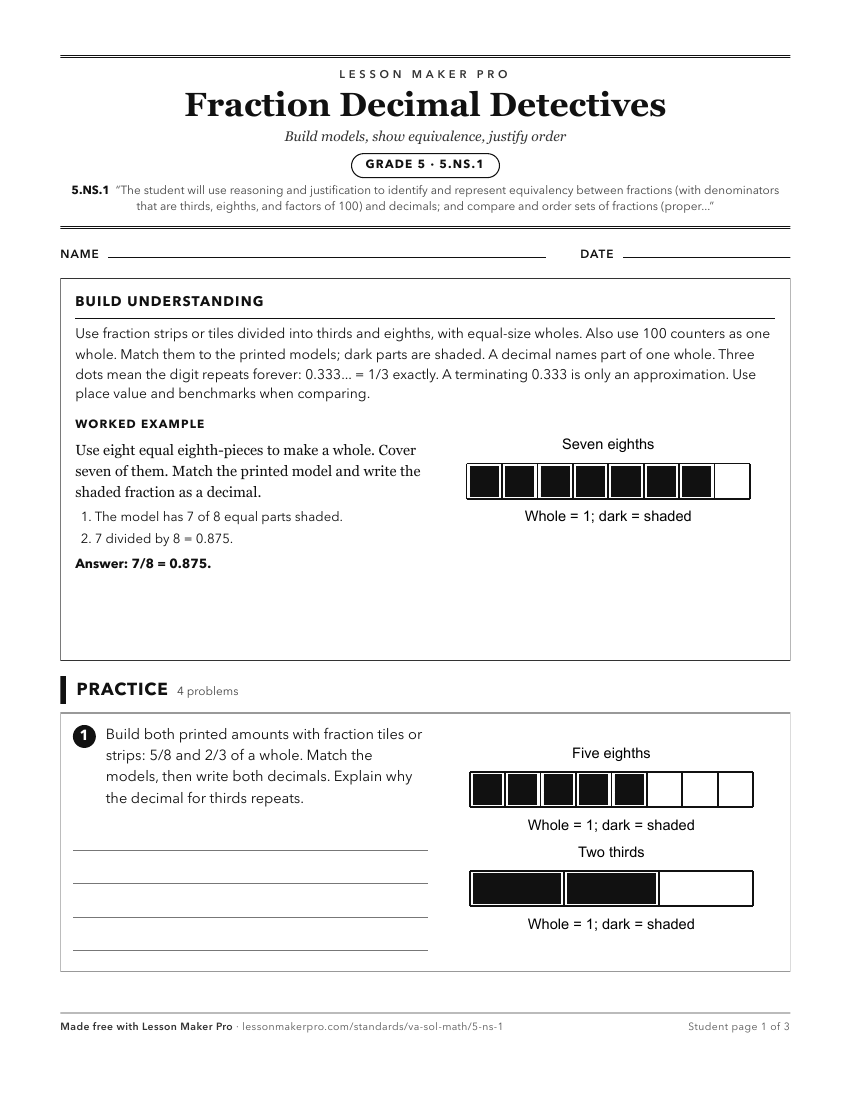
A ready-to-print activity worksheet aligned to 5.NS.1, with an answer key for the teacher on its own page. No account needed.
PDF, US Letter, prints cleanly in black and white.
Download the worksheetKeep exploring
Related Standards
- 6.NS.1
The student will reason and use multiple strategies to express equivalency, compare, and order numbers written as fractions, mixed numbers, decimals, and percen...
- 4.NS.3
The student will use mathematical reasoning and justification to represent, compare, and order fractions (proper, improper, and mixed numbers with denominators ...
- 4.NS.5
The student will reason about the relationship between fractions and decimals (limited to halves, fourths, fifths, tenths, and hundredths) to identify and repre...
- 3.NS.3
The student will use mathematical reasoning and justification to represent and compare fractions (proper and improper) and mixed numbers with denominators of 2,...
Turn this cluster into a lesson
Grade, subject, topic, and the complete cluster are prefilled. Create one free, no account needed.
Also for this cluster:Make a WorksheetMake a QuizMake a Sub Lesson