Virginia SOL 5.NS.1.a
The Standard
Use concrete and pictorial models to represent fractions with denominators that are thirds, eighths, and factors of 100 in their equivalent decimal form.*
Virginia Standards of Learning for Mathematics · The student will use reasoning and justification to identify and represent equivalency between fractions (with denominators that are thirds, eighths, and factors of 100) and decimals; and compare and order sets of fractions (proper, improper, and/or mixed numbers having denominators of 12 or less) and decimals (through thousandths).
Teacher's field guide
What This Standard Means
What Students Need to Do
- Students use fraction strips, grids, and number lines to connect fractions with decimal values. They represent terminating decimals and recognize the repeating pattern created by thirds.
What Mastery Looks Like
- Students match shaded grids, fraction strips, and number lines to correct decimal values. They explain why eighths and factors of 100 terminate, while thirds produce repeating decimals.
Common Misconceptions
- Students may write 3/8 as 0.38 by treating the numerator and denominator as decimal digits. They may also think 1/3 equals exactly 0.33 instead of a repeating decimal.
How to Assess It
- Give an exit ticket: “Use a grid, strip, or number line to show 7/20, 3/8, and 2/3 as decimals. Mark any repeating decimal.”
Lesson moves
Ways to Teach It
Fold paper strips into thirds and eighths, place them above a 0-to-1 decimal number line, and label each endpoint.
Ask students to explain why 1/3 is not exactly 0.33, using a shaded strip or number line as evidence.
Play a three-card match using fraction, decimal, and shaded-model cards for 2/5, 3/8, 7/20, and 2/3.
Read recipe amounts of 1/3 and 3/8 cup, then mark their decimal locations on a one-cup measuring strip.
Free download
Printable 5.NS.1.a Worksheet
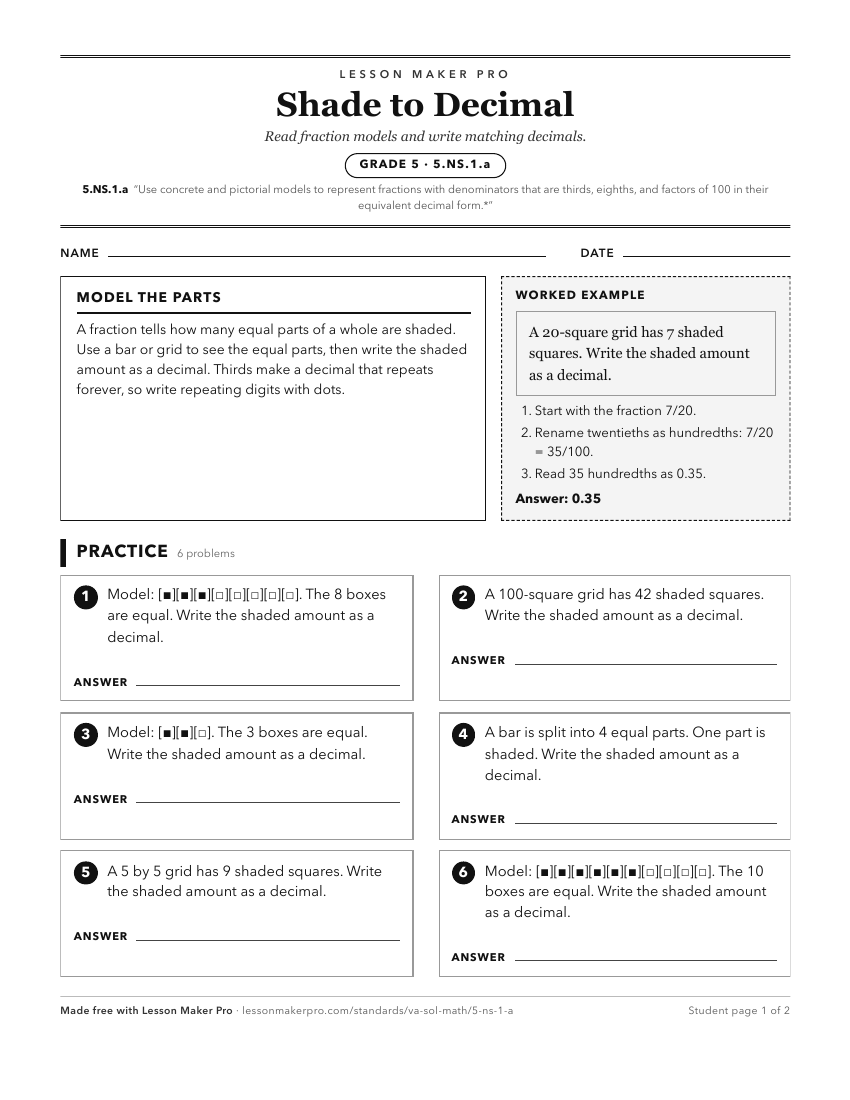
A ready-to-print activity worksheet aligned to 5.NS.1.a, with an answer key for the teacher on its own page. No account needed.
PDF, US Letter, prints cleanly in black and white.
Download the worksheetKeep exploring
Related Standards
- 4.NS.5.b
Identify and model equivalent relationships between fractions (proper or improper) and/or mixed numbers and decimals, using halves, fourths, fifths, tenths, and...
- 6.NS.1.c
Represent and determine equivalencies among fractions (proper or improper) and mixed numbers that have denominators that are 12 or less or factors of 100 and pe...
- 5.NS.1.b
Use concrete and pictorial models to represent decimals in their equivalent fraction form (thirds, eighths, and factors of 100).*
- 5.NS.1.c
Identify equivalent relationships between decimals and fractions with denominators that are thirds, eighths, and factors of 100 in their equivalent decimal form...
Turn this exact standard into a lesson
Grade, subject, topic, and the complete standard are prefilled. Create one free, no account needed.
Also for this standard:Make a WorksheetMake a QuizMake a Sub Lesson