Virginia SOL 3.MG.3
SOL Standard (Knowledge and Skills Cluster)
The student will demonstrate an understanding of the concept of time to the nearest minute and solve single-step contextual problems involving elapsed time in one-hour increments within a 12-hour period.
Virginia Standards of Learning for Mathematics
Cluster contents
Knowledge and Skills in This Standard
3.MG.3 is a Standards of Learning standard. These are the knowledge and skills expectations under it.
- 3.MG.3.a
Tell and write time to the nearest minute, using analog and digital clocks.
- 3.MG.3.b
Match a written time (e.g., 4:38, 7:09, 12:51) to the time shown on analog and digital clocks to the nearest minute.
- 3.MG.3.c.i
the starting time and the ending time, determine the amount of time that has elapsed
- 3.MG.3.c.ii
the starting time and amount of elapsed time in one-hour increments, determine the ending time
- 3.MG.3.c.iii
the ending time and the amount of elapsed time in one-hour increments, determine the starting time.
Teacher's field guide
What This Cluster Means
What Students Need to Do
- Students read analog clocks by using both hand positions and write each time in digital form, including minutes from 00 to 59. In story problems, they add or subtract whole hours to find a missing start time, end time, or duration without switching between a.m. and p.m.
What Mastery Looks Like
- A student accurately matches times such as 7:09 and 12:51 to clock faces, with the hour hand placed between the correct numbers. In time problems, the student chooses addition or subtraction, keeps the minutes unchanged, and labels the answer a.m. or p.m.
Common Misconceptions
- Students often place the short hand exactly on an hour number even when many minutes have passed. They may count each minute mark as five minutes, omit the zero in 7:09, or confuse 12:xx with 1:xx. In elapsed-time problems, they may change the minutes, count clock labels instead of intervals, or add when they need to subtract.
How to Assess It
- Exit ticket: Draw hands on a blank clock for 4:38. Then solve: A movie ends at 8:17 p.m. after two hours. When did it start?
Lesson moves
Ways to Teach It
Give pairs movable clocks and time cards; one student builds each time, and the partner checks the hour and minute hands.
Ask students to explain why adding three hours to 6:24 changes the hour but not the minutes.
Play Time Match: students pair analog clock cards, digital time cards, and whole-hour elapsed-time cards.
Use a class schedule and ask when an event ends if it starts at 9:15 a.m. and lasts two hours.
Free download
Printable 3.MG.3 Worksheet
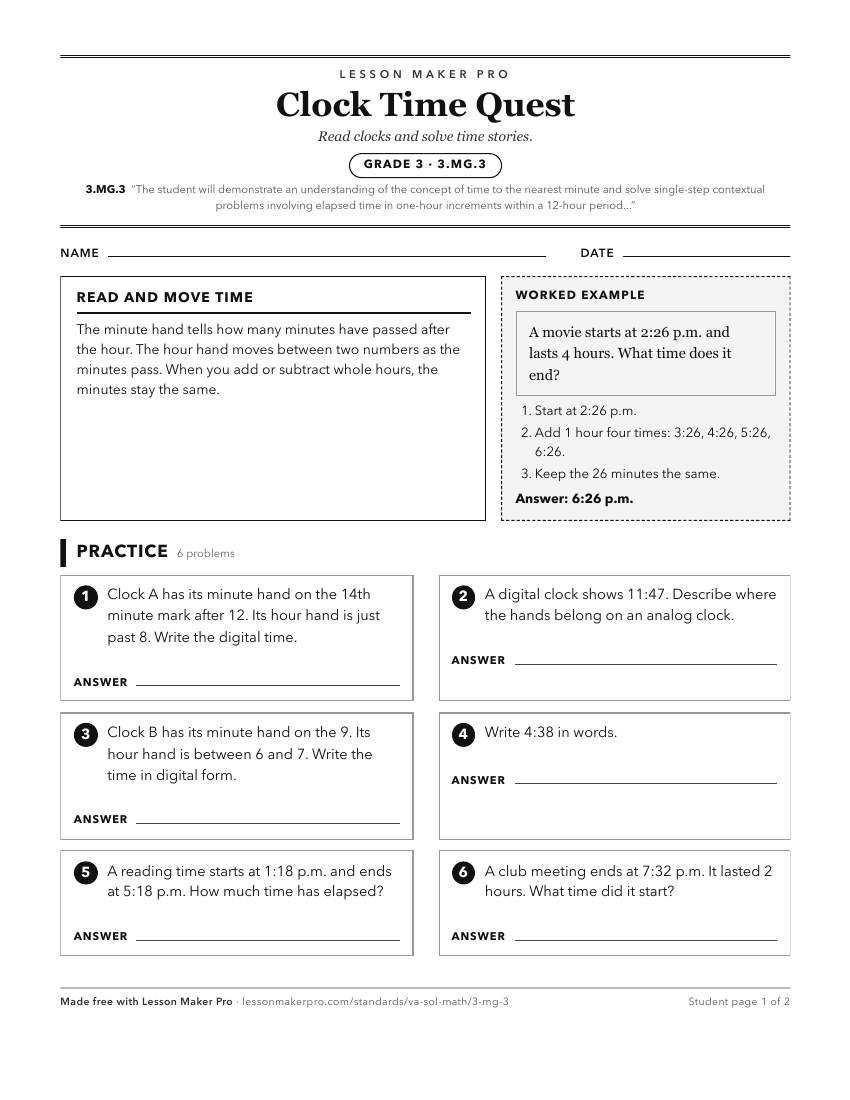
A ready-to-print activity worksheet aligned to 3.MG.3, with an answer key for the teacher on its own page. No account needed.
PDF, US Letter, prints cleanly in black and white.
Download the worksheetKeep exploring
Related Standards
- 4.CE.3
The student will estimate, represent, solve, and justify solutions to single-step problems, including those in context, using addition and subtraction of fracti...
- 1.MG.3
The student will demonstrate an understanding of the concept of passage of time (to the nearest hour and half-hour) and the calendar.
- 2.MG.2
The student will demonstrate an understanding of the concept of time to the nearest five minutes, using analog and digital clocks.
- 4.MG.2
The student will solve single-step and multistep contextual problems involving elapsed time (limited to hours and minutes within a 12-hour period).
Turn this cluster into a lesson
Grade, subject, topic, and the complete cluster are prefilled. Create one free, no account needed.
Also for this cluster:Make a WorksheetMake a QuizMake a Sub Lesson