Virginia SOL 1.MG.3
SOL Standard (Knowledge and Skills Cluster)
The student will demonstrate an understanding of the concept of passage of time (to the nearest hour and half-hour) and the calendar.
Virginia Standards of Learning for Mathematics
Cluster contents
Knowledge and Skills in This Standard
1.MG.3 is a Standards of Learning standard. These are the knowledge and skills expectations under it.
- 1.MG.3.a
Identify different tools to measure time including clocks (analog and digital) and calendar.
- 1.MG.3.b
Describe the units of time represented on a clock as minutes and hours.
- 1.MG.3.c
Tell time to the hour and half-hour, using analog and digital clocks.
- 1.MG.3.d
Describe the location of the hour hand relative to time to the hour and half-hour on an analog clock.
- 1.MG.3.e
Describe the location of the minute hand relative to time to the hour and half-hour on an analog clock.
- 1.MG.3.f
Match the time shown on a digital clock to an analog clock to the hour and half-hour.
- 1.MG.3.g
Identify specific days/dates on a calendar (e.g., What date is Saturday? How many Fridays are in October?).
- 1.MG.3.h
Use ordinal numbers first through tenth to describe the relative position of specific days/dates (e.g., What is the first Monday in October? What day of the wee...
- 1.MG.3.i
Determine the day/date before and after a given day/date (e.g., Today is the 8 th , so yesterday was the ?), and a date that is a specific number of days/weeks ...
Teacher's field guide
What This Cluster Means
What Students Need to Do
- Students read and show times to the hour and half-hour on analog and digital clocks. They explain where each hand points and name hours and minutes. They find dates, use ordinal numbers first through tenth, and count forward or backward by days and weeks.
What Mastery Looks Like
- Students correctly read, build, and match hour and half-hour times on both clock types. They explain that the minute hand points to 12 for the hour and 6 for the half-hour. They accurately locate, order, and count dates on a calendar, including across weeks.
Common Misconceptions
- Students may swap the hour and minute hands or read :30 as “30 o’clock.” They often place the hour hand directly on a number at half past instead of halfway toward the next hour. On calendars, they may count the starting date as day one, miss a month change, or confuse the first Monday with Monday the first.
How to Assess It
- Give each student a paper clock showing 3:30 and a one-month calendar. Ask them to write the digital time, explain both hand positions, circle the second Friday, and find dates one day before and seven days after the 12th.
Lesson moves
Ways to Teach It
Give pairs geared clocks and time cards; one student builds each time, while the other checks the hour and minute hands.
Show 4:30 and ask, “Why is the hour hand between 4 and 5 rather than on 4?”
Play Calendar Race: call a starting date and a move, such as eight days forward, and students cover the landing date.
Plan a class field trip schedule by matching digital event times to analog clocks and finding the trip date on a calendar.
Free download
Printable 1.MG.3 Worksheet
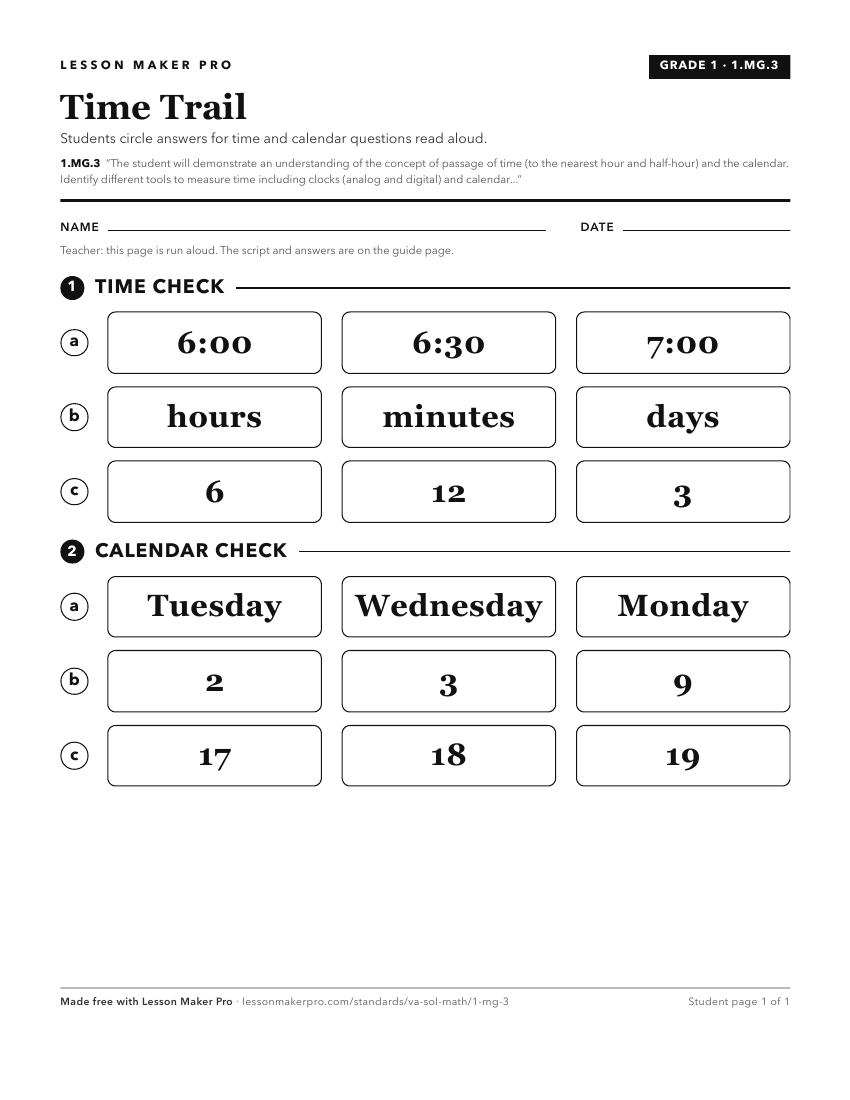
A ready-to-print activity worksheet aligned to 1.MG.3, with an answer key for the teacher on its own page. No account needed.
PDF, US Letter, prints cleanly in black and white.
Download the worksheetKeep exploring
Related Standards
- 2.MG.2
The student will demonstrate an understanding of the concept of time to the nearest five minutes, using analog and digital clocks.
- 4.MG.2
The student will solve single-step and multistep contextual problems involving elapsed time (limited to hours and minutes within a 12-hour period).
- K.MG.3
The student will describe the units of time represented in a calendar.
- 3.MG.3
The student will demonstrate an understanding of the concept of time to the nearest minute and solve single-step contextual problems involving elapsed time in o...
Turn this cluster into a lesson
Grade, subject, topic, and the complete cluster are prefilled. Create one free, no account needed.
Also for this cluster:Make a WorksheetMake a QuizMake a Sub Lesson