Virginia SOL 4.CE.3
SOL Standard (Knowledge and Skills Cluster)
The student will estimate, represent, solve, and justify solutions to single-step problems, including those in context, using addition and subtraction of fractions (proper, improper, and mixed numbers with like denominators of 2, 3, 4, 5, 6, 8, 10, and 12), with and without models; and solve single-step contextual problems involving multiplication of a whole number (12 or less) and a unit fraction, with models.
Virginia Standards of Learning for Mathematics
Cluster contents
Knowledge and Skills in This Standard
4.CE.3 is a Standards of Learning standard. These are the knowledge and skills expectations under it.
- 4.CE.3.a
Estimate and determine the sum or difference of two fractions (proper or improper) and/or mixed numbers, having like denominators limited to 2, 3, 4, 5, 6, 8, 1...
- 4.CE.3.b
Estimate, represent, solve, and justify solutions to single-step contextual problems using addition and subtraction with fractions (proper or improper) and/or m...
- 4.CE.3.c
Solve single-step contextual problems involving multiplication of a whole number, limited to 12 or less, and a unit fraction (e.g., 6 × 1 3 , 1 5 × 8, 2 × 1 10 ...
- 4.CE.3.d
Apply the inverse property of multiplication in models (e.g., use a visual fraction model to represent 4 4 or 1 as the product of 4 × 1 4 ).
Teacher's field guide
What This Cluster Means
What Students Need to Do
- Students estimate, model, and solve one-step addition and subtraction problems with like-denominator fractions and mixed numbers. They regroup when needed, simplify answers, and explain why each result is reasonable. They also model a whole number times a unit fraction.
What Mastery Looks Like
- Students choose addition or subtraction from a short context, estimate, calculate accurately, and simplify. They regroup a mixed number without changing its value and justify their work with a model or equations. They also model a whole number times a unit fraction as repeated equal parts.
Common Misconceptions
- Students often add or subtract denominators instead of keeping the shared denominator. When subtracting mixed numbers, they may regroup one whole but not rename it as equal fractional parts. They may treat 5 × 1/6 as 1/30 instead of five copies of 1/6.
How to Assess It
- Exit ticket: Estimate and solve 2 3/4 minus 1 2/4, simplify, and explain the regrouping with a sketch. Then draw a model for 5 × 1/6 and write the product.
Lesson moves
Ways to Teach It
Use fraction strips to model 2 1/4 minus 3/4, regroup one whole, solve, and check the answer against an estimate.
Ask students to explain why 5 × 1/6 equals 5/6 and draw a model showing when repeated sixths make one whole.
Play Fraction Match by pairing expression cards with simplified answer cards, then have students defend one match using an estimate.
Plan a snack mix by combining like-denominator cup amounts, then model several one-eighth-cup scoops as multiplication.
Free download
Printable 4.CE.3 Worksheet
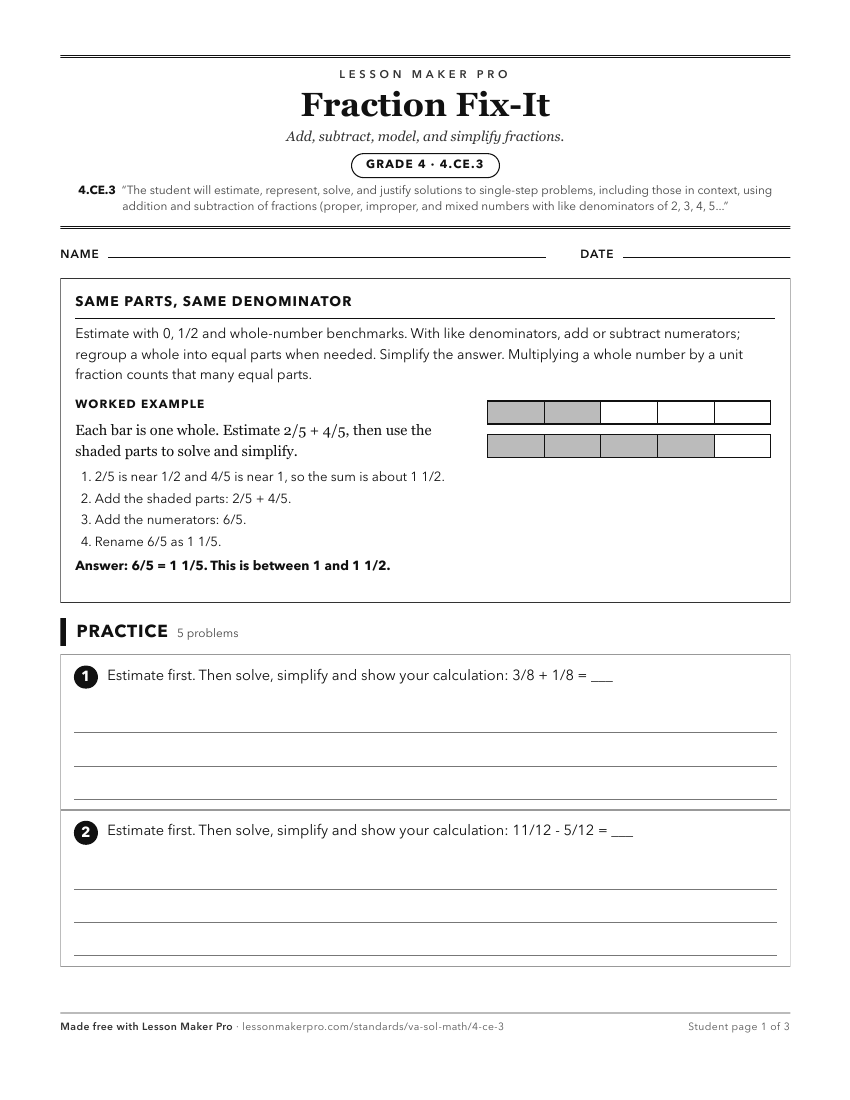
A ready-to-print activity worksheet aligned to 4.CE.3, with an answer key for the teacher on its own page. No account needed.
PDF, US Letter, prints cleanly in black and white.
Download the worksheetKeep exploring
Related Standards
- 5.CE.2
The student will estimate, represent, solve, and justify solutions to single-step and multistep problems, including those in context, using addition and subtrac...
- 4.CE.4
The student will estimate, represent, solve, and justify solutions to single-step and multistep problems, including those in context, using addition and subtrac...
- 5.CE.1
The student will estimate, represent, solve, and justify solutions to single-step and multistep contextual problems using addition, subtraction, multiplication,...
- 4.CE.1
The student will estimate, represent, solve, and justify solutions to single-step and multistep problems, including those in context, using addition and subtrac...
Turn this cluster into a lesson
Grade, subject, topic, and the complete cluster are prefilled. Create one free, no account needed.
Also for this cluster:Make a WorksheetMake a QuizMake a Sub Lesson