Virginia SOL VS.2
SOL Standard (Skills Cluster)
The student will apply history and social science skills to describe the Indigenous nations of Virginia past and present by describing how archaeologists have recovered artifacts from important places in the history of Indigenous people including, but not limited to Werowocomoco; describing Virginia’s three most prominent Indigenous language groups (i.e., the Algonquian, the Siouan, and the Iroquoian); describing the diversity among the Indigenous nations; describing the relationships and interactions of Virginia’s Indigenous People and their environment, circa 1600; and describing the lives and cultures of Virginia’s Indigenous People leading to the present day.
Virginia Standards of Learning for History and Social Science
Cluster contents
Skills in This Standard
VS.2 is a Standards of Learning history and social science standard. These are the skills expectations under it.
- VS.2.a
describing how archaeologists have recovered artifacts from important places in the history of Indigenous people including, but not limited to Werowocomoco
- VS.2.b
describing Virginia’s three most prominent Indigenous language groups (i.e., the Algonquian, the Siouan, and the Iroquoian)
- VS.2.c
describing the diversity among the Indigenous nations
- VS.2.d
describing the relationships and interactions of Virginia’s Indigenous People and their environment, circa 1600
- VS.2.e
describing the lives and cultures of Virginia’s Indigenous People leading to the present day.
Teacher's field guide
What This Cluster Means
What Students Need to Do
- Students use artifacts and archaeological findings from places such as Werowocomoco to make claims about Indigenous life. They locate Algonquian, Siouan, and Iroquoian language groups and compare distinct nations. They explain how communities used local environments around 1600 and trace Indigenous cultures into the present.
What Mastery Looks Like
- A student can examine an artifact, make a reasonable inference, and cite visible evidence. The student can connect language groups with regions without treating each group as one nation. The student describes cultural change and continuity using specific past and present examples.
Common Misconceptions
- Students may treat all Virginia Indigenous people as one culture or confuse a language group with a single nation. They may assume artifacts tell a complete story rather than support careful inferences. Some speak only in the past tense or assume Indigenous communities disappeared after English settlement.
How to Assess It
- Give students an artifact image from Werowocomoco, a language-group map, and a short excerpt from a current tribal website. Ask: “What does each source show about place, culture, or continuity, and what evidence supports your claims?”
Lesson moves
Ways to Teach It
Place artifact picture cards in labeled soil-layer trays, then have pairs record what each item may reveal and what it cannot prove.
Ask students to respond: How can two nations share a language group yet have different traditions, governments, and histories?
Play a map relay where teams match nation cards, language-group cards, environmental resources, and Virginia regions, then explain each match.
Use a current Virginia tribal nation website to create a then-and-now card showing one cultural continuity and one change.
Free download
Printable VS.2 Worksheet
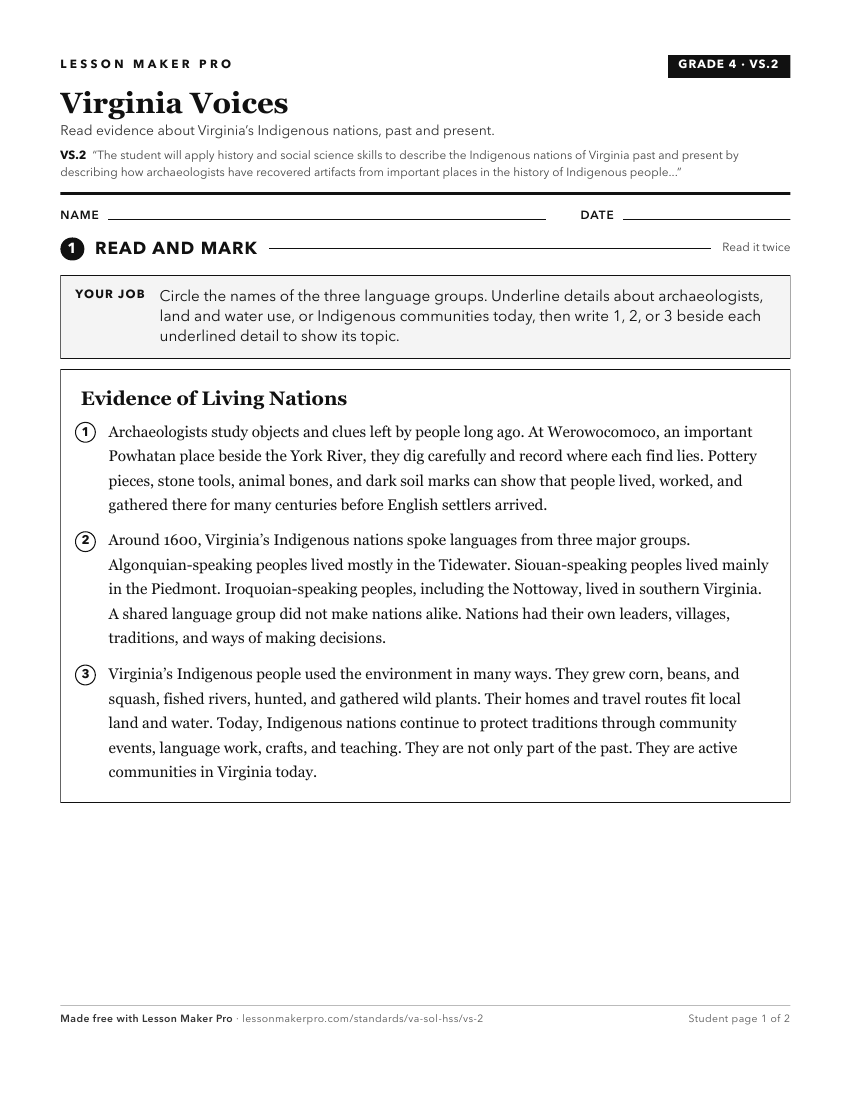
A ready-to-print activity worksheet aligned to VS.2, with an answer key for the teacher on its own page. No account needed.
PDF, US Letter, prints cleanly in black and white.
Download the worksheetKeep exploring
Related Standards
- VS.1
The student will apply history and social science skills to explain the relationship between physical geography and the lives of Virginia’s peoples, past and pr...
- 1.7
The student will apply history and social science skills to connect geography to historic events of Virginia and the United States by
- 1.4
The student will apply history and social science skills to understand Virginia’s history by
- K.4
The student will apply history and social science skills to recognize Virginia’s earliest communities by
Turn this cluster into a lesson
Grade, subject, topic, and the complete cluster are prefilled. Create one free, no account needed.
Also for this cluster:Make a WorksheetMake a QuizMake a Sub Lesson