Virginia SOL VS.2.d
The Standard
- VS.2
- The student will apply history and social science skills to describe the Indigenous nations of Virginia past and present by
describing the relationships and interactions of Virginia’s Indigenous People and their environment, circa 1600
Virginia Standards of Learning for History and Social Science
Teacher's field guide
What This Standard Means
What Students Need to Do
- Students explain how Virginia’s Indigenous communities used nearby plants, animals, waterways, and land around 1600. They connect local resources and seasons to food, shelter, clothing, farming, and travel.
What Mastery Looks Like
- Given a map or village image, students identify available resources and explain how people used them. They support each connection with examples, such as rivers for fishing and travel or forests for hunting and building.
Common Misconceptions
- Students may picture tepees or constant wandering, though many Virginia communities lived in settled villages. They may treat all tribes as identical. They may also overlook farming, controlled burning, and other ways communities changed the land.
How to Assess It
- Show a riverbank village image. Ask students to name two environmental resources and explain how each supported food, shelter, clothing, farming, or travel.
Lesson moves
Ways to Teach It
Give groups twigs, bark, reeds, and clay to build a small shelter model, then label why each material fit the local environment.
Write: How would living near a river change a community’s food, travel, and settlement choices around 1600?
Play a matching game pairing resource cards with uses, such as deer with clothing and rivers with fishing or travel.
Use a Virginia tribe’s website to compare one resource used around 1600 with how the community relates to that place today.
Free download
Printable VS.2.d Worksheet
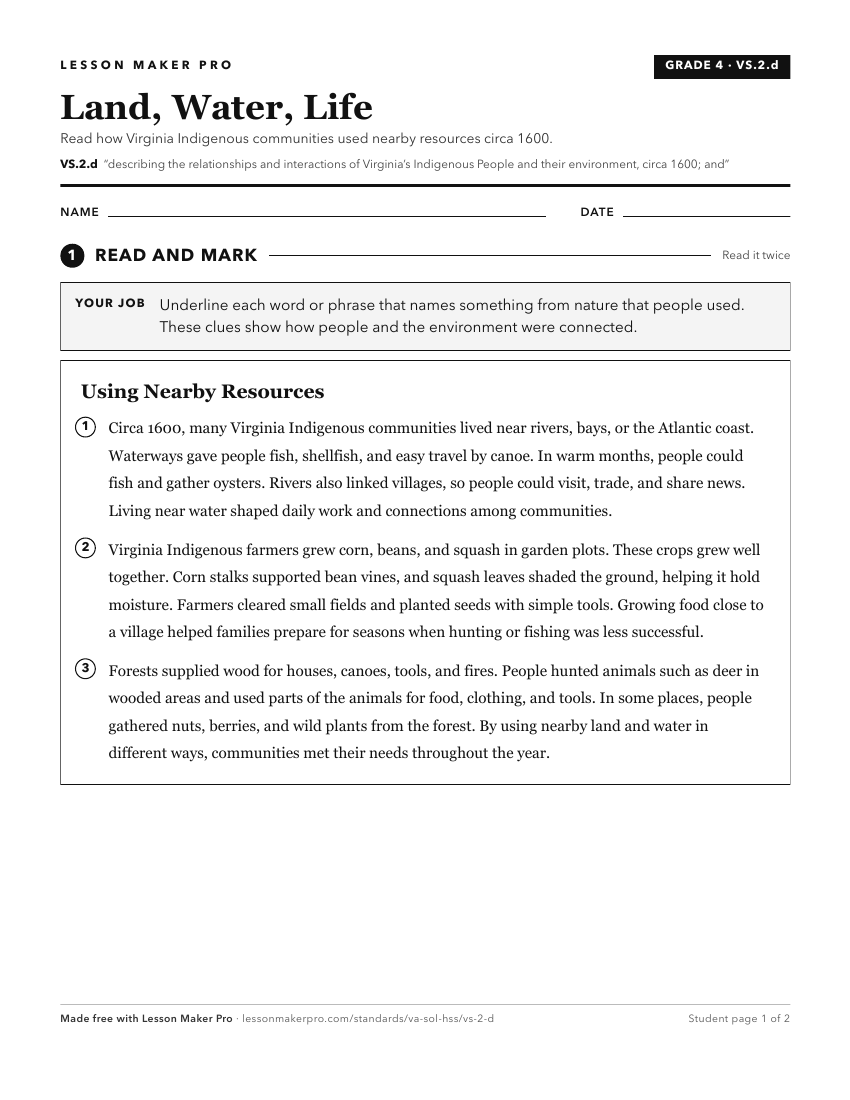
A ready-to-print activity worksheet aligned to VS.2.d, with an answer key for the teacher on its own page. No account needed.
PDF, US Letter, prints cleanly in black and white.
Download the worksheetKeep exploring
Related Standards
- VS.2
The student will apply history and social science skills to describe the Indigenous nations of Virginia past and present by
- 1.7.a
identifying landforms and bodies of water of Virginia and describing how they affect the way people live
- 1.4.b
describing how life in various Virginia communities has changed over time
- VS.2.e
describing the lives and cultures of Virginia’s Indigenous People leading to the present day.
Turn this exact standard into a lesson
Grade, subject, topic, and the complete standard are prefilled. Create one free, no account needed.
Also for this standard:Make a WorksheetMake a QuizMake a Sub Lesson