Virginia SOL VS.2.e
The Standard
- VS.2
- The student will apply history and social science skills to describe the Indigenous nations of Virginia past and present by
describing the lives and cultures of Virginia’s Indigenous People leading to the present day.
Virginia Standards of Learning for History and Social Science
Teacher's field guide
What This Standard Means
What Students Need to Do
- Students use maps, photographs, oral histories, and short texts to study distinct Virginia tribal nations. They identify changes and continuities in language, government, food, art, community life, and ties to land.
What Mastery Looks Like
- Students can explain one cultural practice that has continued and one part of life that has changed. They support each point with evidence and recognize that Virginia Indigenous communities remain active today.
Common Misconceptions
- Students may think Indigenous people disappeared after colonization or live only on reservations. They may treat all Virginia tribes as one culture or assume daily life has never changed. They may also view modern practices as less authentic.
How to Assess It
- Use this exit ticket: Name one continuity and one change in a Virginia Indigenous community, then cite one source detail for each.
Lesson moves
Ways to Teach It
Give pairs photo and description cards to sort into past, present, or both, then require one evidence-based explanation for each choice.
Ask, "What has changed and what has continued in Virginia Indigenous communities?" Students cite two details from a short source.
Play continuity bingo with squares for language, government, food, art, land, and celebrations, using source cards to justify each match.
Open a current Virginia tribal nation website and have students record one community program, public event, or cultural tradition active today.
Free download
Printable VS.2.e Worksheet
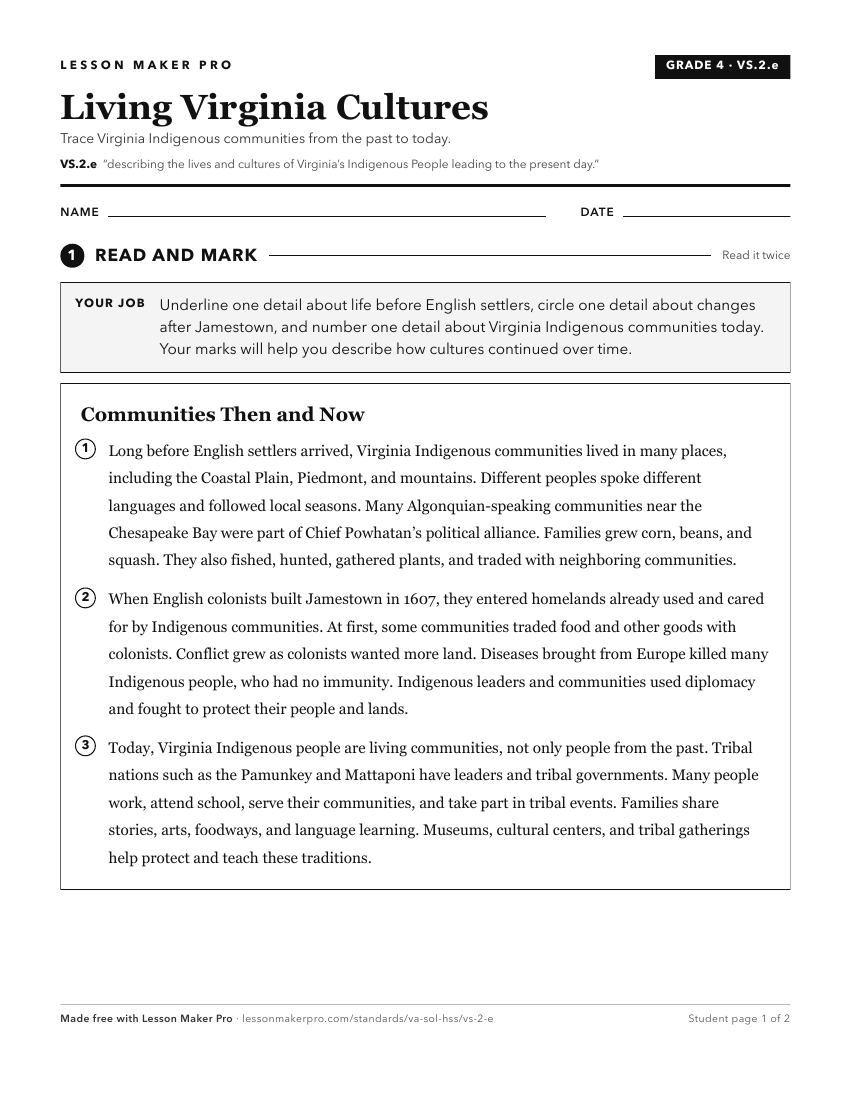
A ready-to-print activity worksheet aligned to VS.2.e, with an answer key for the teacher on its own page. No account needed.
PDF, US Letter, prints cleanly in black and white.
Download the worksheetKeep exploring
Related Standards
- VS.2
The student will apply history and social science skills to describe the Indigenous nations of Virginia past and present by
- VS.4.b
examining how colonial Virginia reflected the culture of Virginia’s Indigenous People, European (English, Scots-Irish, German) immigrants, and Africans
- 1.4.b
describing how life in various Virginia communities has changed over time
- VS.2.d
describing the relationships and interactions of Virginia’s Indigenous People and their environment, circa 1600
Turn this exact standard into a lesson
Grade, subject, topic, and the complete standard are prefilled. Create one free, no account needed.
Also for this standard:Make a WorksheetMake a QuizMake a Sub Lesson