Virginia SOL VS.2.c
The Standard
- VS.2
- The student will apply history and social science skills to describe the Indigenous nations of Virginia past and present by
describing the diversity among the Indigenous nations
Virginia Standards of Learning for History and Social Science
Teacher's field guide
What This Standard Means
What Students Need to Do
- Students identify Virginia’s Indigenous nations as distinct communities, not one single group. They compare nations by homeland, language, government, traditions, and use of local resources.
What Mastery Looks Like
- A student can compare two named Virginia nations using accurate details from a map or source. The student names a similarity and a difference without treating either nation as frozen in the past.
Common Misconceptions
- Students may describe all Virginia Indigenous people as one tribe with the same language, homes, and customs. They may confuse a language family, such as Algonquian, with one nation. Some assume Indigenous nations existed only in the past.
How to Assess It
- Exit ticket: Choose two nations from the class map. Write one similarity and one difference, citing a map or source-card detail for each claim.
Lesson moves
Ways to Teach It
Give pairs a Virginia map and nation cards; students place each card, then build a two-circle Venn diagram from the evidence.
Ask, “Why is it inaccurate to describe Virginia’s Indigenous peoples as one group?” Students answer with two details from class sources.
Play Evidence Match: teams pair homeland, language, leadership, and tradition cards with named nations, then explain each match before scoring.
Open two official tribal government websites and compare each nation’s location, public programs, and one way it maintains community life today.
Free download
Printable VS.2.c Worksheet
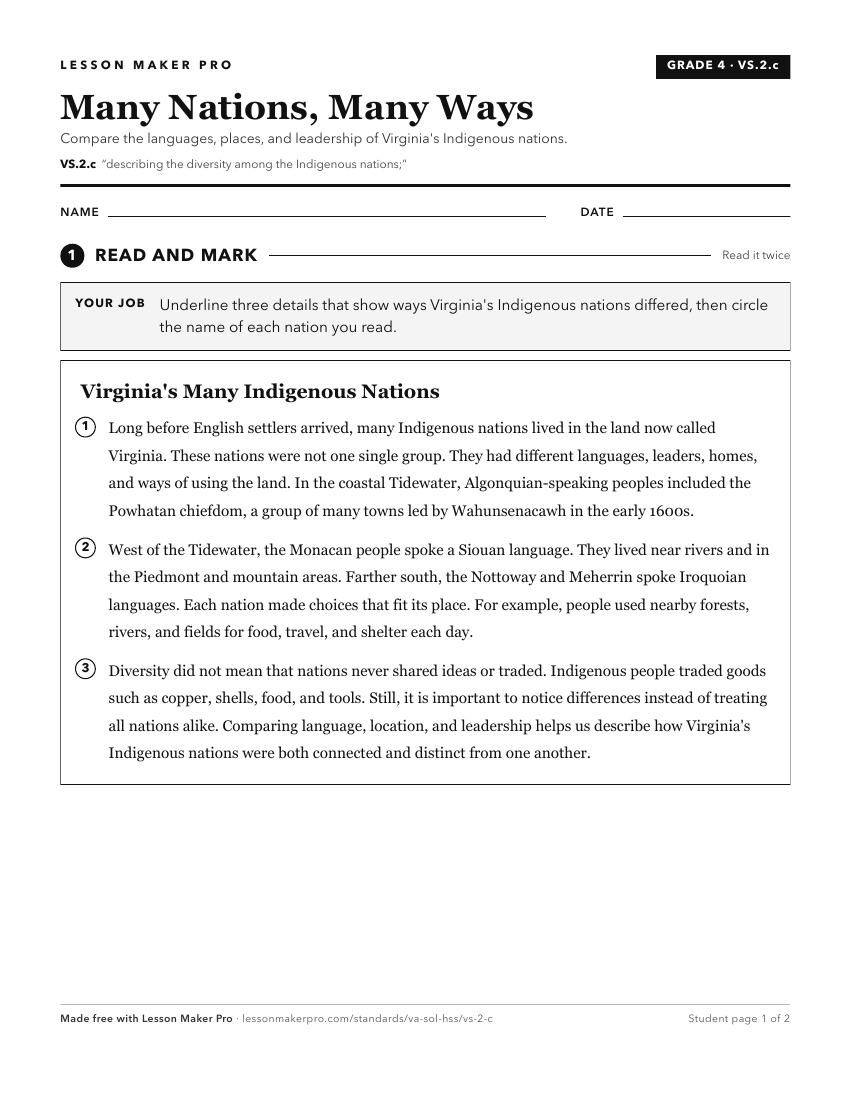
A ready-to-print activity worksheet aligned to VS.2.c, with an answer key for the teacher on its own page. No account needed.
PDF, US Letter, prints cleanly in black and white.
Download the worksheetKeep exploring
Related Standards
- USII.1.d
explaining the effect that the growth of the United States had on Indigenous people.
- VS.2.b
describing Virginia’s three most prominent Indigenous language groups (i.e., the Algonquian, the Siouan, and the Iroquoian)
- VS.2.e
describing the lives and cultures of Virginia’s Indigenous People leading to the present day.
- 2.5.b
Indigenous nations and tribes of the Plains
Turn this exact standard into a lesson
Grade, subject, topic, and the complete standard are prefilled. Create one free, no account needed.
Also for this standard:Make a WorksheetMake a QuizMake a Sub Lesson