Virginia SOL USII.1.d
The Standard
- USII.1
- The student will apply history and social science skills to examine westward expansion after the mid-19th century by
explaining the effect that the growth of the United States had on Indigenous people.
Virginia Standards of Learning for History and Social Science
Teacher's field guide
What This Standard Means
What Students Need to Do
- Students trace how settlement, federal policies, railroads, and resource loss changed the lives of specific Indigenous nations. They explain effects such as displacement, land loss, conflict, reservation confinement, and pressure to abandon languages and traditions.
What Mastery Looks Like
- A student can create a clear cause-and-effect chain connecting one government action or settlement pattern to two effects on an Indigenous nation. They support the explanation with evidence from a map, treaty, image, or firsthand account.
Common Misconceptions
- Students may treat Indigenous peoples as one group with a single experience. They may assume treaties were always voluntary and honored. They may also describe removal and cultural loss as events with no effects today.
How to Assess It
- Give students a before-and-after land map and a short treaty excerpt. Ask them to identify one cause, explain two effects, and cite one detail from each source.
Lesson moves
Ways to Teach It
Pairs layer maps of tribal homelands, treaty boundaries, railroad lines, and reservations, then mark where land loss occurred.
Ask students to write: How did one federal policy change land, food sources, movement, or culture for a specific Indigenous nation?
Students sort cause-and-effect cards linking settlement, railroads, treaties, bison loss, removal, reservations, and cultural suppression.
Compare a historical homeland map with a current tribal lands map, then identify one lasting effect visible today.
Free download
Printable USII.1.d Worksheet
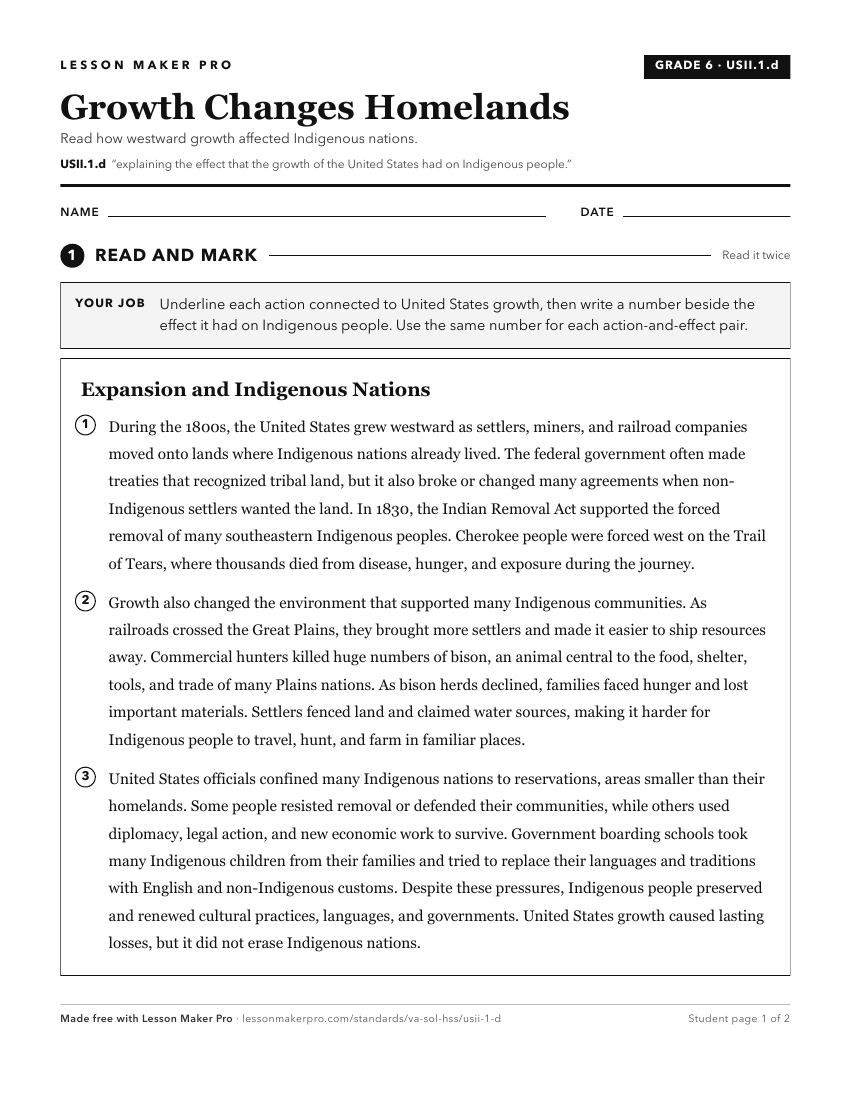
A ready-to-print activity worksheet aligned to USII.1.d, with an answer key for the teacher on its own page. No account needed.
PDF, US Letter, prints cleanly in black and white.
Download the worksheetKeep exploring
Related Standards
- USI.3.b
describing cultural and economic interactions between Indigenous people and Europeans that led to cooperation and conflict.
- USI.8.g
explaining how the expansion of U.S. territory led to increased momentum for the abolitionist and women’s suffrage movements
- USII.3.d
explaining the events, factors, and motivations that caused individuals and groups to migrate to the United States towards the end of the 19th century
- USI.8.d
analyzing the impact of westward expansion on Indigenous people including, but not limited to the Indian Removal Act (1830), the Trail of Tears, and the Seminol...
Turn this exact standard into a lesson
Grade, subject, topic, and the complete standard are prefilled. Create one free, no account needed.
Also for this standard:Make a WorksheetMake a QuizMake a Sub Lesson