Virginia SOL 11.RI
SOL Standard (Knowledge and Skills Cluster)
The student will use textual evidence to demonstrate comprehension and build knowledge from grade-level complex informational texts read.
Virginia Standards of Learning for English
Cluster contents
Knowledge and Skills in This Standard
11.RI is a Standards of Learning standard. These are the knowledge and skills expectations under it.
- 11.RI.1
Key Ideas and Confirming Details
- 11.RI.1.A
Interpret and complete an application for employment or college admission, and summarize the intent, main ideas, and purpose of the workplace or technical docum...
- 11.RI.1.B
Analyze the hypotheses, data, analysis, and/or conclusions in informational, historical, scientific, or technical texts, verifying the data when possible and co...
- 11.RI.1.C
Evaluate the relevance and quality of an author’s premises, claims, counterclaims, and evidence by corroborating or challenging them with other information.
- 11.RI.2
Craft and Style
- 11.RI.2.A
Examine how textual elements and organizational patterns contribute to meaning and the author’s purpose.
- 11.RI.2.B
Analyze and interpret the key terms (e.g., content-specific words and phrases, technical terminology) and ideas of historical, scientific, technical, and employ...
- 11.RI.2.C
Recognize and analyze the author’s purpose and impact of ambiguity, contradiction, paradox, oxymoron, irony, sarcasm, overstatement, and understatement in infor...
- 11.RI.3
Integration of Concepts
- 11.RI.3.A
Analyze information within and between paired passages for similar and conflicting ideas and how authors reach similar or different conclusions.
- 11.RI.3.B
Compare and contrast informational and technical texts for intent, content, and clarity.
Teacher's field guide
What This Cluster Means
What Students Need to Do
- Students read complex nonfiction and use precise details to explain ideas, claims, data, and conclusions. They check evidence against other sources and judge its relevance and quality. They also interpret applications, technical language, text structure, and an author’s use of ambiguity or irony.
What Mastery Looks Like
- Students accurately complete an application using details from a provided profile. They summarize technical or workplace documents, evaluate claims and data, and identify reliable evidence. They compare sources and explain how wording, structure, and contradictions affect meaning.
Common Misconceptions
- Students may treat any quotation, statistic, or expert comment as strong evidence without checking its source. They often confuse the topic with the author’s purpose or miss how structure and figurative language shape meaning. They may assume similar conclusions confirm accuracy, even when both sources rely on weak data.
How to Assess It
- Give students a short article and a second source. Ask them to identify the main claim, cite the strongest evidence, and explain whether the second source supports or challenges the conclusion.
Lesson moves
Ways to Teach It
Give students a fictional applicant profile and blank job application, then have them complete it and highlight the source for each response.
After reading two conflicting articles, ask students to write which conclusion is better supported and cite two specific reasons.
Run a claim and evidence card sort where teams match claims to evidence, rank source quality, and reject one misleading card.
Compare a product manual with an online troubleshooting guide, then decide which gives clearer directions and explain why.
Free download
Printable 11.RI Worksheet
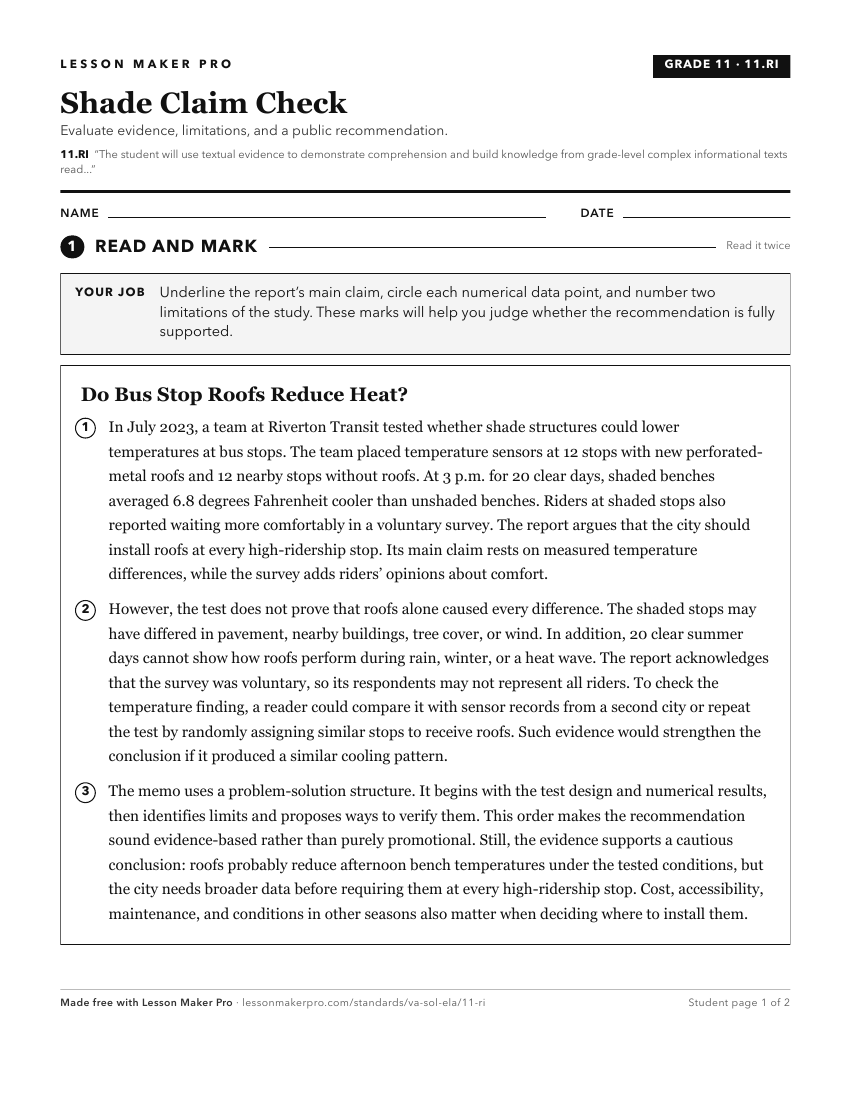
A ready-to-print activity worksheet aligned to 11.RI, with an answer key for the teacher on its own page. No account needed.
PDF, US Letter, prints cleanly in black and white.
Download the worksheetKeep exploring
Related Standards
Turn this cluster into a lesson
Grade, subject, topic, and the complete cluster are prefilled. Create one free, no account needed.
Also for this cluster:Make a WorksheetMake a QuizMake a Sub Lesson