Texas TEKS 8.23
TEKS Knowledge Statement (Expectation Cluster)
Culture. The student understands the relationships between and among people from various groups, including racial, ethnic, and religious groups, during the 17th, 18th, and 19th centuries. The student is expected to: identify racial, ethnic, and religious groups that settled in the United States and explain their reasons for immigration; explain how urbanization contributed to conflicts resulting from differences in religion, social class, and political beliefs; identify ways conflicts between people from various racial, ethnic, and religious groups were addressed; analyze the contributions of people of various racial, ethnic, and religious groups to our national identity; and identify the political, social, and economic contributions of women to American society.
Texas Essential Knowledge and Skills for Social Studies
Cluster contents
Student Expectations in This Statement
8.23 is a TEKS knowledge and skills statement. These are the student expectations under it.
- 8.23.A
identify racial, ethnic, and religious groups that settled in the United States and explain their reasons for immigration
- 8.23.B
explain how urbanization contributed to conflicts resulting from differences in religion, social class, and political beliefs
- 8.23.C
identify ways conflicts between people from various racial, ethnic, and religious groups were addressed
- 8.23.D
analyze the contributions of people of various racial, ethnic, and religious groups to our national identity
- 8.23.E
identify the political, social, and economic contributions of women to American society.
Teacher's field guide
What This Cluster Means
What Students Need to Do
- Students identify groups that came to America and explain why they came, including persecution, jobs, land, and forced migration. They connect urban growth to conflict over religion, class, work, and politics. They explain responses to conflict and evaluate how different groups and women shaped American life.
What Mastery Looks Like
- Students can name a group, place it in the correct period, and explain its migration using evidence. They can build a clear chain from urban growth to tension, conflict, and response. They can support claims about national identity and women’s political, social, and economic contributions with specific examples.
Common Misconceptions
- Students may treat every arrival as voluntary or assume all groups came for the same reason. They may explain urban conflict only through ethnicity while ignoring religion, class, jobs, and political power. They may overlook women’s public influence before voting rights or assume cultural contributions ended discrimination.
How to Assess It
- Give a four-box exit ticket: group and migration reason, urban conflict and cause, response to that conflict, and one contribution by a group or woman. Require one named example in each box.
Lesson moves
Ways to Teach It
Pairs sort group, migration reason, city conflict, response, and contribution cards, then correct mismatches using a textbook timeline.
Write a paragraph arguing whether cultural contributions or responses to conflict shaped national identity more, citing two groups and one woman.
Play a four-corner clue game where students move to the matching group, migration reason, urban conflict, or contribution posted around the room.
Students use a local historic map or census table to trace one immigrant neighborhood and connect its institutions to present-day city culture.
Free download
Printable 8.23 Worksheet
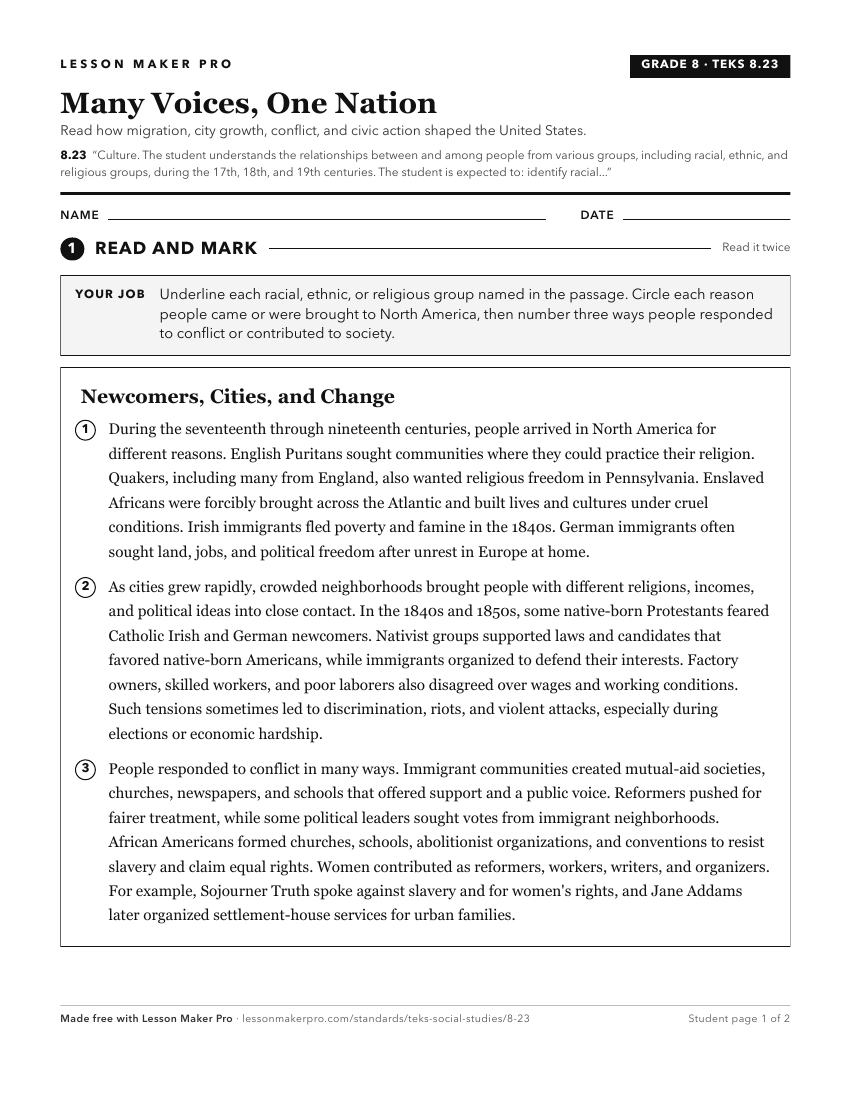
A ready-to-print activity worksheet aligned to 8.23, with an answer key for the teacher on its own page. No account needed.
PDF, US Letter, prints cleanly in black and white.
Download the worksheetKeep exploring
Related Standards
- 4.17
Culture. The student understands the contributions of people of various racial, ethnic, and religious groups to Texas culture. The student is expected to:
- 8.24
Culture. The student understands the major reform movements of the 19th century. The student is expected to:
- 5.21
Culture. The student understands the contributions of people of various racial, ethnic, and religious groups to the United States culture. The student is expect...
- 5.20
Culture. The student understands the relationship between the arts and the times during which they were created. The student is expected to:
Turn this cluster into a lesson
Grade, subject, topic, and the complete cluster are prefilled. Create one free, no account needed.
Also for this cluster:Make a WorksheetMake a QuizMake a Sub Lesson