Texas TEKS 8.23.C
The Standard
- 8.23
- Culture. The student understands the relationships between and among people from various groups, including racial, ethnic, and religious groups, during the 17th, 18th, and 19th centuries. The student is expected to:
identify ways conflicts between people from various racial, ethnic, and religious groups were addressed
Texas Essential Knowledge and Skills for Social Studies
Teacher's field guide
What This Standard Means
What Students Need to Do
- Students connect specific group conflicts in early U.S. history with the responses used, such as laws, treaties, court decisions, protests, compromises, removal, or war. They explain who acted and whether the response reduced, continued, or worsened the conflict.
What Mastery Looks Like
- Students accurately match a conflict with a historical response and cite a supporting fact. They distinguish between addressing a conflict and resolving it fairly or permanently.
Common Misconceptions
- Students may assume every response was peaceful, fair, or successful. They may confuse the cause of a conflict with the action taken afterward, or treat racial, ethnic, and religious groups as interchangeable.
How to Assess It
- Give students one event, such as the Indian Removal Act or Missouri Compromise. Ask them to name the conflict, describe the response, and judge its result using one fact.
Lesson moves
Ways to Teach It
Give pairs event and response cards to match, then sort responses into laws, treaties, court decisions, protests, removal, compromise, or war.
Ask students to write: When does a government response address a conflict without solving it? Support your answer with one historical example.
Play Response Relay, where teams read conflict cards and race to select the correct response, evidence, and outcome cards.
Have students compare one historical response with a current school conflict policy, focusing on who decides, who benefits, and whether tension remains.
Free download
Printable 8.23.C Worksheet
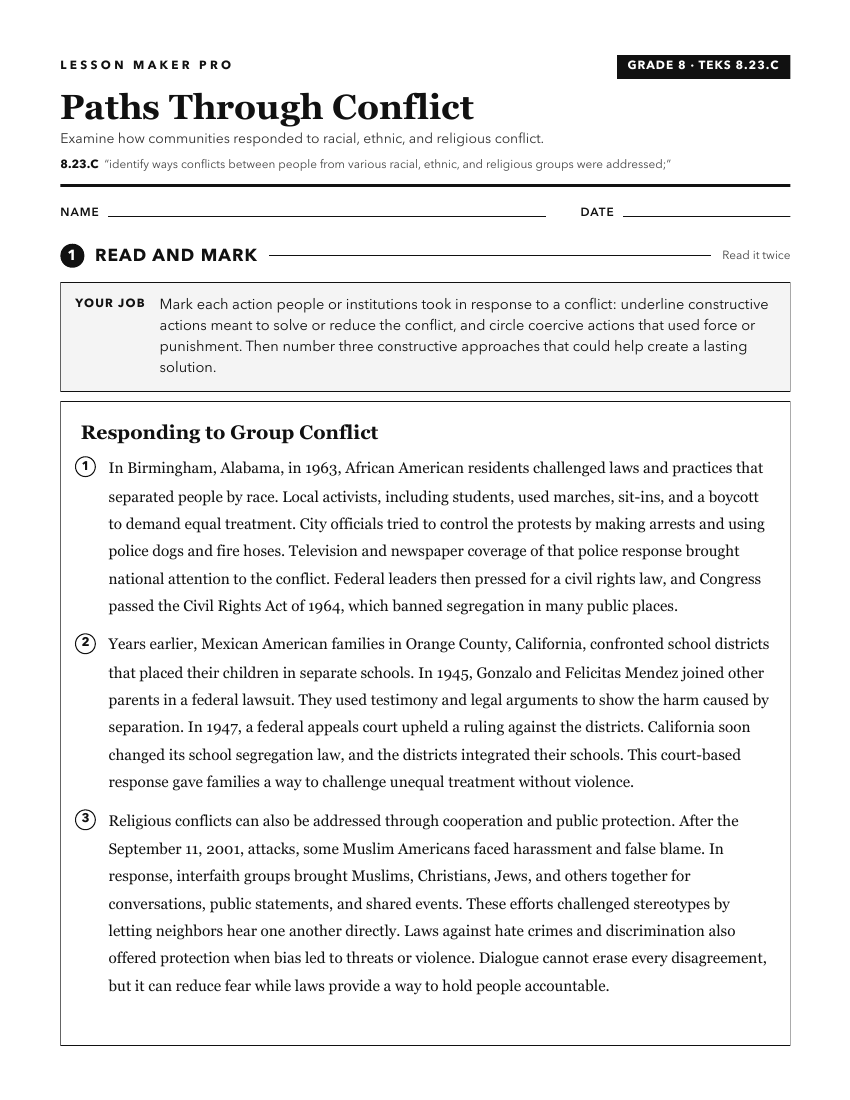
A ready-to-print activity worksheet aligned to 8.23.C, with an answer key for the teacher on its own page. No account needed.
PDF, US Letter, prints cleanly in black and white.
Download the worksheetKeep exploring
Related Standards
- 5.21.A
describe customs and traditions of various racial, ethnic, and religious groups in the United States
- 8.23.B
explain how urbanization contributed to conflicts resulting from differences in religion, social class, and political beliefs
- 6.13.D
identify and explain examples of conflict and cooperation between and among cultures
- 8.23.D
analyze the contributions of people of various racial, ethnic, and religious groups to our national identity
Turn this exact standard into a lesson
Grade, subject, topic, and the complete standard are prefilled. Create one free, no account needed.
Also for this standard:Make a WorksheetMake a QuizMake a Sub Lesson