Texas TEKS 8.15
TEKS Knowledge Statement (Expectation Cluster)
Government. The student understands the American beliefs and principles reflected in the Declaration of Independence, the U.S. Constitution, and other important historic documents. The student is expected to: identify the influence of ideas from historic documents, including the Magna Carta, the English Bill of Rights, the Mayflower Compact, and the Federalist Papers, on the U.S. system of government; summarize the strengths and weaknesses of the Articles of Confederation; identify colonial grievances listed in the Declaration of Independence and explain how those grievances were addressed in the U.S. Constitution and the Bill of Rights; analyze how the U.S. Constitution reflects the principles of limited government, republicanism, checks and balances, federalism, separation of powers, popular sovereignty, and individual rights; and explain the role of significant individuals such as Thomas Hooker, Charles de Montesquieu, and John Locke in the development of self-government in colonial America.
Texas Essential Knowledge and Skills for Social Studies
Cluster contents
Student Expectations in This Statement
8.15 is a TEKS knowledge and skills statement. These are the student expectations under it.
- 8.15.A
identify the influence of ideas from historic documents, including the Magna Carta, the English Bill of Rights, the Mayflower Compact, and the Federalist Papers...
- 8.15.B
summarize the strengths and weaknesses of the Articles of Confederation
- 8.15.C
identify colonial grievances listed in the Declaration of Independence and explain how those grievances were addressed in the U.S. Constitution and the Bill of ...
- 8.15.D
analyze how the U.S. Constitution reflects the principles of limited government, republicanism, checks and balances, federalism, separation of powers, popular s...
- 8.15.E
explain the role of significant individuals such as Thomas Hooker, Charles de Montesquieu, and John Locke in the development of self-government in colonial Amer...
Teacher's field guide
What This Cluster Means
What Students Need to Do
- Students trace how earlier documents and political thinkers shaped American government. They compare the Articles of Confederation with the Constitution, connect colonial grievances to later protections, and explain constitutional principles.
What Mastery Looks Like
- Students can use evidence from a document to identify an idea, grievance, or principle. They can explain how constitutional structures and rights responded to earlier problems and limited government power.
Common Misconceptions
- Students often confuse separation of powers with checks and balances, or federalism with state independence. They may treat the Articles as entirely ineffective or assume every colonial grievance became a specific amendment.
How to Assess It
- Give students one colonial grievance and one constitutional principle. Ask them to name the later protection or structure that addressed the grievance and explain the principle in two sentences.
Lesson moves
Ways to Teach It
Give groups document excerpt cards and principle cards, then have them build and defend a cause-and-influence map with string.
Ask students to write which weakness of the Articles created the greatest danger, using two specific facts to support their choice.
Run a matching relay with cards for thinkers, historic documents, grievances, constitutional responses, and governing principles.
Use a city council agenda to identify examples of popular sovereignty, limited government, individual rights, or divided power in local decisions.
Free download
Printable 8.15 Worksheet
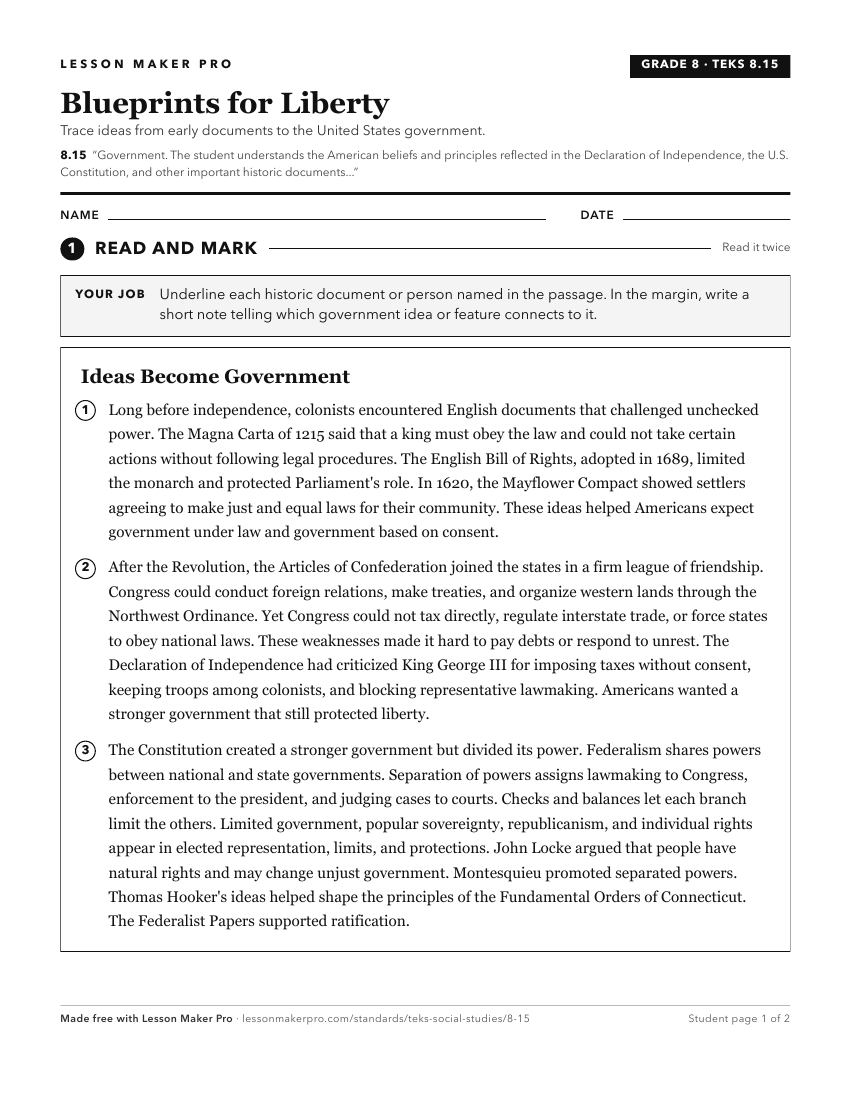
A ready-to-print activity worksheet aligned to 8.15, with an answer key for the teacher on its own page. No account needed.
PDF, US Letter, prints cleanly in black and white.
Download the worksheetKeep exploring
Related Standards
- 4.13
Government. The student understands important ideas in historical documents of Texas and the United States. The student is expected to:
- 5.15
Government. The student understands the framework of government created by the U.S. Constitution of 1787. The student is expected to:
- 5.14
Government. The student understands important ideas in the Declaration of Independence, the U.S. Constitution, and the Bill of Rights. The student is expected t...
- 3.8
Government. The student understands important ideas in historical documents at various levels of government. The student is expected to:
Turn this cluster into a lesson
Grade, subject, topic, and the complete cluster are prefilled. Create one free, no account needed.
Also for this cluster:Make a WorksheetMake a QuizMake a Sub Lesson