Texas TEKS 8.15.B
The Standard
- 8.15
- Government. The student understands the American beliefs and principles reflected in the Declaration of Independence, the U.S. Constitution, and other important historic documents. The student is expected to:
summarize the strengths and weaknesses of the Articles of Confederation
Texas Essential Knowledge and Skills for Social Studies
Teacher's field guide
What This Standard Means
What Students Need to Do
- Students identify powers the national government had and limits that made governing difficult. They summarize both strengths and weaknesses using examples such as western land policies, taxation, trade, and enforcement.
What Mastery Looks Like
- A student can describe at least two strengths and two weaknesses with accurate evidence. They can connect each feature to a result, such as organized settlement, unpaid debt, or disputes between states.
Common Misconceptions
- Students may say there was no national government, rather than a weak one. They may think Congress could collect taxes or enforce laws. Some confuse powers later granted by the Constitution with earlier powers.
How to Assess It
- Use a two-column exit ticket labeled Strengths and Weaknesses. Students list two examples in each column and explain one result caused by a weakness.
Lesson moves
Ways to Teach It
Give pairs government power cards to sort under Strength or Weakness, then require a written reason for each placement.
Ask students to write: Which weakness created the greatest danger for the new nation, and what evidence supports your answer?
Play Articles Challenge by reading government scenarios and awarding points when teams correctly identify a strength, weakness, or missing power.
Give students a mock school council that can request dues but not collect them, then discuss whether it could pay its bills.
Free download
Printable 8.15.B Worksheet
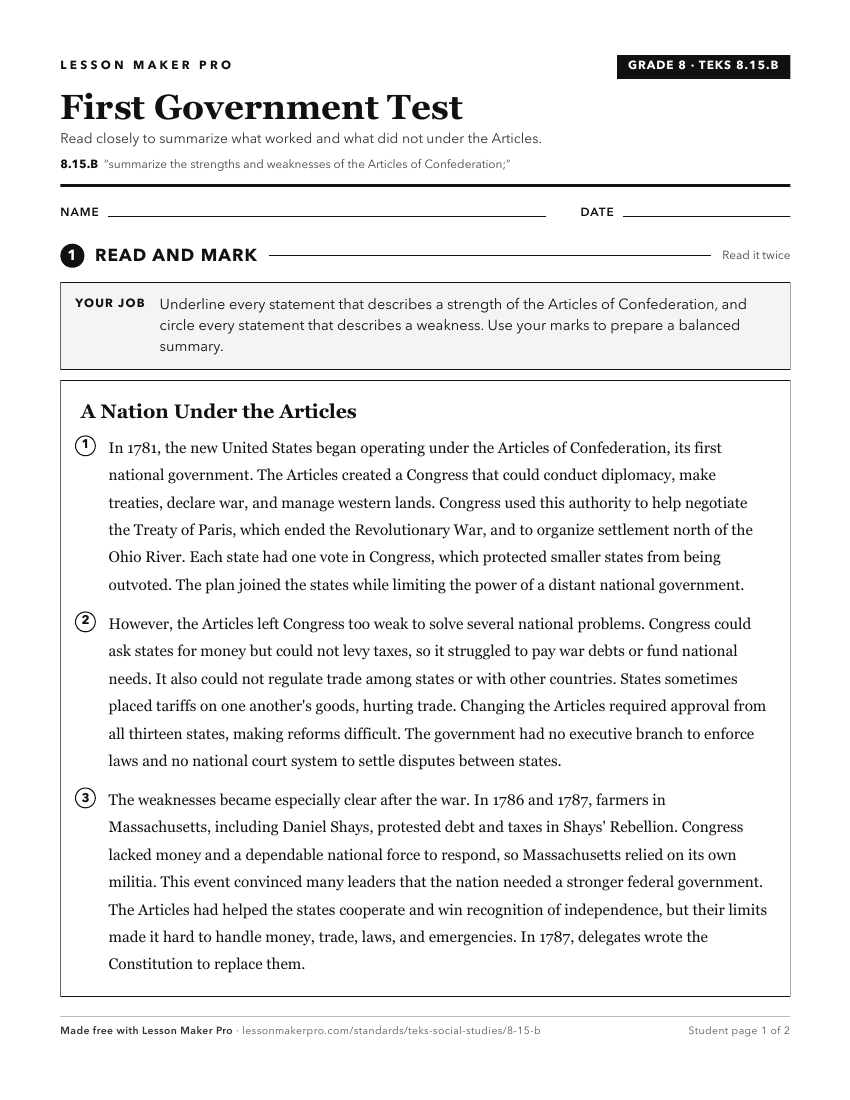
A ready-to-print activity worksheet aligned to 8.15.B, with an answer key for the teacher on its own page. No account needed.
PDF, US Letter, prints cleanly in black and white.
Download the worksheetKeep exploring
Related Standards
- 8.4.D
analyze the issues of the Constitutional Convention of 1787, including the Great Compromise and the Three-Fifths Compromise.
- 5.15.B
identify the reasons for and describe the system of checks and balances outlined in the U.S. Constitution
- 8.16.A
summarize the purposes for amending the U.S. Constitution
- 8.15.D
analyze how the U.S. Constitution reflects the principles of limited government, republicanism, checks and balances, federalism, separation of powers, popular s...
Turn this exact standard into a lesson
Grade, subject, topic, and the complete standard are prefilled. Create one free, no account needed.
Also for this standard:Make a WorksheetMake a QuizMake a Sub Lesson