Texas TEKS 8.4.D
The Standard
- 8.4
- History. The student understands significant political and economic issues of the revolutionary and Constitutional eras. The student is expected to:
analyze the issues of the Constitutional Convention of 1787, including the Great Compromise and the Three-Fifths Compromise.
Texas Essential Knowledge and Skills for Social Studies
Teacher's field guide
What This Standard Means
What Students Need to Do
- Students explain why large and small states disagreed over representation in Congress. They compare the Great Compromise and Three-Fifths Compromise, including who benefited and how each shaped political power.
What Mastery Looks Like
- Students can identify each dispute, describe the competing positions, and explain the resulting agreement. They also explain that counting enslaved people increased slaveholding states' representation without giving enslaved people rights or votes.
Common Misconceptions
- Students may think the Three-Fifths Compromise gave enslaved people three-fifths of a vote or personhood. They may also confuse equal Senate representation with population-based House representation. Some assume every delegate supported the final agreements.
How to Assess It
- Give students this exit prompt: “Explain one dispute over representation, the agreement delegates reached, and one group that gained political power from it.”
Lesson moves
Ways to Teach It
Give groups state population cards and have them build Congress under equal, population-based, and compromise representation plans.
Ask students to write which states benefited from each compromise and support both claims with evidence.
Play a delegate matching game using cards for state size, regional interest, preferred plan, and final compromise.
Compare current census-based House apportionment with the 1787 counting rule, then list who could vote and who gained representation in each system.
Free download
Printable 8.4.D Worksheet
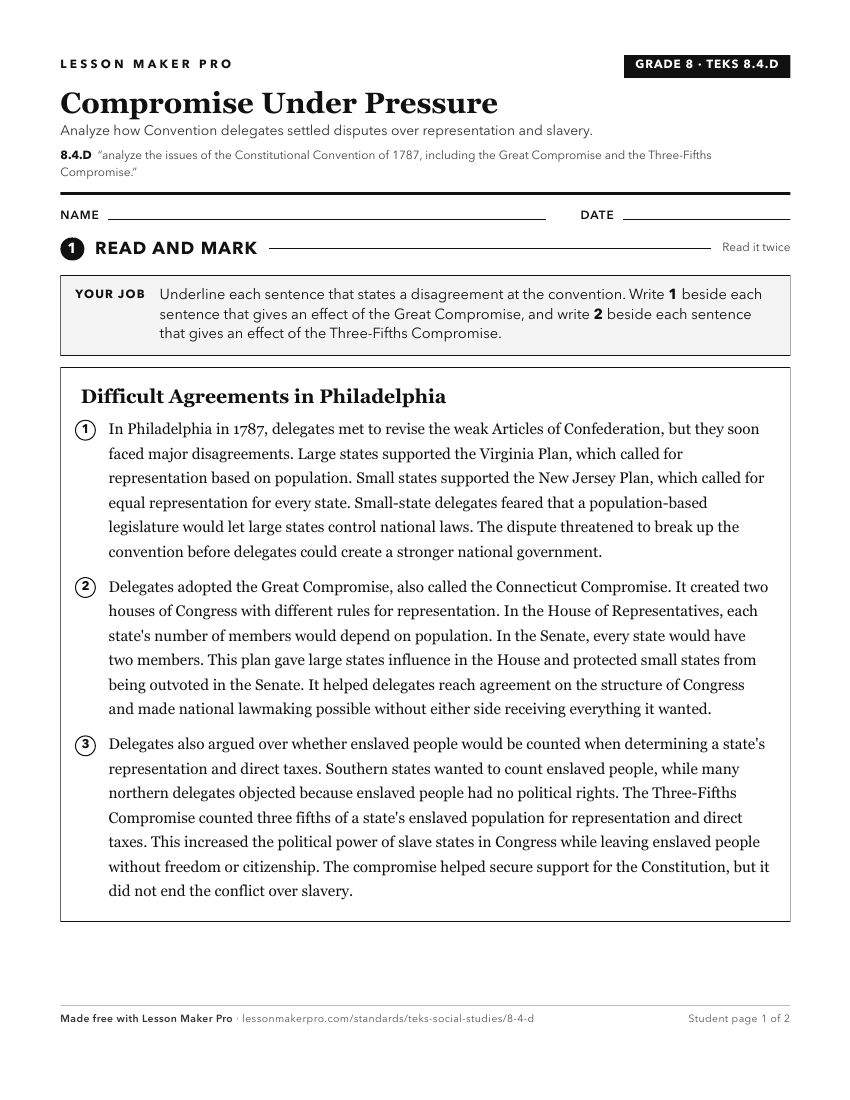
A ready-to-print activity worksheet aligned to 8.4.D, with an answer key for the teacher on its own page. No account needed.
PDF, US Letter, prints cleanly in black and white.
Download the worksheetKeep exploring
Related Standards
- 8.21.C
summarize historical events in which compromise resulted in a resolution such as the Missouri Compromise, Compromise of 1850, and Kansas-Nebraska Act.
- 8.17.A
analyze the arguments of the Federalists and Anti-Federalists, including those of Alexander Hamilton, Patrick Henry, James Madison, and George Mason, and explai...
- 8.3.B
analyze the importance of the Mayflower Compact, the Fundamental Orders of Connecticut, and the Virginia House of Burgesses to the growth of representative gove...
- 8.15.D
analyze how the U.S. Constitution reflects the principles of limited government, republicanism, checks and balances, federalism, separation of powers, popular s...
Turn this exact standard into a lesson
Grade, subject, topic, and the complete standard are prefilled. Create one free, no account needed.
Also for this standard:Make a WorksheetMake a QuizMake a Sub Lesson