Texas TEKS 8.17.A
The Standard
- 8.17
- Government. The student understands the dynamic nature of the powers of the national government and state governments in a federal system. The student is expected to:
analyze the arguments of the Federalists and Anti-Federalists, including those of Alexander Hamilton, Patrick Henry, James Madison, and George Mason, and explain how their debates exemplify civil discourse
Texas Essential Knowledge and Skills for Social Studies
Teacher's field guide
What This Standard Means
What Students Need to Do
- Students compare arguments for and against ratifying the Constitution and connect key claims to Hamilton, Henry, Madison, and Mason. They explain how speakers used evidence, rebuttals, and respectful disagreement during public debate.
What Mastery Looks Like
- Students accurately sort each leader’s position and support it with evidence from a speech or essay. They compare opposing claims about federal power, individual rights, and a bill of rights, then identify features of civil discourse.
Common Misconceptions
- Students may assume Federalists supported unlimited national power or that Anti-Federalists opposed any union. They may also confuse James Madison with George Mason or treat civil discourse as simple agreement rather than reasoned disagreement.
How to Assess It
- Give students one short excerpt from Hamilton or Madison and one from Henry or Mason. Ask them to identify each position, cite one phrase, and explain how the texts model civil discourse.
Lesson moves
Ways to Teach It
Give groups quote cards from all four leaders to sort by speaker, position, concern, and supporting evidence.
Hold a structured discussion: Which posed the greater risk, a weak national government or a powerful one? Require evidence and one respectful rebuttal.
Play Who Said It? Read a claim aloud, then teams name the leader and justify their answer with a position card.
Have students draft a school constitution, then debate whether it needs a student bill of rights using Federalist and Anti-Federalist reasoning.
Free download
Printable 8.17.A Worksheet
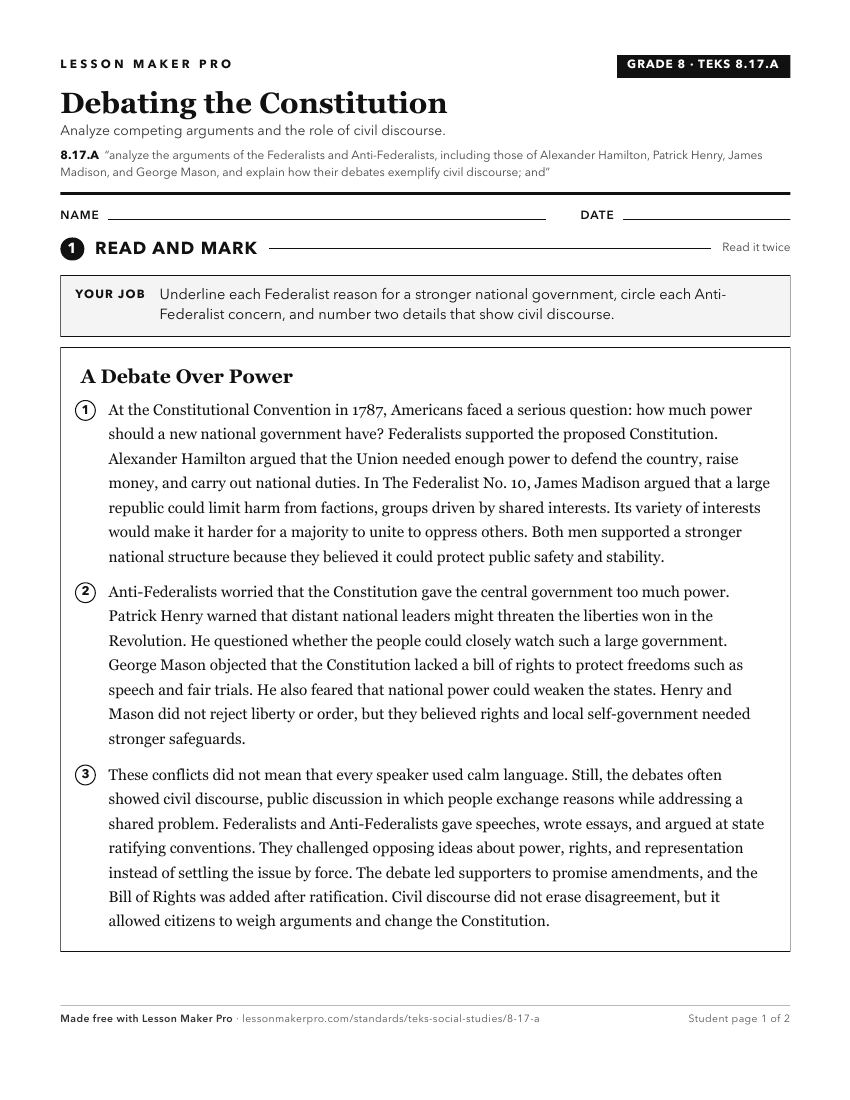
A ready-to-print activity worksheet aligned to 8.17.A, with an answer key for the teacher on its own page. No account needed.
PDF, US Letter, prints cleanly in black and white.
Download the worksheetKeep exploring
Related Standards
- 8.15.A
identify the influence of ideas from historic documents, including the Magna Carta, the English Bill of Rights, the Mayflower Compact, and the Federalist Papers...
- 8.4.D
analyze the issues of the Constitutional Convention of 1787, including the Great Compromise and the Three-Fifths Compromise.
- 8.20.A
evaluate the contributions of the Founding Fathers as models of civic virtue
- 8.15.D
analyze how the U.S. Constitution reflects the principles of limited government, republicanism, checks and balances, federalism, separation of powers, popular s...
Turn this exact standard into a lesson
Grade, subject, topic, and the complete standard are prefilled. Create one free, no account needed.
Also for this standard:Make a WorksheetMake a QuizMake a Sub Lesson