Texas TEKS 8.20.A
The Standard
- 8.20
- Citizenship. The student understands the importance of voluntary individual participation in the democratic process. The student is expected to:
evaluate the contributions of the Founding Fathers as models of civic virtue
Texas Essential Knowledge and Skills for Social Studies
Teacher's field guide
What This Standard Means
What Students Need to Do
- Students examine the choices, public service, and sacrifices of key founders. They use historical evidence to judge how well each person modeled civic virtues such as responsibility, courage, compromise, and service.
What Mastery Looks Like
- Students make a clear judgment about a founder’s civic virtue and support it with specific actions. They also recognize contradictions between the person’s public ideals and private conduct.
Common Misconceptions
- Students may list accomplishments without judging whether the actions show civic virtue. They may treat every founder as equally admirable or ignore contradictions involving slavery, voting rights, and political power.
How to Assess It
- Ask: “Was George Washington a strong model of civic virtue? State your judgment and support it with two specific actions.”
Lesson moves
Ways to Teach It
Sort founder evidence cards into civic virtue, contradiction, or unclear, then defend one placement with a partner.
Write: “Which founder best modeled service to the public, and what evidence makes your choice stronger than another?”
Play Founder Match by pairing action cards with founders and naming the civic virtue each action shows.
Compare a founder’s public service with a local official’s duties, then list one shared civic virtue and one difference.
Free download
Printable 8.20.A Worksheet
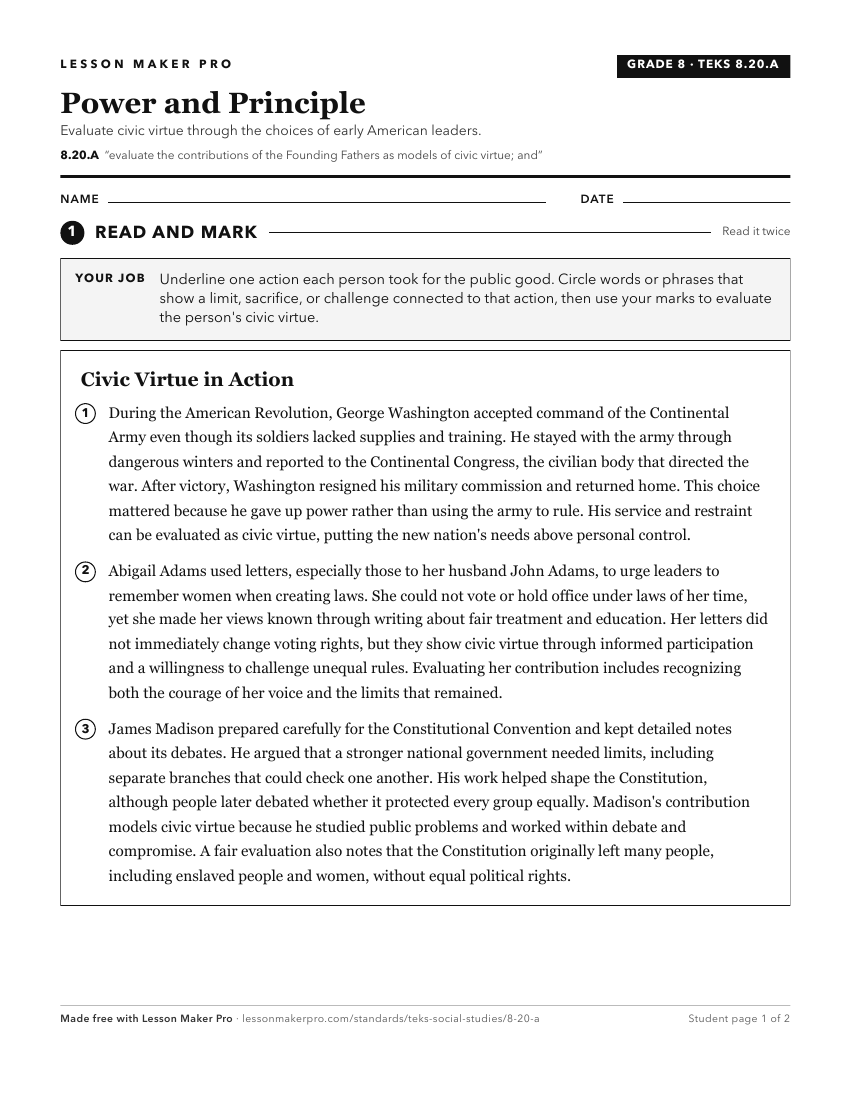
A ready-to-print activity worksheet aligned to 8.20.A, with an answer key for the teacher on its own page. No account needed.
PDF, US Letter, prints cleanly in black and white.
Download the worksheetKeep exploring
Related Standards
- 8.17.A
analyze the arguments of the Federalists and Anti-Federalists, including those of Alexander Hamilton, Patrick Henry, James Madison, and George Mason, and explai...
- 5.2.B
identify the Founding Fathers and Patriot heroes, including John Adams, Benjamin Franklin, Thomas Jefferson, the Sons of Liberty, and George Washington, and the...
- 8.3.B
analyze the importance of the Mayflower Compact, the Fundamental Orders of Connecticut, and the Virginia House of Burgesses to the growth of representative gove...
- 1.12.B
identify historical figures and other individuals who have exemplified good citizenship such as Benjamin Franklin and Eleanor Roosevelt.
Turn this exact standard into a lesson
Grade, subject, topic, and the complete standard are prefilled. Create one free, no account needed.
Also for this standard:Make a WorksheetMake a QuizMake a Sub Lesson