Texas TEKS 8.15.D
The Standard
- 8.15
- Government. The student understands the American beliefs and principles reflected in the Declaration of Independence, the U.S. Constitution, and other important historic documents. The student is expected to:
analyze how the U.S. Constitution reflects the principles of limited government, republicanism, checks and balances, federalism, separation of powers, popular sovereignty, and individual rights
Texas Essential Knowledge and Skills for Social Studies
Teacher's field guide
What This Standard Means
What Students Need to Do
- Students connect specific clauses, amendments, and government structures to constitutional principles. They explain how each example limits power, divides authority, gives citizens a voice, or protects rights.
What Mastery Looks Like
- Students accurately match constitutional evidence to a principle and explain the connection. They can distinguish related ideas, such as separation of powers and checks and balances, using clear examples.
Common Misconceptions
- Students often confuse popular sovereignty with republicanism, or federalism with separation of powers. They may think limited government means weak government, or that individual rights have no legal limits.
How to Assess It
- Exit ticket: Read Article I, Section 7. Identify two principles shown in the passage, cite one phrase for each, and explain your choices.
Lesson moves
Ways to Teach It
Give groups clause cards and principle labels, then have them sort each clause and defend one placement with evidence.
Ask which principle best prevents abuse of power, then require one constitutional example in a four-sentence response.
Run a matching relay where teams pair government scenarios with principles and correct mismatches after reading an answer card.
Have students connect a current state and federal dispute to federalism, citing the power claimed by each level of government.
Free download
Printable 8.15.D Worksheet
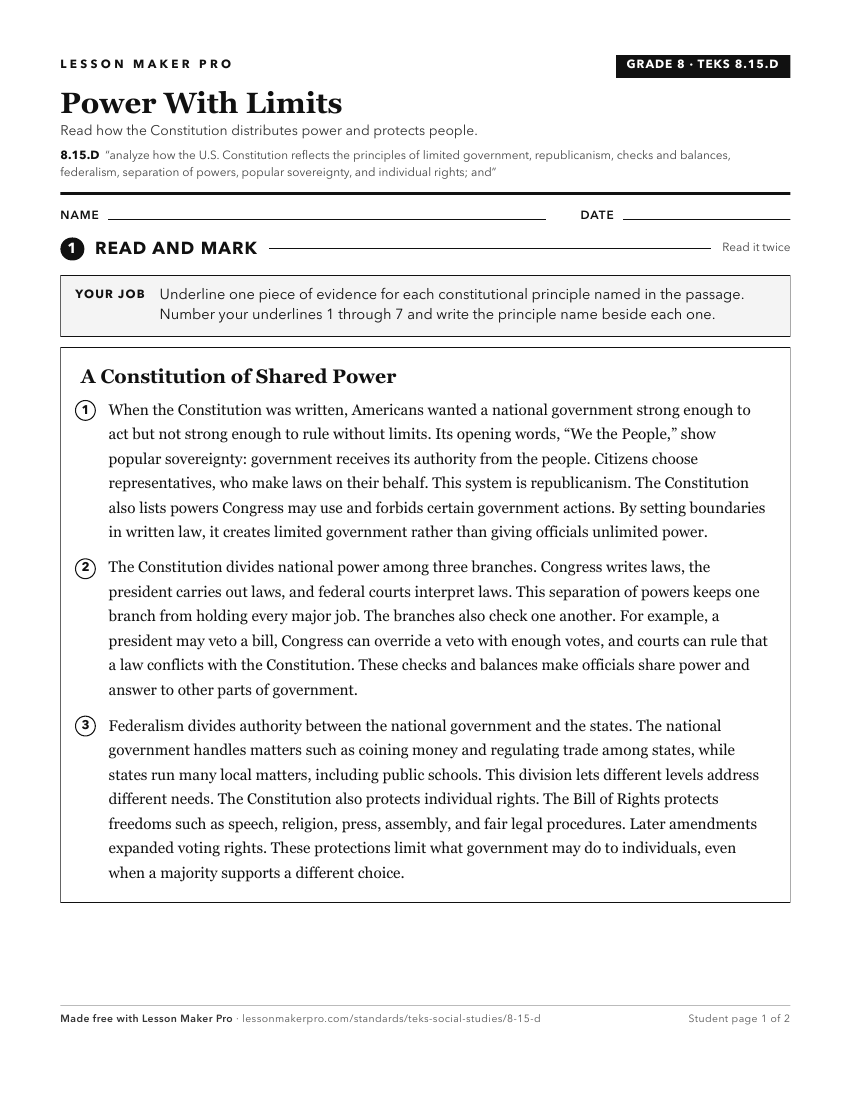
A ready-to-print activity worksheet aligned to 8.15.D, with an answer key for the teacher on its own page. No account needed.
PDF, US Letter, prints cleanly in black and white.
Download the worksheetKeep exploring
Related Standards
- 7.13.A
identify how the Texas Constitution reflects the principles of limited government, republicanism, checks and balances, federalism, separation of powers, popular...
- 8.15.A
identify the influence of ideas from historic documents, including the Magna Carta, the English Bill of Rights, the Mayflower Compact, and the Federalist Papers...
- 7.13.B
compare the principles and concepts of the Texas Constitution to the U.S. Constitution, including the Texas and U.S. Bill of Rights.
- 5.15.B
identify the reasons for and describe the system of checks and balances outlined in the U.S. Constitution
Turn this exact standard into a lesson
Grade, subject, topic, and the complete standard are prefilled. Create one free, no account needed.
Also for this standard:Make a WorksheetMake a QuizMake a Sub Lesson