Texas TEKS 5.15.B
The Standard
- 5.15
- Government. The student understands the framework of government created by the U.S. Constitution of 1787. The student is expected to:
identify the reasons for and describe the system of checks and balances outlined in the U.S. Constitution
Texas Essential Knowledge and Skills for Social Studies
Teacher's field guide
What This Standard Means
What Students Need to Do
- Students explain why government power is divided among three branches. They identify how each branch can limit actions taken by the other branches.
What Mastery Looks Like
- Given a government action, students name the branch responsible and a possible check on that action. They explain how the check prevents one branch from gaining too much power.
Common Misconceptions
- Students may think the president controls Congress and the courts. They may confuse a presidential veto with a congressional override or assume courts write laws.
How to Assess It
- Give this exit ticket: “The president vetoes a bill. What can Congress do next, and why does that power matter?”
Lesson moves
Ways to Teach It
Give groups branch cards and action cards, then have them build chains showing one branch checking another.
Ask students to write: “What might happen if one branch could make, enforce, and judge every law?”
Play a checks and balances matching game using cards labeled veto, override, appointment, confirmation, and judicial review.
Compare the three branches with school roles, then list where the comparison works and where it breaks down.
Free download
Printable 5.15.B Worksheet
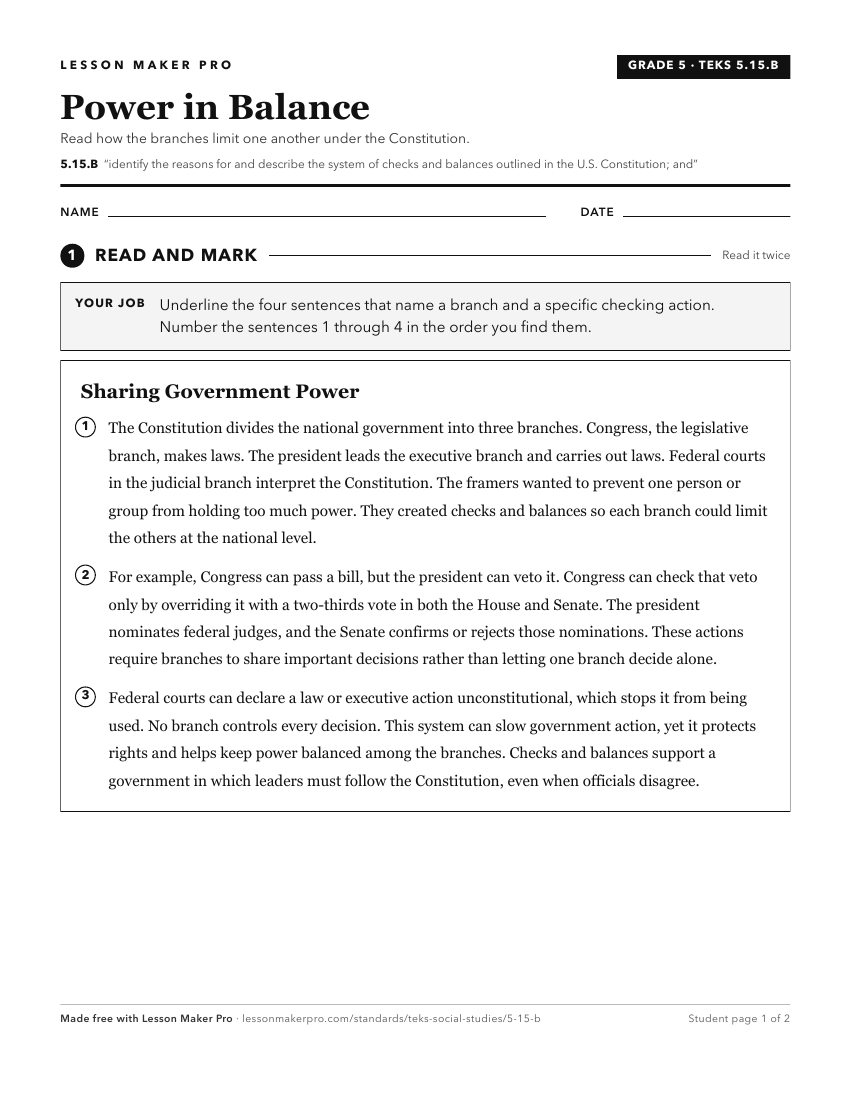
A ready-to-print activity worksheet aligned to 5.15.B, with an answer key for the teacher on its own page. No account needed.
PDF, US Letter, prints cleanly in black and white.
Download the worksheetKeep exploring
Related Standards
- 8.15.A
identify the influence of ideas from historic documents, including the Magna Carta, the English Bill of Rights, the Mayflower Compact, and the Federalist Papers...
- 3.8.A
identify the purposes of the Declaration of Independence and the U.S. Constitution, including the Bill of Rights
- 5.15.A
identify and explain the basic functions of the three branches of government
- 8.15.D
analyze how the U.S. Constitution reflects the principles of limited government, republicanism, checks and balances, federalism, separation of powers, popular s...
Turn this exact standard into a lesson
Grade, subject, topic, and the complete standard are prefilled. Create one free, no account needed.
Also for this standard:Make a WorksheetMake a QuizMake a Sub Lesson